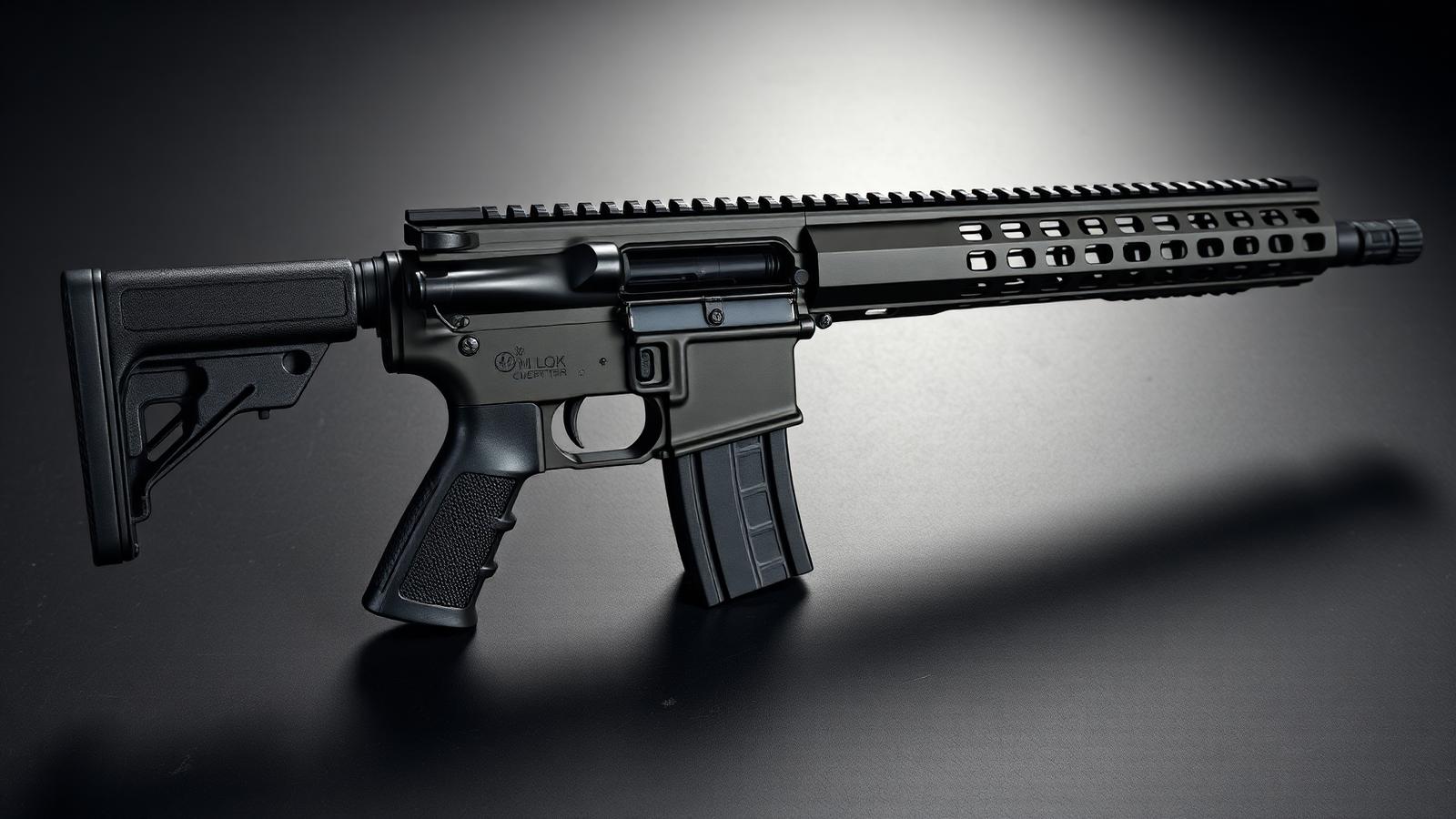
How to choose the right AR-15 handguard: free-float vs drop-in, length matching, materials, and attachment systems (M-LOK, KeyMod, Picatinny).
A handguard covers and protects the barrel and gas system, gives you a place to grip the rifle forward of the receiver, and, on nearly every modern build, provides the mounting real estate for lights, optics, grips, and bipods. Get the wrong length, attachment system, or float design for your build, and you'll either fight accessory placement for the life of the rifle or pay for capability you'll never use.
Free-Float vs. Drop-In Handguards
This is the first fork in the road, and it affects both accuracy and how the rifle handles under load.
Free-float handguards attach only to the upper receiver via a barrel nut, with no contact anywhere along the barrel itself. Because nothing touches the barrel, pressure from gripping the handguard, mounting a bipod, or slinging the rifle doesn't transfer to the barrel and shift point of impact. This is why free-float designs are the standard on precision and long-range builds, and increasingly the default even on general-purpose rifles, the accuracy benefit is real, and prices have come down enough that there's little reason not to go free-float on most new builds.
Drop-in handguards clamp onto the front sight base or barrel nut assembly and rely on the factory gas system components for support, with two-piece clamshell designs that install without removing the barrel. They're simpler and cheaper to install, often no barrel nut torquing required, which made them the standard for decades on mil-spec-pattern rifles. The tradeoff is that handguard pressure can transfer to the barrel, and they generally don't offer the same continuous accessory rail real estate as a free-float design.
Bottom line: unless you're restoring a retro-pattern build or working with a tight budget on a basic range gun, free-float is the better choice for nearly every use case today. Drop-in handguards still make sense for classic A2/A4-style builds or when matching an existing rifle's original configuration, and it's worth noting that converting from drop-in to free-float later usually means removing the barrel to install a new barrel nut, so it's not always a simple bolt-on upgrade if you change your mind down the road.
Free-float is the better choice for nearly every modern build. The accuracy benefit is real and prices have come down enough that skipping it rarely makes sense.
Handguard Length Guide
Handguard length needs to match your barrel length and gas system, not just your visual preference, an oversized handguard on a short barrel looks wrong and can interfere with muzzle devices, while an undersized one wastes usable rail space and can leave the gas block exposed.
A few practical notes on top of this table:
- Free-float handguards generally run longer than the equivalent drop-in option for the same barrel and gas system, since they extend forward over the gas block rather than stopping short of it.
- Longer isn't always better. A 15" handguard on a 16" mid-length carbine can look proportional and offer excellent rail space, but it adds weight forward of the receiver that shifts the rifle's balance point and can make fast target transitions feel sluggish.
- Confirm gas block clearance before ordering. Low-profile gas blocks fit under most free-float handguards, but a taller front-sight-style gas block may require a longer handguard or a handguard with a wider inner diameter to clear it.
- Barrel nut compatibility matters as much as length. Not every free-float handguard fits every barrel nut, some manufacturers use proprietary nuts, so check compatibility with your specific upper before buying, especially if you're mixing brands between barrel and handguard.
Materials and Attachment Systems
Aluminum is the standard handguard material, typically 6061-T6 or 7075-T6 aircraft aluminum, anodized for durability. 7075 is stronger and slightly more expensive; 6061 is lighter and more common on budget-to-mid-tier handguards. For most builds, the difference is marginal enough not to be a deciding factor on its own. Anodizing type (Type II vs. Type III hardcoat) affects wear resistance more than the base alloy does for most shooters, Type III hardcoat is more durable and worth prioritizing if the rifle will see hard use or frequent accessory swaps.
Polymer handguards exist at the budget end of the market and shave some weight and cost, but they flex more under pressure and generally aren't rated for the same accessory mounting loads as aluminum. They're a reasonable choice for a lightweight range gun with minimal accessories, less so for a rifle that will carry a light, sling mount, and vertical grip simultaneously.
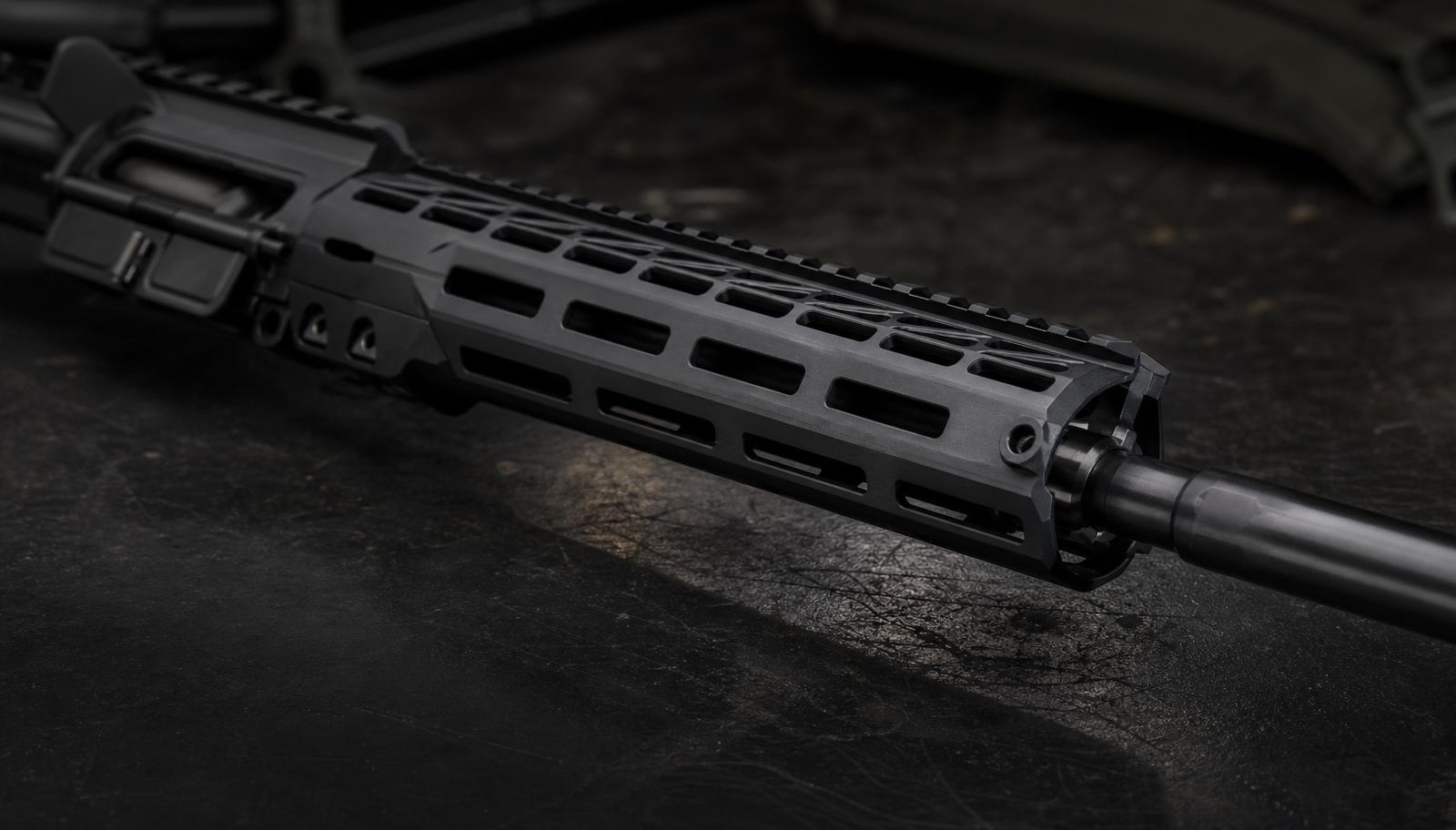
M-LOK is the current dominant attachment standard. Its slotted design lets accessories mount directly to the handguard body using T-nuts, without an intervening rail section, this saves weight and bulk compared to full-length Picatinny while still offering strong, direct-contact mounting points anywhere along the handguard.
KeyMod was M-LOK's primary competitor for several years and is still available on some handguards, but it's increasingly a legacy standard. If you already own KeyMod accessories, it's still a perfectly functional system, but for a new build, M-LOK has broader accessory support and is the safer long-term bet.
Picatinny (quad-rail) provides continuous mounting compatibility with the widest possible range of accessories and is still the right call if you need to run mounted accessories that specifically require Picatinny compatibility (certain bipods, some optics mounts, or aftermarket accessories that haven't caught up to M-LOK). The tradeoff is weight and the notorious "rail bite" on bare sections of exposed Picatinny, most modern quad-rails now include rubber rail covers to offset this, and many hybrid designs run a short top rail section for optics with M-LOK slots on the sides and bottom.
How to Choose Based on Your Build
Lightweight and competition builds should prioritize a slim-profile free-float M-LOK handguard, sized to match barrel length without excess length carried "just in case." Weight savings compound here, a few extra ounces forward of the receiver affects transition speed on a shot timer more than most shooters expect. Skip Picatinny entirely unless a specific accessory requires it, and consider a handguard with a reduced or skeletonized cross-section if your build is optimized purely for speed.
Accessory-heavy and home-defense builds benefit from a slightly longer free-float handguard with M-LOK slots at the 3, 6, and 9 o'clock positions at minimum, giving you flexibility to mount a light, foregrip, and sling point without fighting for real estate. A short top rail section (even on an otherwise M-LOK handguard) is worth having if you plan to co-witness iron sights with an optic, or if you want the option to add a top-mounted light or laser later without needing a separate rail adapter.
Hunting and general-purpose builds sit comfortably in the middle, a mid-length free-float M-LOK handguard sized to the barrel, with enough real estate for a sling mount and maybe a light, without the bulk of a full accessory-ready defensive build. This is also where the aluminum-vs-polymer weight tradeoff is worth reconsidering if you're carrying the rifle over long distances in the field.
Whatever category your build fits, matching handguard length to barrel and gas system length first, then narrowing by attachment system and materials, will get you to the right handguard faster than sorting by price or brand alone.
Ready to find the right fit for your build? Browse the full AR-15 upper and parts catalog at ar15parts.com, filterable by length, attachment system, and barrel compatibility.