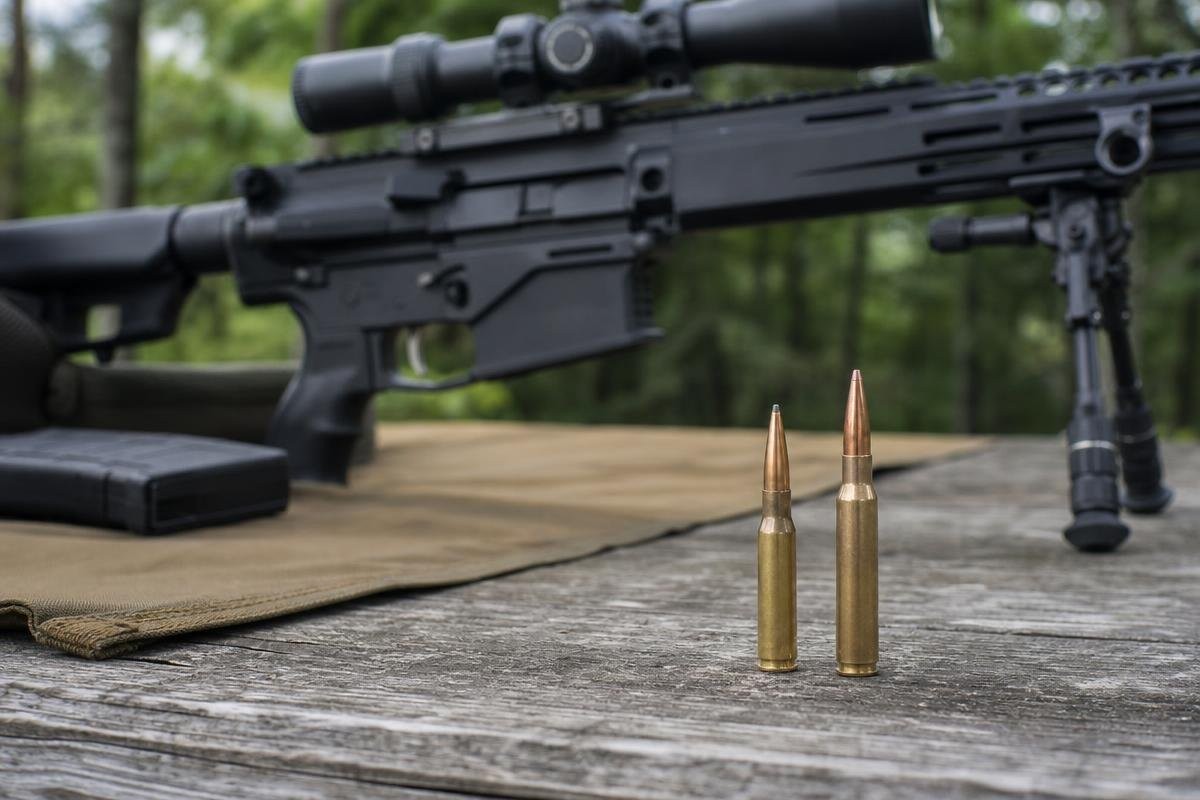
If you're trying to decide between 6.5 Creedmoor vs .308 for long-range shooting, you're asking the right question before you buy. These two cartridges dominate the precision rifle world for good reason, but they're not interchangeable, and the wrong choice for your setup will cost you at the range and in the field. Out here near Lake Texoma and the open agricultural stretches of Grayson County, wind and distance make that difference real fast.
Here's a quick note on origins before we get into the numbers: the .308 Winchester has anchored military, law enforcement, and hunting use since it was standardized in 1952, while the 6.5 Creedmoor was purpose-engineered by Hornady in 2007 to push high-BC bullets at long range.
We build complete AR-10 pattern uppers in both calibers at our Sherman, TX shop, each one headspaced and function-checked before it ships directly to your door. No FFL required (upper receivers ship as non-regulated components). Not sure which caliber fits your rifle and your terrain? We'll help you match the chambering to how and where you shoot.
Ballistics Head-to-Head: Velocity, Energy, and Bullet Drop
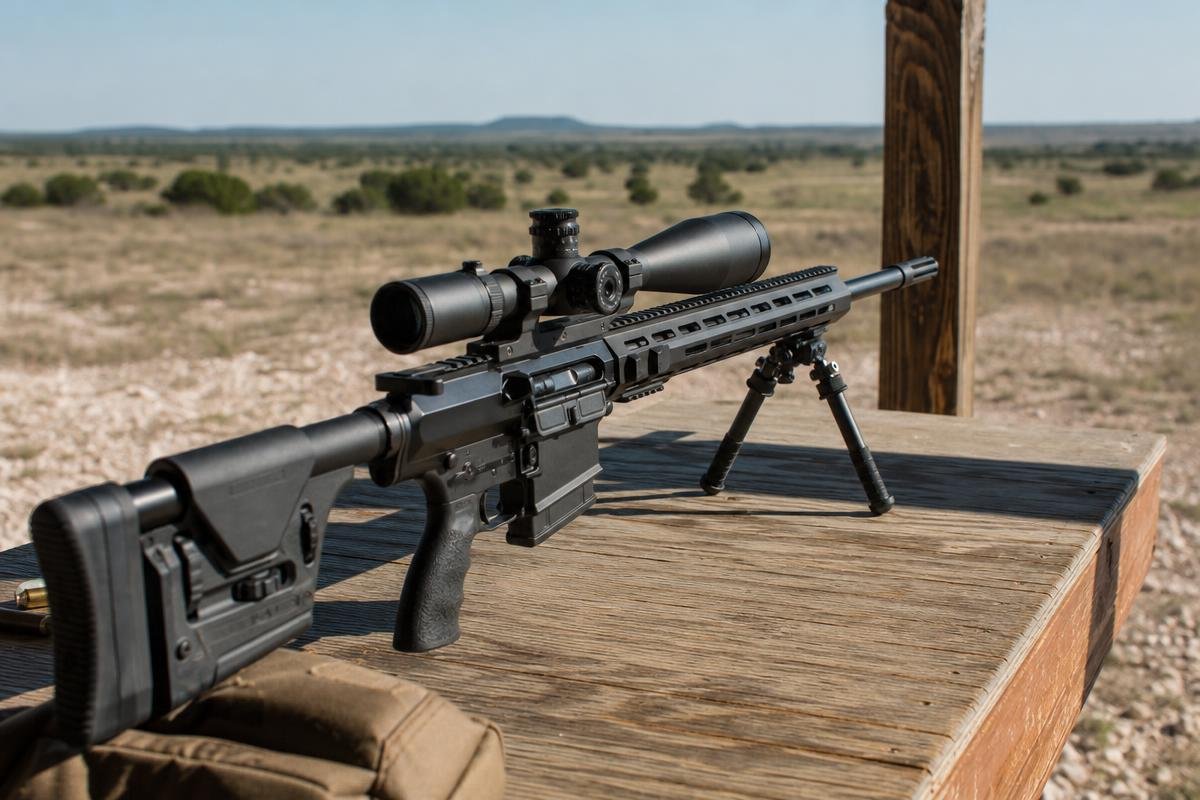
Numbers settle arguments, so let's put both cartridges on paper and let the data speak. Both run on the same AR-10 pattern platform, so the choice really comes down to what you're doing with the rifle. Once you know which direction you're going, we stock 6.5 Creedmoor complete uppers and .308 Win complete uppers, built to order.
Muzzle Velocity and Downrange Speed
A 168-grain .308 Federal Gold Medal Match leaves the muzzle at roughly 2,650 fps. A 140-grain Hornady ELD Match starts at approximately 2,710 fps. Close enough at the muzzle that it barely matters. The gap opens fast downrange.
At 500 yards, the 6.5 retains around 2,050 fps while the .308 is down to roughly 1,900 fps. At 1,000 yards, that spread widens further. The 6.5 stays supersonic longer, which keeps it stable and predictable at distance. The .308 gets there, but it's working harder to do it.
Does the 6.5 Creedmoor Really Buck Wind Better Than the .308?
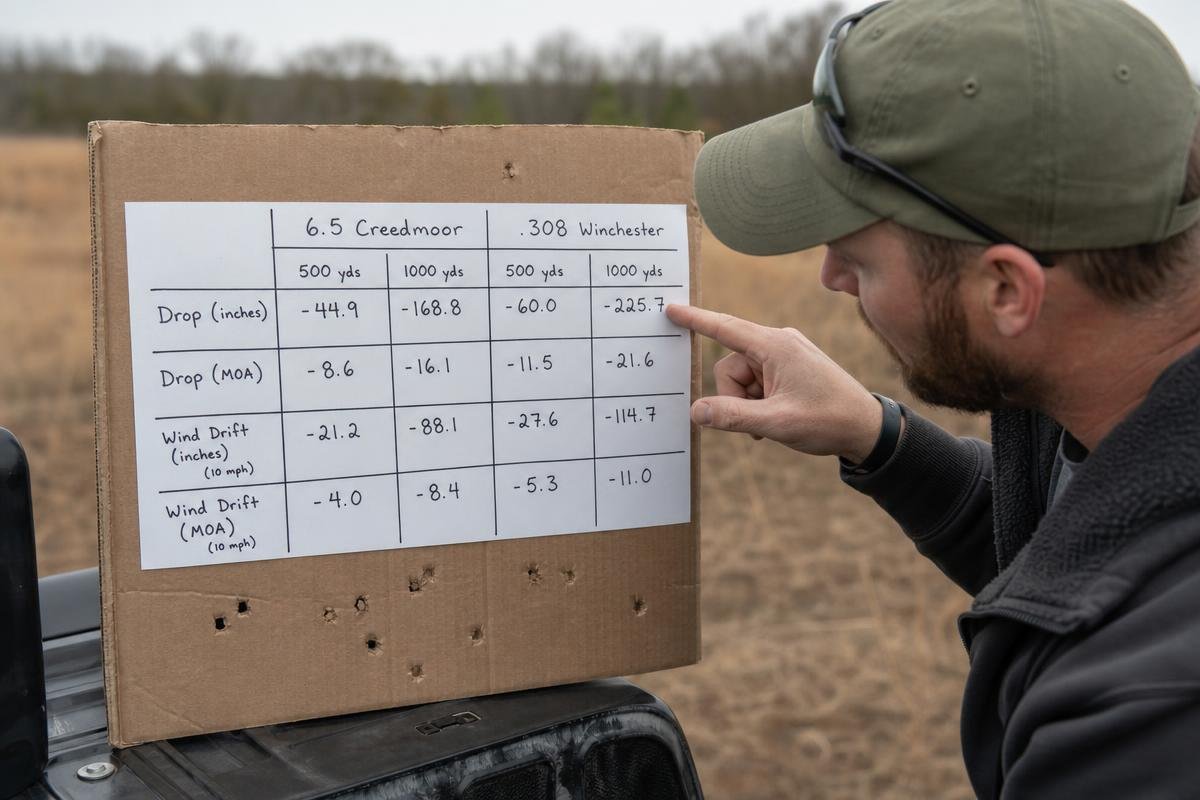
Yes, and the ballistic coefficient is why. Ballistic coefficient measures how well a bullet punches through air resistance: higher number, less drag, less drift. The 140-grain 6.5 ELD Match carries a G7 BC of around 0.315, while the 168-grain .308 Sierra MatchKing runs about 0.243. That gap is significant in a 10 mph full-value crosswind at 1,000 yards.
That difference translates to roughly 10 inches less wind drift for the 6.5. Out on the open fields of this part of North Texas, where wind rolls in off the Red River corridor with nothing to stop it, that is not a range-card footnote. At 1,000 yards, that 10-inch difference is the gap between a hit and a miss.
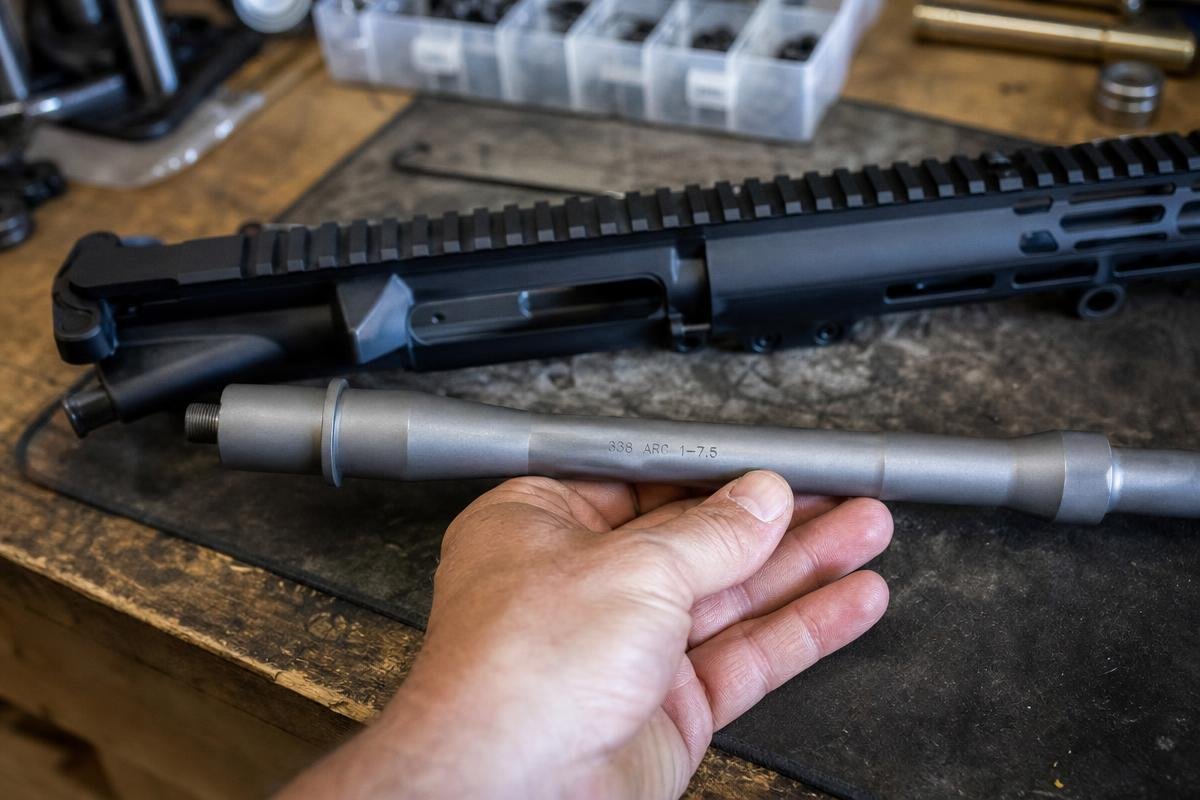
If you want to see how a third cartridge stacks up in this same wind, our 338 ARC complete uppers page covers that option for shooters pushing past 1,000 yards.
How Much Does the .308 Drop at 500 and 1,000 Yards?
Zeroed at 100 yards, the 168-grain .308 drops roughly 44 inches at 500 yards and around 280 inches at 1,000. The 140-grain 6.5 drops about 38 inches at 500 and 240 inches at 1,000. That is 40 fewer inches of elevation adjustment at a mile. Both cartridges demand a quality scope with enough elevation travel to make 1,000-yard shooting work. That requirement is non-negotiable for either chambering.
The .308 came up first, standardized as the commercial version of the 7.62x51mm NATO round and trusted by militaries and law enforcement snipers for over seventy years. The 6.5 was designed later to answer a single question: could a smaller-diameter bullet outperform it at distance? On these numbers, it can.
Ready to build around these numbers? Compare our 6.5 Creedmoor complete upper receivers against our .308 Win complete uppers and pick the platform that fits your range.
Recoil, Barrel Life, and Practical Shootability
Felt Recoil: A Real Difference Over a Long Session
On paper, the gap is clear. A .308 generates roughly 20 to 22 ft-lbs of free recoil in a typical 8.5-lb rifle. The 6.5 produces closer to 13 to 15 ft-lbs in a comparable build. That is about 30 percent less recoil energy.
On an AR-10 platform, the gas-operated action softens the impulse on both cartridges compared to a bolt gun, so the raw numbers shrink a bit in practice. But the difference between the two does not disappear. Run 100 rounds in a morning session and you will feel it. Fast follow-up shots on hogs at night are also easier to manage with the lighter-recoiling round. Add a muzzle brake or a suppressor and both become very comfortable, but the 6.5 still stays ahead on felt recoil.
If you are wondering whether recoil actually matters, the honest answer is: it depends on your round count and your use case.
Barrel Life: What the Round Count Actually Means for You
The .308 is easier on barrels. Expect 5,000 to 8,000 rounds before accuracy degrades, depending on barrel steel and how fast you shoot. The 6.5 runs hotter and pushes a smaller bore harder. Plan on 2,500 to 4,000 rounds under similar conditions.
Context matters here. A Grayson County hog hunter running a semi-auto .308 upper through 200 rounds a season is never going to wear out a barrel. A PRS competitor driving to Dallas-area ranges every weekend and burning 3,000 rounds a year will hit that 6.5 threshold in a season or two. Know your round count before you decide this is a dealbreaker. If you shoot high volume, factor a barrel replacement into your long-term cost when you build a 6.5.
Which Cartridge Is Better for Hunting?
For the hunting debate, the honest answer depends on what you're shooting and how far. Both cartridges are capable killers, but they have different strengths, and in North Texas terrain, those differences matter. Around here most whitetail and hog shots fall between 100 and 400 yards across open fields and river-bottom senderos.
Deer-Sized Game: Whitetail, Mule Deer, and Pronghorn
Out in Grayson County's open agricultural fields, shots on whitetail can stretch past 400 yards easily. That's where the 6.5 earns its keep. The flatter trajectory and superior wind-bucking performance make it the smarter choice when you're shooting across open ground with a crosswind rolling in off the water. The Hornady ELD-X 143-grain is a proven deer bullet. It expands reliably, penetrates deep, and holds together through the vitals.
The .308 with a 165-grain bonded bullet like the Nosler Partition is equally lethal inside 400 yards. It has decades of whitetail behind it. If your shots stay inside that range, you won't feel undergunned. But push past 500 yards in open country, and the 6.5's wind-drift advantage becomes real and measurable, not theoretical.
Elk, Large Hogs, and Heavy Game
Feral hog hunting on private land around the Red River bottoms runs year-round. Big boars are thick-skinned, heavy-boned, and often taken in low light at moderate distances. The .308 with 180 to 200-grain bonded bullets delivers more retained energy at those ranges and gives you a wider selection of deep-penetrating hunting loads. For a large boar quartering away in a sendero at 150 yards, the .308 gives you more margin. Our .308 Win complete uppers are built for exactly this kind of work.
The 6.5 can take elk cleanly with premium bullets at appropriate ranges. But the .308's heavier bullet weights give you more bone-crushing energy when angles are bad or brush is a factor. Shot placement always matters more than cartridge choice at ethical hunting distances.
Not sure which upper fits your hunting setup? Call us at (888) 706-0633 and we'll point you in the right direction.
Long-Range Target Shooting and Competition: Where the 6.5 Creedmoor Dominates
In Precision Rifle Series and National Rifle League competition, the 6.5 took over fast. Within a few years of its introduction, it displaced the .308 as the dominant cartridge across both bolt-gun and gas-gun divisions. The reason is straightforward: higher ballistic coefficients, less wind drift, and lower recoil add up to faster, more accurate follow-up shots on steel from 100 to 1,200 yards.
If you are shooting past 800 yards on steel, the 6.5 Creedmoor is the answer.
For precision rifle competitors near Sherman and Denison who drive down to Dallas-corridor ranges for 600 to 1,000 yard practice, that wind advantage is real. North Texas spring and fall winds rolling off the plains punish high-drift cartridges. The 6.5's tighter wind numbers translate directly into fewer misses on the clock. You can see that difference on a 10 mph crosswind at 800 yards, where the gap between the two cartridges widens to several inches of drift.
The .308 is not dead in competition. Inside 800 yards it remains a solid choice, and newer long-range shooters often start there because ammo costs less and selection is wider. Both cartridges run well in AR-10 pattern semi-auto platforms, which are legal in gas-gun competition divisions.
Ammunition Availability and Cost: A Practical Consideration for 2026
Both cartridges are widely available, but there are real differences worth knowing before you commit to a build or stock up for a season.
Factory match-grade .308 runs roughly $1.50 to $2.50 per round. Match loads for the 6.5 land in the same range. Where .308 has a clear edge is budget hunting ammunition. Cheap brass-cased .308 is easy to find, and it's noticeably less expensive per box than comparable 6.5 hunting loads. Both cartridges have excellent reloading component availability if you load your own.
Finding Ammo in Denison and Sherman
Along the US-75 corridor between Denison and Sherman, .308 is almost always on the shelf. Gun shops, sporting goods stores, and big-box retailers stock it consistently. The 6.5 has become nearly as common at major retailers since around 2015, and you can order it online without trouble. But in a supply crunch, .308 is the one you'll find locally. If you're heading out for a weekend hunt north of town and forgot to order online, .308 is the safer bet for a quick local pickup.
Platform: AR-10, Not AR-15
This is where builders make a costly mistake. Neither cartridge runs on a standard AR-15 lower. Both the .308 and 6.5 require an AR-10 or LR-308 pattern platform. You need the right upper and lower matched to that larger action.
The .308 is the native chambering for most AR-10 builds. The 6.5 uses the same bolt face and feeds from the same magazines in most configurations, making it a straightforward swap if you're already on an AR-10 platform. Verify compatibility with your specific upper manufacturer before ordering. Every upper we assemble is headspaced and function-checked before it ships.
Long-Range Shooting in and Around Denison, TX
North Texas terrain shapes this decision as much as any ballistics chart. Out here in Grayson County, most whitetail and hog shots fall between 100 and 400 yards across open agricultural fields and river-bottom senderos. At those distances, either cartridge handles the job. But on a windy spring morning north of Denison, where the terrain opens up toward the Red River corridor, that wind-bucking advantage covered in the ballistics breakdown above becomes real and practical, not just a number on paper.
For feral hog hunting on private land, heavy .308 loads in the 180 to 200 grain range are a solid call, especially for large boars in low-light conditions. Local gun shops along the US-75 corridor between Denison and Sherman stock .308 more consistently than the 6.5, so ammo availability matters if you are not ordering in bulk. If you want to stretch your range past 500 yards and practice at a public facility, the nearest 600 to 1,000 yard ranges sit roughly 45 to 60 minutes south toward the Dallas corridor.
We are based in Sherman at 2022 S Crockett St, about 10 miles south of Denison. We build and ship complete uppers in both calibers directly to your door. No FFL required for upper receivers.
Once you know which cartridge fits your build, the next step is simple. Get in touch and we'll confirm platform compatibility, walk through barrel and handguard options, and build your upper to order before it ships to your door. Call us at (888) 706-0633 or stop by our Sherman, TX location at 2022 S Crockett St to talk through your build before you order.