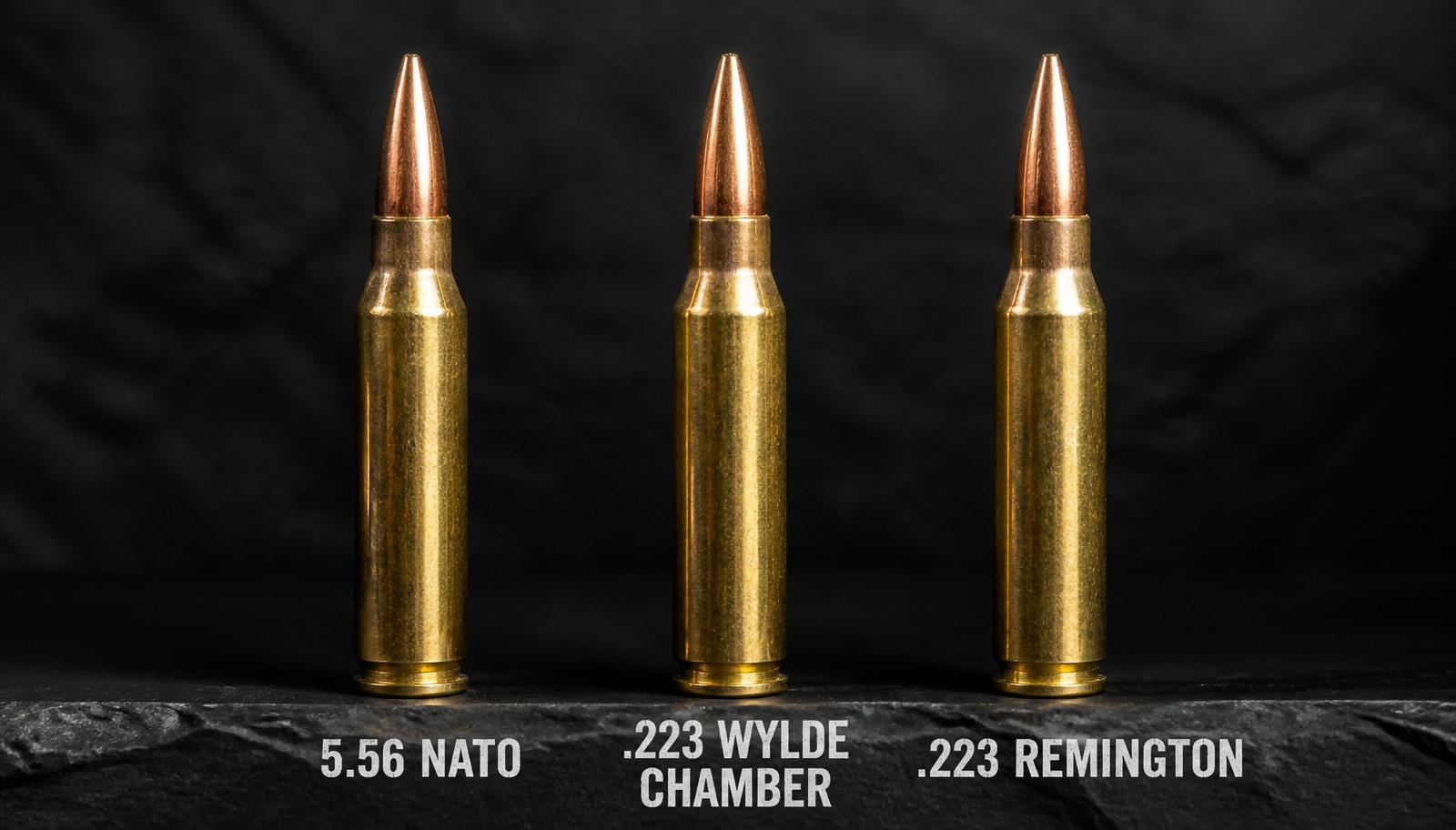
5.56 NATO, .223 Remington, and .223 Wylde look identical on the outside but chamber differently. Here's what that means for pressure, accuracy, and safety.
The 5.56 NATO vs .223 Remington confusion has probably caused more misinformation than any other AR-15 topic. The cartridges look identical, chamber into rifles that look identical, and even fire from magazines that look identical. But the chamber specifications and pressure ratings are meaningfully different, and getting it wrong can damage brass, damage your rifle, or hurt you. Here's the whole picture.
Where the Confusion Comes From
5.56x45mm NATO and .223 Remington share the same external cartridge dimensions. A round of either fits in the same magazines, feeds the same way, and looks identical. The differences are internal:
- Pressure: 5.56 NATO loads hotter than .223 Rem
- Chamber leade: 5.56 chambers have a longer leade to handle the higher pressure and longer NATO bullets
- Case wall thickness: NATO brass is often (not always) slightly thicker
Because the cartridges look interchangeable, shooters assume the chambers are too. They're not. This is where damage happens.
Chamber Specs Compared
Note: SAAMI and NATO measure pressure differently (SAAMI at case mouth, NATO at chamber). The 62,000 vs 55,000 psi comparison is close but not perfectly apples-to-apples. What matters is the practical outcome: firing 5.56 in a .223 chamber raises pressure beyond safe .223 limits.
Pressure: The Real Difference
When a .223 Remington cartridge fires in a proper .223 chamber, everything is engineered to spec. When a 5.56 NATO cartridge fires in a .223 chamber, two problems compound:
- The 5.56 case is loaded to higher pressure to start with
- The shorter leade in the .223 chamber means the bullet contacts the rifling sooner, further raising pressure
The result is overpressure signs (flattened primers, hard extraction, brass flow into extractor cuts) and, over time, accelerated wear on the bolt, barrel extension, and locking lugs. In worst-case scenarios with hot lots of 5.56, you can see case head separations or blown primers.
The reverse (.223 in a 5.56 chamber) is safe because pressure goes down, not up. Accuracy suffers slightly because the bullet has farther to jump before engaging the rifling, but nothing dangerous happens.
.223 Wylde: The Best of Both Worlds
.223 Wylde is a hybrid chamber designed by Bill Wylde specifically to solve this problem. It has:
- The case dimensions of .223 SAAMI (tighter, better accuracy)
- The leade angle of 5.56 NATO (safer pressure with 5.56 ammo)
The result: you can safely fire both 5.56 NATO and .223 Remington, and .223 match ammo shoots more accurately than it would in a pure 5.56 chamber. It's genuinely the best of both worlds, and for accuracy-focused AR builds, it's the smart chamber choice.
The tradeoff is minor: .223 Wylde is slightly less forgiving of dirty ammo or extreme high-pressure loads than a full 5.56 chamber. In practice, this doesn't matter for anyone but competition shooters running the ragged edge.
Which Chamber Should You Pick
Pick 5.56 NATO if:
- You want a duty, defense, or general-purpose AR
- You'll shoot mixed ammo including 5.56 NATO surplus and range 5.56
- You don't care about squeezing the last 0.25 MOA out of match .223
- You want maximum ammo flexibility
This is the right chamber for 90% of AR-15 builds. Every duty upper (BCM, DD, KAC, SOLGW) ships in 5.56 NATO for this reason.
Pick .223 Wylde if:
- Accuracy with heavy match .223 (69 to 77 gr) matters
- You still want to shoot 5.56 sometimes
- You're building a DMR-style, precision, or competition upper
Aero Precision Solus precision configs, Ballistic Advantage Modern Series, JP Enterprises match, and Faxon precision uppers commonly ship in .223 Wylde. It's the right chamber for accuracy-focused ARs.
Pick .223 Remington only if:
- You're building a bolt-action or dedicated .223-only rifle
- You will never fire 5.56 in it
- You want the tightest possible chamber for .223 match ammo
This is rare on AR-15 uppers. Skip it unless you have a specific reason.
Browse 5.56 NATO and .223 Wylde complete uppers and barrels at ar15parts.com, filterable by chamber spec.