How to pick a .350 Legend upper: barrel length, twist rate, compatibility with your existing AR-15, and why straight-wall states drove this cartridge into the mainstream.
.350 Legend is one of the more targeted cartridges on the AR-15 platform. Winchester introduced it in 2019 specifically to give hunters in straight-wall-only states (Ohio, Iowa, Indiana, parts of Michigan) a modern rifle option that satisfies restrictive game regulations. It uses the same bolt as 5.56, converts an existing AR-15 with just a barrel and magazine change, and delivers legitimate deer-hunting ballistics inside 200 yards. Here's how to pick the right upper.
Why .350 Legend Exists
Several Midwest states restrict rifle deer hunting to straight-wall cartridges, cases that don't taper significantly from base to shoulder. The regulations were written to limit effective range for safety in populated hunting areas, and they excluded most conventional bottleneck rifle cartridges (5.56, .308, 6.5 Creedmoor). Hunters in those states historically had to use shotguns with slugs, muzzleloaders, or handguns.
.350 Legend was engineered specifically to satisfy these restrictions while giving hunters a modern semi-auto option: straight-wall case (0.390-inch base diameter, no bottleneck), .35-caliber bullet, moderate velocity, and designed to feed reliably from a modified AR-15 magazine. Winchester designed it around the AR-15 bolt face, which meant existing rifles could convert with just a barrel and magazine change.
The result is a cartridge that legally hunts deer in states where 5.56 or .308 rifles are illegal, with less recoil than .450 Bushmaster and better terminal energy than .300 Blackout at hunting ranges.
Ballistics and Effective Range
For deer, most hunters treat .350 Legend as a 150 to 200-yard cartridge. Bullet drop at 200 yards with a 100-yard zero is roughly 8 to 10 inches, manageable with holdover or a simple duplex reticle. Beyond 200 yards, drop and energy loss make ethical shots harder.
Recoil is notably milder than .450 Bushmaster (roughly half the felt recoil), which makes .350 Legend appropriate for smaller-statured hunters and younger shooters who might struggle with .450. It's also cheaper to shoot: bulk .350 Legend runs $0.50 to $0.80 per round, versus $1.00+ for .450 Bushmaster.
Barrel Length and Gas System
16-inch barrel with carbine or mid-length gas system is the standard .350 Legend configuration. 16 inches gives you full advertised velocity, keeps the rifle handy for field use, and stays legal as a standard rifle everywhere.
Some manufacturers offer 18 or 20-inch barrels for slight velocity gains (roughly 50 to 100 fps), but the ballistic advantage is minor and the added length rarely worth it for a hunting rifle.
For gas system:
- 16-inch with carbine gas: most common configuration.
- 16-inch with mid-length gas: slightly smoother recoil impulse, growing in popularity.
- Both work; either is fine for hunting use.
Twist rate is typically 1:16, which stabilizes the 145 to 180-grain bullets .350 Legend was designed around. Some barrels use 1:12 or 1:14, both work fine. Avoid faster twists like 1:7 or 1:8, they're unnecessary and marginally over-stabilize .350 Legend bullets.
What Swaps and What Doesn't
.350 Legend is one of the simpler AR-15 caliber conversions because it shares the 5.56 bolt face. The parts breakdown:
What transfers from your 5.56 rifle:
- Lower receiver (any mil-spec AR-15 lower)
- Bolt carrier group (standard 5.56 BCG works, though a dedicated .350 Legend BCG is available)
- Charging handle
- Buffer and spring (standard carbine buffer, or H1/H2 if desired)
- Optic and mount
What you need to change or add:
- Barrel: .350 Legend-specific
- Gas system: sized to match barrel length
- Magazines: .350 Legend-specific (Winchester, ASC, Duramag). Do not use 5.56 magazines.
- Muzzle device: .350 Legend uses 1/2x28 threading (same as 5.56), so most 5.56 muzzle devices work.
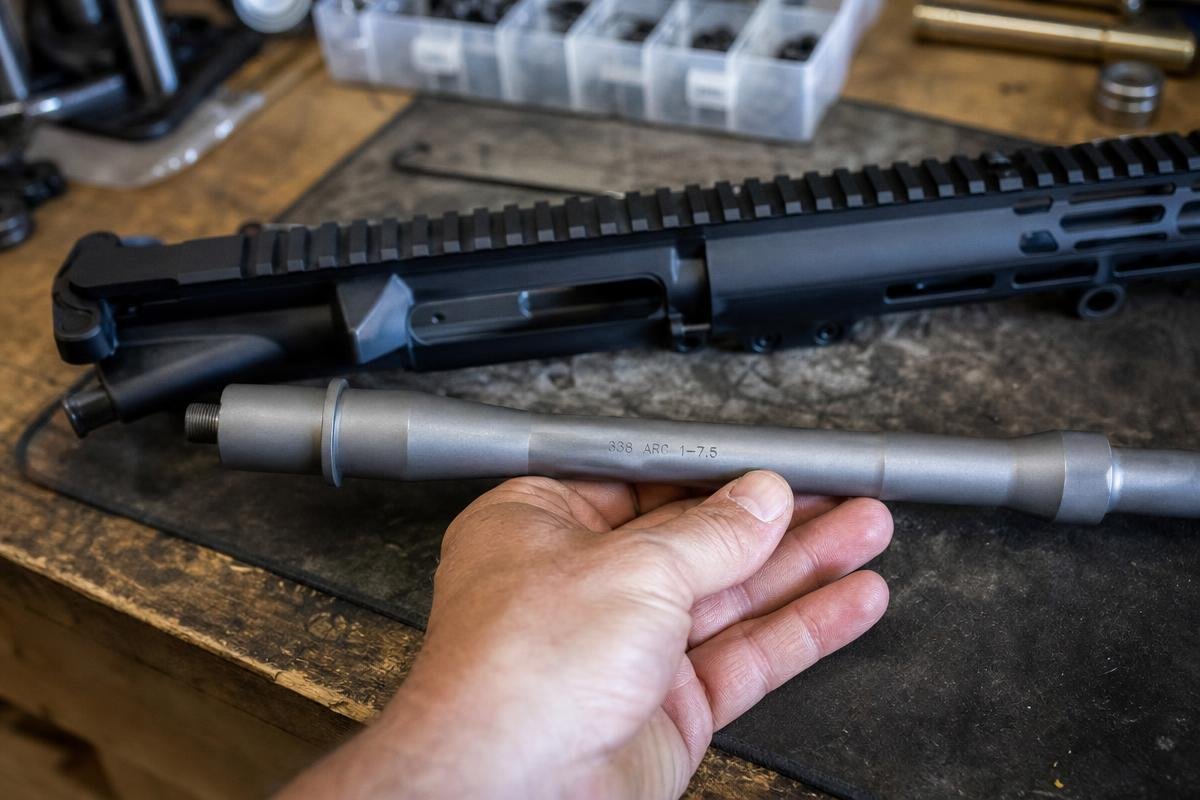
The simplest path is buying a complete .350 Legend upper and running it on your existing 5.56 lower with dedicated .350 Legend magazines. Building from parts is possible but adds tooling requirements and barrel-nut torque work.
How to Pick a .350 Legend Upper
The decision framework:
1. Confirm state legality. Verify .350 Legend is legal for your intended game and season. Straight-wall regulations vary by state and even by county, and some states restrict specific cartridge cases.
2. Barrel length: 16-inch is the default. Only go longer if you specifically want the modest velocity gain and can accept the added length.
3. Barrel material: 4150 CMV nitride is the standard and affordable choice. Chrome-lined is fine but rarely needed for a hunting rifle that sees limited round counts.
4. Handguard: M-LOK free-float, 12 to 15 inches. Long enough to mount a bipod or hand stop, short enough to keep the rifle handy in the field.
5. Complete upper vs. barrel-only: For most hunters, a complete upper is the simpler path. It ships assembled with the correct gas system, headspaced, and ready to install. Barrel-only makes sense only if you already have a spare upper receiver, gas block, and gas tube.
6. Budget for magazines. Plan on 2 to 3 .350 Legend magazines at $20 to $35 each. Winchester, ASC, and Duramag are the common suppliers.
.350 Legend is a specialist cartridge, but for the specific job it was designed to do (deer hunting in straight-wall states on the AR-15 platform), nothing else on the market does it as well. If you hunt in Ohio, Iowa, Indiana, or Michigan and want a semi-auto, .350 Legend is the right answer.
Browse .350 Legend uppers and magazines at ar15parts.com.