Barrel break-in procedures range from elaborate rituals to 'ignore it entirely.' Here's what actually helps, what doesn't, and how to do it right.
Barrel break-in is one of the most debated topics in the AR-15 world. Some shooters follow elaborate 100-round protocols with specific cleaning intervals. Others argue break-in is a marketing myth. The truth is somewhere in the middle: it depends entirely on what kind of barrel you have. Here's the honest answer without the ritual.
What Barrel Break-In Actually Is
The premise of barrel break-in is that new barrels have microscopic tool marks in the bore that trap copper fouling during initial firing. By shooting a small number of rounds and cleaning aggressively between them, you allow the bullet jackets to polish out the tool marks progressively, resulting in a smoother bore that fouls less over time.
The theory is legitimate for some barrels. The practice is largely unnecessary for others, and elaborate protocols are almost never justified.
Chrome-Lined and Nitride Barrels: Skip It
Chrome-lined barrels have a plating process that creates a smooth, hard bore surface. The chrome layer covers whatever tool marks were in the original bore, so there's nothing to polish out. Copper fouling behavior on a chrome-lined barrel is set from round one; break-in procedures don't change it.
Nitride barrels are similar. The nitride treatment diffuses into the steel surface, creating a very hard smooth layer. Tool marks are minimized by the nitride process itself.
For chrome-lined or nitride barrels:
- Clean the packing grease/oil out of the bore before first firing
- Apply a light coat of preservative oil
- Shoot the rifle normally
- Clean when you'd normally clean (every few hundred rounds is fine)
No structured break-in required. This covers most duty and general-purpose AR-15 barrels from BCM, Daniel Defense, FN, PSA, and similar.
Match Stainless Barrels: A Short Break-In Helps
Match stainless barrels (button rifled, cut rifled, or hand-lapped) don't have chrome or nitride surface coatings. The bore is the raw steel surface, however finely machined. Tool marks in the bore, however small, can trap copper on early firings.
For match stainless barrels, a short break-in procedure can help:
- Shoot one round, then clean thoroughly (patches until clean, one bronze brush pass with copper solvent, dry patches).
- Repeat for the first 5 rounds (5 individual shot cycles).
- Then shoot 3 rounds and clean. Do this for another 3 to 5 groups.
- After 20 to 30 rounds, transition to normal cleaning intervals.
Some shooters extend this to 40 or 50 rounds. Beyond that, additional break-in effort shows no measurable benefit.
Cut-rifled barrels from Bartlein, Krieger, and Proof Research often come pre-lapped and may require no break-in at all. Check the manufacturer's guidance.
How to Do a Sensible Break-In
If you have a match stainless barrel and want a sensible break-in protocol:
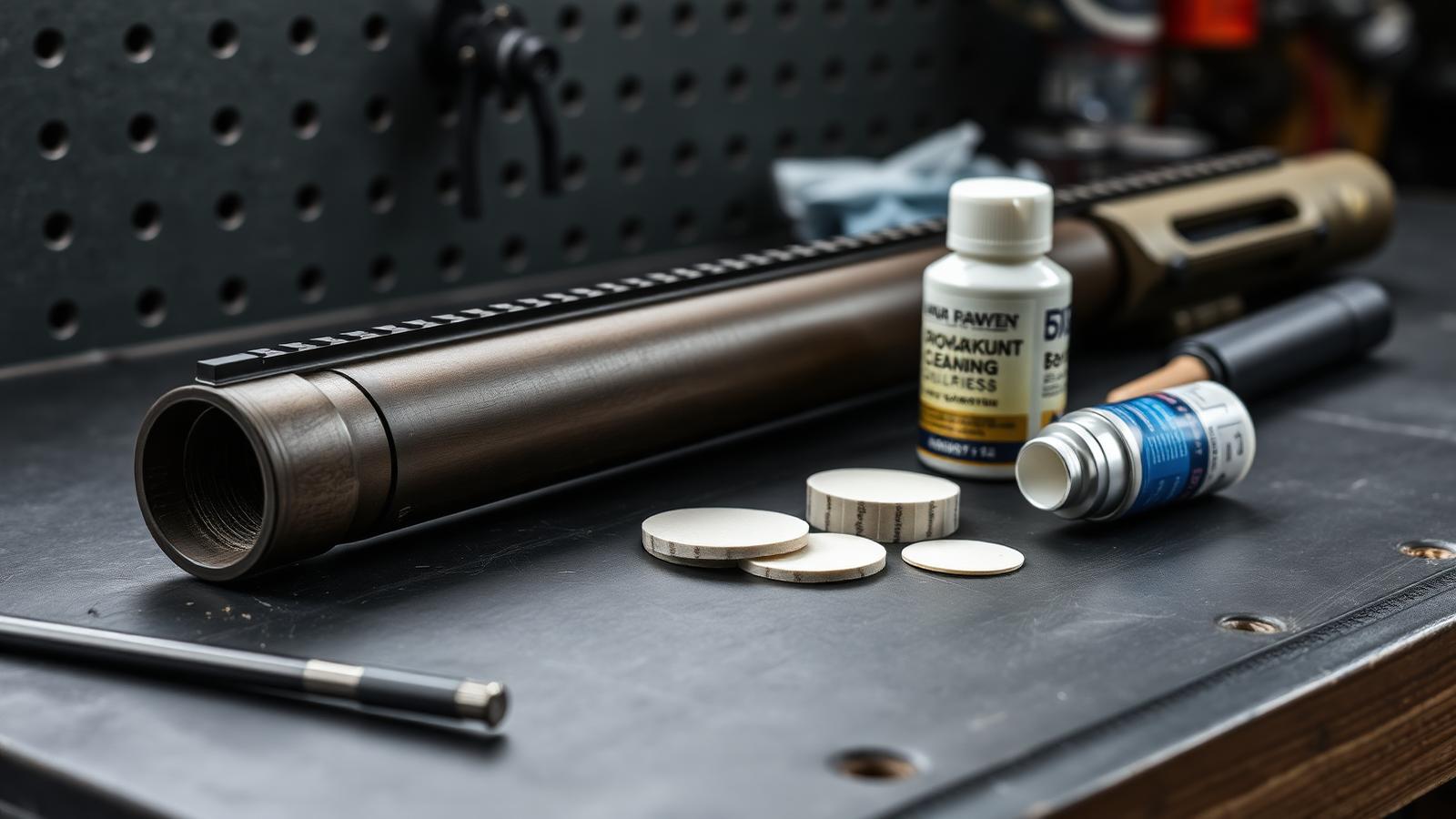
Supplies:
- Bore guide (protects the chamber and directs solvent forward)
- Bronze bore brush (correct caliber)
- Cotton patches
- Bore solvent (Hoppes, Butch's, Bore Tech Eliminator)
- Copper solvent (Bore Tech Cu+2, Sweet's 7.62, Hoppes Copper)
- Cleaning rod (one-piece carbon fiber or coated preferred)
Procedure:
- Set up on a solid rest at the range. Have targets, ammo, and cleaning supplies staged.
- Fire one round. Note the point of impact and group size (n=1 doesn't tell you much, but track it).
- Between shots, run a wet patch of copper solvent, let sit 5 minutes, then bronze brush pass, then dry patches until clean. Follow with a wet patch of regular bore solvent, then dry patches until clean.
- Repeat single-shot cycles for the first 5 rounds.
- Move to 3-shot groups with cleaning between groups for the next 15 rounds.
- After 20 rounds, clean normally and shoot for group.
The whole process takes about 1 to 2 hours at the range. It's not fun. But for a match stainless barrel you're going to shoot for 5,000 to 8,000 rounds, spending an hour up front is reasonable.
Break-In Myths to Ignore
Myth: "100+ round elaborate break-in protocol." No evidence supports 100-round protocols. Diminishing returns hit hard past 30 rounds.
Myth: "Break-in with only specific ammo." Any quality ammo works. Match ammo doesn't 'break in' the barrel differently than range ammo.
Myth: "Never fire more than one round between cleanings for the first 100." This is time-consuming ritual with no measurable payoff.
Myth: "Skipping break-in ruins the barrel." No. A chrome-lined barrel needs no break-in. A match barrel used without break-in will still shoot well, it may just take slightly longer to reach its accuracy potential and may foul slightly more initially.
Myth: "Break-in improves barrel life." No evidence. Barrel life is determined by chamber pressure, heat, and round count, not the first 30 rounds of firing.
Reality: Chrome-lined barrels don't need break-in. Match stainless barrels benefit from a sensible short break-in. Elaborate protocols are ritual, not engineering.
Browse quality complete uppers (chrome-lined and match stainless options) at ar15parts.com.