Your AR-15 thread pitch decides which flash hiders, brakes, compensators and suppressor mounts will fit your barrel. Get it right and every muzzle device you buy threads on cleanly. Get it wrong and a new brake ends up in a drawer.
Thread specs vary by barrel and muzzle device, so this guide organizes common thread pitches by caliber. You will see why most 5.56 barrels share one thread, why .30 caliber and 6.5 barrels move to a larger one, and why the big-bore cartridges are the outliers. We also cover how to read a thread callout, how to confirm what is on your barrel and how to plan for a suppressor later.
Shopping for a complete upper with the right muzzle thread already cut? Start with complete uppers at AR15Parts.com.
Key Takeaways
- Thread pitch follows bore diameter, so your caliber usually decides it for you.
- Barrels in 5.56 NATO and .223 Wylde are commonly threaded 1/2x28.
- Barrels in .30 caliber and 6.5mm cartridges such as 300 Blackout, 6.5 Grendel and .308 are commonly threaded 5/8x24.
- Big-bore cartridges like 450 Bushmaster, 458 SOCOM and 50 Beowulf use larger threads such as 5/8x32, 3/4x24 or 49/64x20, and they vary by barrel maker.
- Always confirm the thread on the actual barrel listing or manufacturer marking before you order a muzzle device.
- A muzzle device must have a bore opening sized for your caliber, not just the right thread.
What Muzzle Thread Pitch Means
A thread callout like 1/2x28 has two parts. The first number is the major diameter of the threaded section in inches. The second number is the threads per inch, often shortened to TPI.
So 1/2x28 means a half-inch diameter with 28 threads per inch. A 5/8x24 thread is larger in diameter and slightly coarser, with 24 threads per inch. Both numbers have to match the muzzle device, or it will not thread on.
Diameter vs Threads per Inch
Diameter is the dimension that matters most for fit. A device cut for a 5/8 inch shank cannot thread onto a 1/2 inch shank, and the reverse is just as true.
Threads per inch is the trap. Two threads can share a diameter but differ in TPI, such as 5/8x24 and 5/8x32. They can look almost identical on a bench, but they are not interchangeable. Forcing one onto the other can damage both parts.
Why the Barrel Shank Size Matters
The threaded tenon has to leave enough steel around the bore. A small .22 caliber bore leaves plenty of wall on a 1/2 inch tenon. A .30 caliber bore needs more room, which is one reason those barrels step up to 5/8 inch threads. Big-bore barrels go larger again.
Common AR-15 Thread Pitch by Caliber
The simplest way to choose an AR-15 thread pitch is to start with your cartridge. The table below reflects thread specs commonly printed on barrel listings. Individual barrels can differ, so treat it as a starting point and verify the specific part.
| Caliber | Thread seen on AR15Parts.com barrels | Notes |
|---|---|---|
| 5.56 NATO / .223 Wylde | 1/2x28 | The common standard for .22 caliber AR-15 barrels |
| 22 ARC / 224 Valkyrie | 1/2x28 or 5/8x24 | Depends on the maker; some use the larger thread |
| 204 Ruger | 1/2x28 or 5/8x24 | Varies by barrel maker |
| 300 Blackout | 5/8x24 | The usual .30 caliber thread |
| 6.5 Grendel / 6mm ARC / 7.62x39 | 5/8x24 | Common on these AR-15 calibers |
| .308 / 6.5 Creedmoor (AR-10) | 5/8x24 | Standard for most AR-10 barrels |
| 350 Legend | 5/8x24 or 9/16x24 | Varies by barrel maker |
| 450 Bushmaster / 458 SOCOM | 5/8x32 or 3/4x24 | Varies by barrel maker |
| 50 Beowulf | 49/64x20 or 3/4x24 | Varies by barrel maker |
The .22 Caliber Group
Standard AR-15 barrels in 5.56 NATO and .223 Wylde use 1/2x28. That thread is supported by a huge range of flash hiders, brakes and suppressor mounts, which makes it the easiest thread to shop for. If you are building a general-purpose rifle, this is usually the path of least resistance. You can see current options in the .223 Wylde barrel lineup.
Some newer .22 caliber cartridges are less uniform. 22 ARC and 224 Valkyrie barrels commonly appear with both 1/2x28 and 5/8x24 threads depending on the manufacturer. Check the listing title before you buy a device.
The .30 Caliber and 6.5mm Group
Barrels in 300 Blackout, 6.5 Grendel, 6mm ARC, 7.62x39, .308 and 6.5 Creedmoor are commonly threaded 5/8x24. The larger shank leaves more steel around the larger bore. A 300 Blackout upper is a common example of a 5/8x24 build on the AR-15 platform.
Big-Bore Outliers
The straight-wall big bores do not share one standard. Barrels for 450 Bushmaster and 458 SOCOM appear with 5/8x32 and 3/4x24 threads, and 50 Beowulf barrels appear with 49/64x20 and 3/4x24. On these builds, never assume. Read the thread off the barrel listing, then buy the device to match. Browse the full barrel catalog to compare specs across calibers.
How to Confirm the Thread on Your Barrel
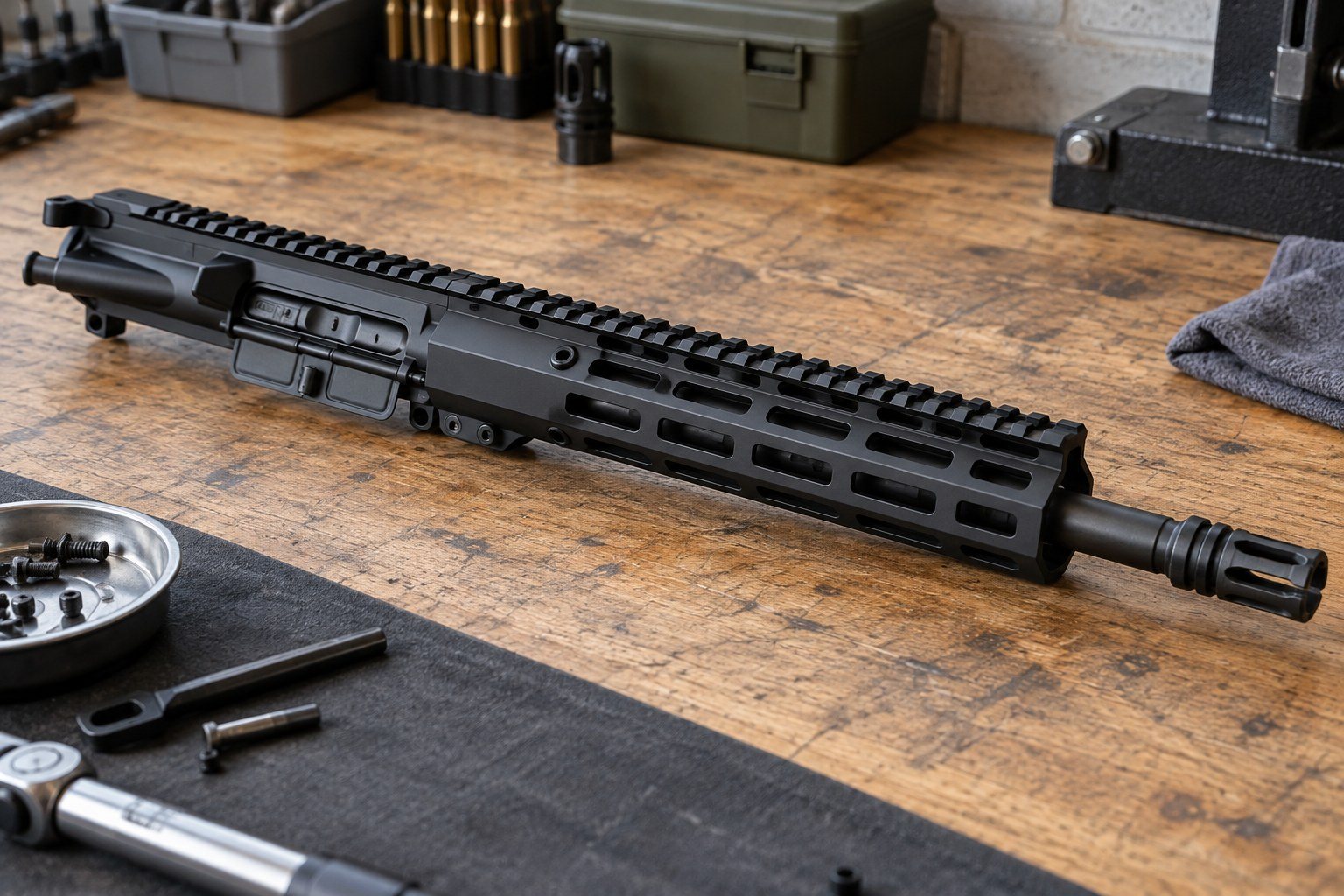
Before you order a muzzle device, confirm what is actually on your barrel. A wrong guess costs time and can damage threads.
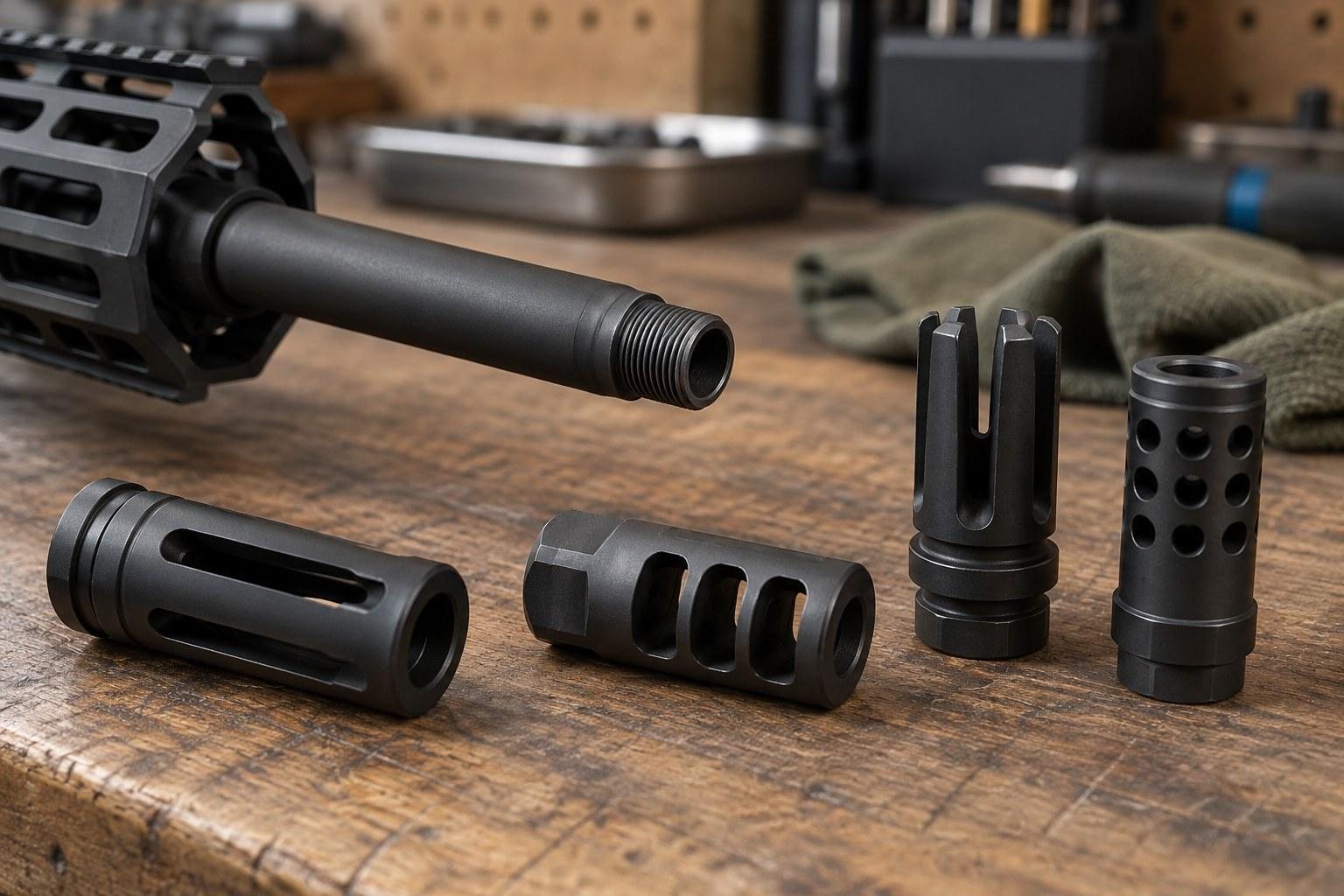
Want more context on the device types themselves? Our breakdown of flash hiders, brakes and comps is a good next read.
Check the Paperwork and Markings
Start with the barrel or upper listing, the box or the manufacturer's spec sheet. Many makers include the thread in the product title, which is a common way these parts are listed. Some barrels also carry markings near the muzzle or under the handguard.
Measure When Records Are Missing
If you bought a used upper with no records, measure. Make sure the firearm is unloaded and the upper is separated from the lower. Then:
- Remove the existing muzzle device following the manufacturer's instructions.
- Measure the outside diameter of the threads with calipers.
- Check threads per inch with a thread pitch gauge.
- Compare both numbers to the published spec of the device you plan to buy.
If the reading is unclear, or the threads look damaged, take the upper to a qualified gunsmith rather than forcing a device on.
Watch for Look-Alike Threads
The 5/8x24 and 5/8x32 pair is the classic mix-up because the diameter matches. The same caution applies to 3/4x24 versus other 3/4 inch threads. A thread pitch gauge settles the question in seconds.
Matching Muzzle Devices to Your Thread
Once you know the thread, shopping gets simple. Muzzle device categories often list each device by its thread, so you can filter by what your barrel carries.
What Is Stocked by Thread
A common lineup of devices by thread includes the following:
- 1/2x28: options often include an A2 flash hider, a competition muzzle brake in black or stainless, a linear comp, a slim cone flash can and a stainless thread protector.
- 5/8x24: options often include an A2 flash hider, a competition muzzle brake in black or stainless, a linear comp rated for 30 caliber and 6.5mm bores, a slim cone flash can and a stainless thread protector.
- 5/8x32: a competition muzzle brake in black is a common option.
- 49/64x20: a multi port compensator is a common option.
Stock changes, so confirm availability on the live page before you plan around a specific part.
Thread Is Not the Only Fit Check
The device bore has to clear your bullet. A 5/8x24 device built for a .30 caliber bore will clear a 6.5mm bullet, but a device sized for a .22 caliber bore will not clear a .30 caliber bullet even if you could somehow match the thread. Many 5/8x24 devices are marked for both 30 caliber and 6.5mm bores for exactly that reason. Read the caliber rating on every device.
Timing and Installation
Brakes and comps usually need to be timed so the ports face the right way. Common methods include crush washers, peel washers and shim kits. Follow the device manufacturer's instructions and torque spec. Our upper torque specs article explains why the component maker's number always wins. If you are not comfortable timing a device, a qualified gunsmith can do it.
Planning for a Suppressor
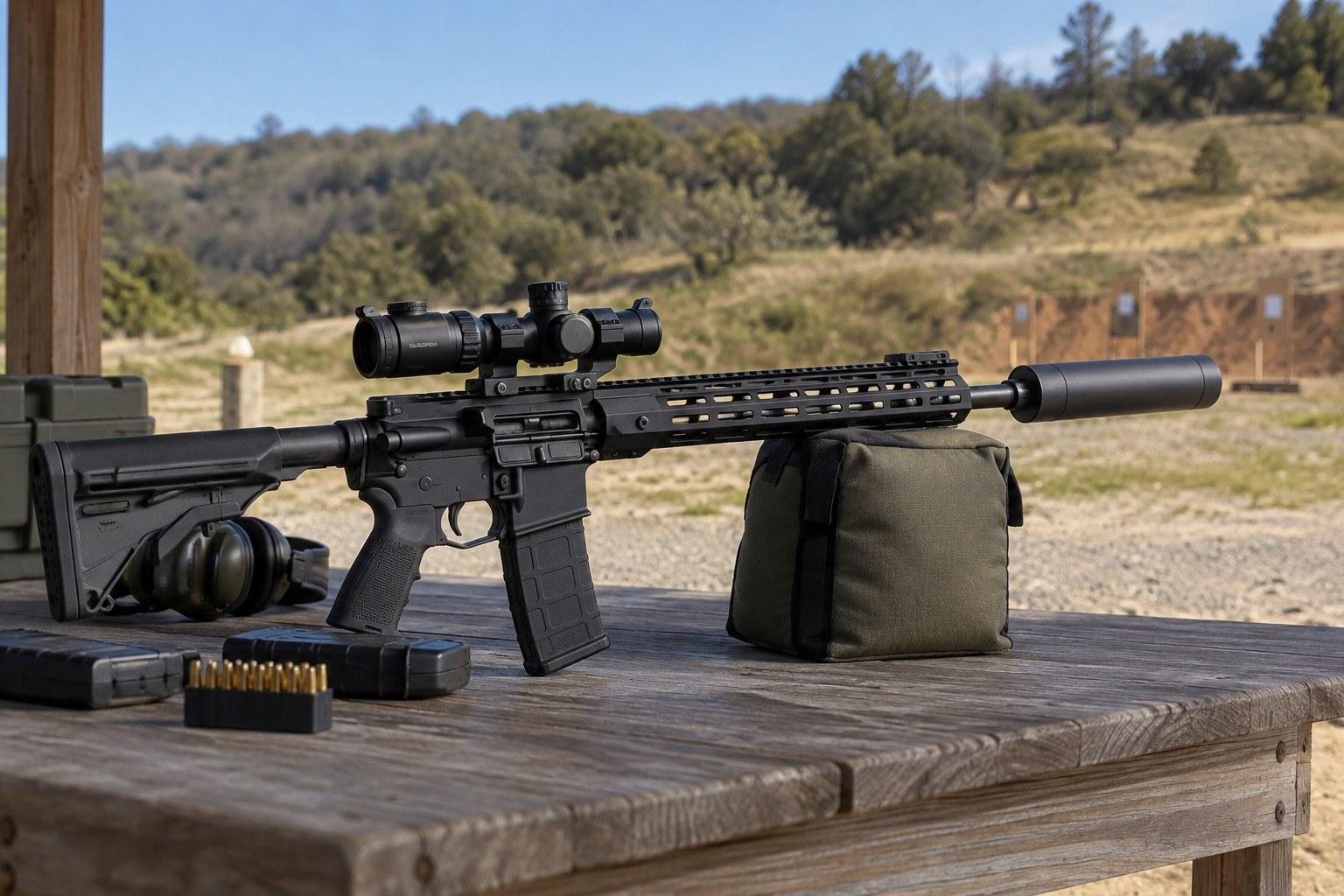
If a suppressor is on your list, think about it before you pick a barrel. The suppressor mount, whether a direct thread or a muzzle device that accepts a quick-detach can, has to match your barrel thread.
Mounts Follow the Barrel Thread
Suppressor makers sell mounts in a range of threads, and 1/2x28 and 5/8x24 are widely supported. If you own one can for several rifles, a common thread across those barrels makes swapping easier. Our roundup of suppressor-ready uppers covers builds that pair well with a can.
The Legal Side
Suppressors remain regulated under the National Firearms Act. Since January 1, 2026 the federal tax on suppressors and short-barreled rifles is $0, but ATF registration is still required. State and local laws vary, so check the rules where you live before you buy.
Barrel Length and Pinned Devices
On a rifle, a barrel under 16 inches makes it a short-barreled rifle under federal law, which also requires registration, and an overall length under 26 inches can trigger the same rule. A muzzle device that is permanently pinned and welded can bring a shorter barrel to 16 inches. That work should be done by a qualified gunsmith, and it changes what thread you can use later because the device is no longer removable.
Choosing the Right Thread for Your Build
For most builders, the right AR-15 thread pitch is simply the one that is standard for the caliber. Fighting that standard rarely pays off.
A Simple Decision Path
- Pick your caliber first.
- Note the thread printed on the barrel or upper listing.
- Confirm muzzle devices and suppressor mounts exist in that thread and bore size.
- If you run several rifles in the same caliber family, favor barrels that share a thread.
When a Nonstandard Thread Makes Sense
Sometimes the barrel you want only comes in one thread. That is common with big-bore cartridges. In that case, buy the barrel for its other qualities, then shop devices to match. Thread adapters exist, but they add length and another joint that has to stay tight. It is generally wise to match the device directly when you can.
Buy It Already Matched
Complete uppers from AR15Parts.com are assembled in-house, headspaced and function-checked before they ship, with the barrel thread noted so you can confirm it before ordering a muzzle device. That removes the guesswork. Explore our 16 inch upper picks or jump to the upper receivers category.
Ready to compare uppers built around the thread you want?