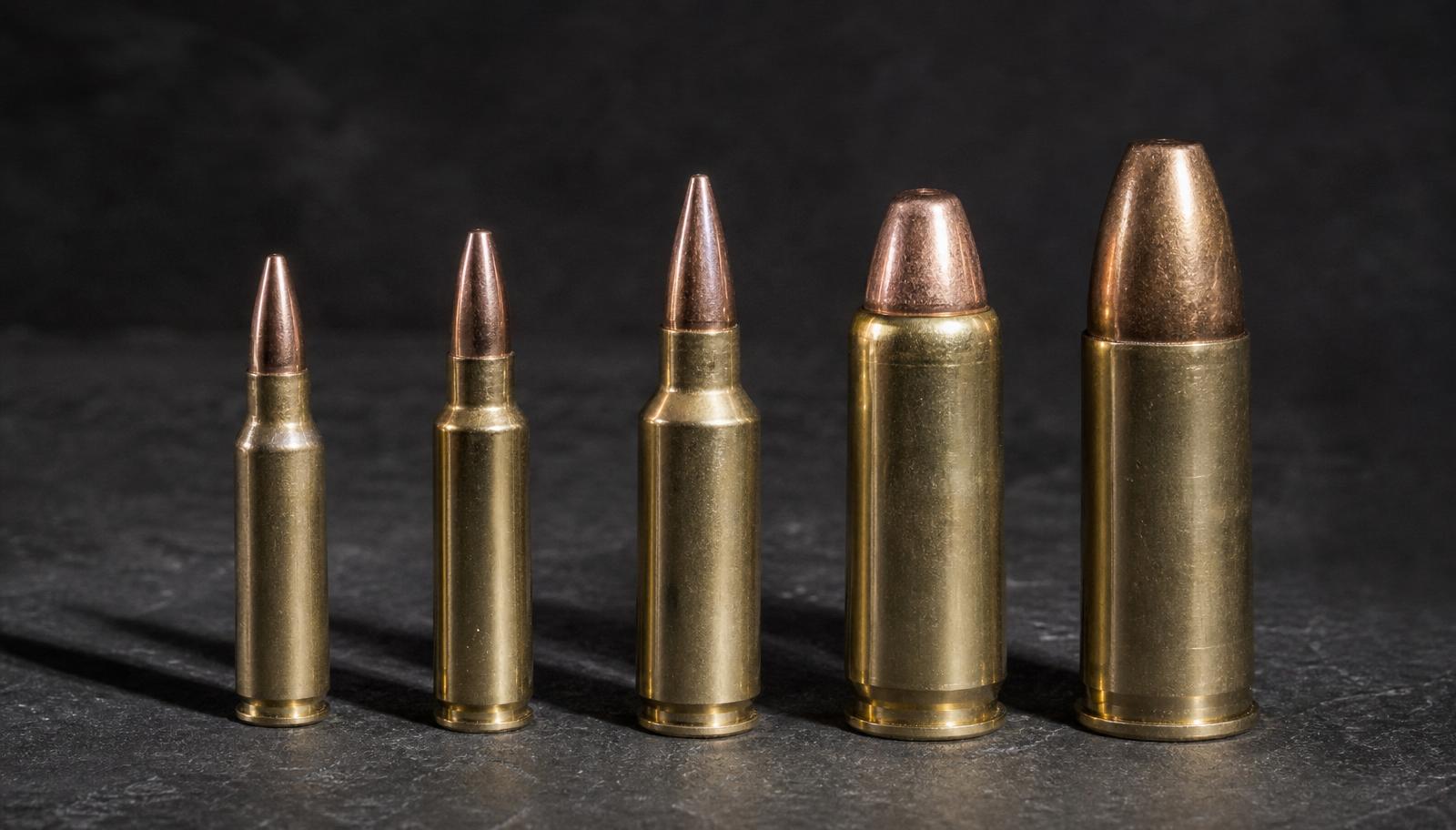
Compare the eight most common AR-15 upper calibers side by side, from 5.56 NATO to .50 Beowulf, with velocity, energy, effective range, and cost per round.
Caliber choice shapes everything about how an AR-15 build performs, recoil, effective range, ammo cost, and what game or targets it's realistically suited for, which makes it one of the first decisions worth getting right before you buy an upper.
The AR-15 platform's split-receiver design means a single lower can accept uppers in a wide range of calibers, from the standard 5.56 NATO to purpose-built long-range and big-bore options. That modularity is a big part of the platform's appeal, the same lower you already own can become a completely different rifle depending on which upper is attached, without needing to buy a new firearm or navigate a new set of paperwork for most caliber swaps.
Below, we break down eight of the most common AR-15 upper calibers, compare them side by side, and walk through how to match a caliber to your actual use case.
5.56 NATO / .223 Remington
The default AR-15 caliber, and for good reason. A 55-grain 5.56 load typically leaves the muzzle around 3,000 to 3,250 fps, generating roughly 1,200 to 1,300 ft-lbs of energy. It's flat-shooting, low-recoil, and effective to 400 to 500 yards in trained hands, though most range and defensive use happens well inside 300 yards.
Its biggest advantages are cost and availability, ammunition is the cheapest of any caliber on this list, magazines and parts are everywhere, and it's the easiest caliber to train on in volume without ammo cost limiting how often you can practice. The tradeoff is limited performance on medium-to-large game and reduced effectiveness at extended range compared to purpose-built long-range cartridges. For a first build, a general-purpose range rifle, or a primary home-defense gun, 5.56 remains the most practical starting point.
.300 AAC Blackout
Developed to give the AR-15 platform stronger short-barrel and suppressed performance, .300 Blackout runs the same magazines and bolt as 5.56 with just a barrel swap. Supersonic loads (110 to 125 grain) typically run 2,000 to 2,300 fps from a 16" barrel, while heavier subsonic loads (200 to 220 grain) drop to around 1,000 to 1,050 fps for quiet, suppressed shooting.
Effective range tops out around 300 to 400 yards with supersonic ammunition, well short of 6.5 Grendel or 6mm ARC, but that's not really the point of this cartridge. Its strength is close-range terminal performance and its unique ability to run both supersonic and subsonic loads reliably through the same gun, which makes it a favorite for suppressed home-defense and short-barrel builds where a quiet, low-flash setup matters more than reach. Ammo costs more than 5.56, roughly double in most markets.
6.5 Grendel
Designed specifically to stretch the AR-15's effective range without stepping up to a larger AR-10 platform, 6.5 Grendel fires higher-ballistic-coefficient bullets that hold velocity and energy well past 500 yards. A 123-grain load typically runs 2,400 to 2,800 fps depending on barrel length, generating around 1,800 to 2,000 ft-lbs of muzzle energy, with a useful supersonic range past 800 yards.
This makes it a strong choice for medium-game hunting and long-range steel, with meaningfully flatter trajectory and better retained energy than 5.56 or .300 Blackout at distance, while still generating noticeably less recoil than larger AR-10-pattern cartridges. The tradeoffs are a non-standard bolt and magazines (it's not a simple barrel swap from 5.56), somewhat faster barrel wear, and ammunition that costs noticeably more per round.
.224 Valkyrie
Federal's .224 Valkyrie was purpose-built to keep light, high-BC bullets supersonic well past 1,000 yards while keeping recoil low. Typical 60 to 90 grain loads run 2,700 to 3,000 fps, generating roughly 1,300 to 1,600 ft-lbs of muzzle energy, with some of the best wind resistance and flattest trajectories of any cartridge on this list at extreme range.
It shines for precision shooters and long-range competitors who want minimal recoil with maximum reach, though it's less established for hunting given its smaller bullet diameter. Barrel length matters more here than with most calibers, performance drops off meaningfully in barrels shorter than 16 inches, so this is not a great candidate for a short-barrel or pistol-length build.
6mm ARC
Hornady's 6mm ARC was built on the 6.5 Grendel case, necked down to 6mm, aiming for a balance of trajectory, recoil, and terminal performance for medium-range precision work. A 103 to 108 grain load typically runs 2,750 to 2,800 fps from an 18" barrel, generating around 1,700 to 1,800 ft-lbs of energy, with excellent wind resistance thanks to high ballistic coefficients.
Compared to .224 Valkyrie, 6mm ARC trades a little bit of extreme-range flatness for noticeably better terminal performance on game, making it a strong dual-purpose choice for hunters and long-range shooters alike. Like 6.5 Grendel, it requires a dedicated bolt and magazines rather than a simple barrel swap, and ammunition costs are on the higher end of this list.
.350 Legend
A straight-walled cartridge designed largely to satisfy state hunting regulations that require straight-wall ammunition for rifle deer hunting, .350 Legend uses the same bolt as 5.56/.223, making it one of the simpler caliber swaps on this list. Typical 145 to 180 grain loads run 2,100 to 2,350 fps, generating roughly 1,500 to 1,900 ft-lbs of muzzle energy.
Effective range is modest, generally inside 200 yards, but that's well within its intended niche of woods and field hunting rather than long-range work. Recoil is mild, ammunition costs are relatively reasonable for a hunting-specific caliber, and it's a good option for hunters in straight-wall-only states who want to keep their AR-15 platform.
.458 SOCOM
Built for close-range stopping power, .458 SOCOM pushes large-diameter bullets (250 to 600 grain) through a modified standard AR-15 magazine and bolt face. A common 300-grain load runs around 1,900 to 2,000 fps, generating roughly 2,400 ft-lbs of energy at the muzzle, though it drops fast, supersonic loads are realistically a 150-yard cartridge, with subsonic loads effective closer to 75 yards.
This is a specialist caliber: too slow for distance work and too expensive to shoot in volume, but excellent for close-range hog and hunting applications, barrier-blind performance, and suppressed subsonic shooting where a heavy, slow-moving bullet retains more energy than a smaller subsonic round.
.50 Beowulf
The largest-diameter cartridge on this list, .50 Beowulf fires true .50-caliber bullets (200 to 600 grain, with 335 to 400 grain most common) at modest velocities, a typical 350-grain load runs around 1,750 to 1,800 fps, generating roughly 2,400 to 2,450 ft-lbs of energy. Effective range is limited to around 150 yards, as the bullet sheds velocity and drops below supersonic quickly downrange.
Like .458 SOCOM, this is a specialized, close-range big-bore option best suited to hog eradication and close-range big game hunting rather than general-purpose use. Recoil is the heaviest of any caliber on this list, so this is very much a purpose-built second or third upper rather than an everyday rifle.
Caliber Compatibility: What Actually Changes When You Swap
One reason caliber choice matters so much for AR-15 owners specifically is that not every caliber swap is equally simple. Some calibers on this list only require a barrel change, while others need a different bolt, magazines, or both.
- Barrel-only swaps: .300 Blackout and .350 Legend both use the same bolt and standard magazines as 5.56/.223, making them the simplest calibers to add to an existing 5.56 lower and bolt carrier group.
- Bolt and magazine required: 6.5 Grendel and 6mm ARC (which shares the Grendel's bolt) both use a different bolt face and dedicated magazines, since their case dimensions differ from 5.56. .224 Valkyrie uses a standard 5.56 bolt and magazines, despite its very different external ballistics.
- Modified magazines and bolt face: .458 SOCOM and .50 Beowulf both use a rebated rim design that fits a modified standard AR-15 magazine (loaded as a single stack instead of the usual double stack) along with a caliber-specific bolt.
Understanding this matters most if you're planning to run multiple uppers on a single lower. A 5.56/.300 Blackout combination, for example, lets you swap between two very different roles, a low-recoil training gun and a suppressed short-barrel setup, without buying extra magazines or bolts. Adding 6.5 Grendel or 6mm ARC to the mix means budgeting for dedicated magazines as part of the upper purchase, not just the upper itself.
This is also worth keeping in mind if you're buying a complete upper rather than building from parts: a listing for a 6.5 Grendel or 6mm ARC complete upper may or may not include a bolt carrier group compatible with your existing lower. Always confirm exactly what's included before assuming a complete upper in a non-5.56 caliber will drop directly onto your existing lower.
Figures are approximate, representative averages across common factory loads and typical barrel lengths. Actual performance varies by specific load, bullet weight, and barrel length.
Which Caliber Is Right for You?
There's no single "best" caliber here, the right choice depends entirely on what role the rifle needs to fill. Think of the following less as strict categories and more as a starting point for narrowing the field.
Home defense: 5.56 remains the most practical default, controllable recoil, proven reliability, and enough performance for realistic indoor and close-range scenarios. .300 Blackout is a strong alternative if you specifically want suppressed or subsonic capability.
Hunting (medium game, general purpose): 6.5 Grendel or 6mm ARC both offer meaningfully more range and energy than 5.56 for deer-sized game, with 6mm ARC edging out slightly better terminal performance and 6.5 Grendel offering a longer track record. In straight-wall-only states, .350 Legend is worth a look.
Long-range precision: .224 Valkyrie and 6mm ARC are the two purpose-built options here. Choose Valkyrie if minimizing recoil and maximizing flat trajectory at extreme distance is the priority. Choose 6mm ARC if you want similar reach with better all-around terminal performance.
Budget plinking and high-volume shooting: 5.56 is the clear choice, no other caliber on this list comes close on cost per round.
Big-game and dangerous-game, close range: .458 SOCOM and .50 Beowulf both deliver serious close-range stopping power on an AR-15 platform, with .458 SOCOM offering a wider selection of factory ammunition and a slight edge in practical range, while .50 Beowulf hits marginally harder at the muzzle.
If you're still torn between two calibers that seem to overlap, 6.5 Grendel and 6mm ARC being the most common example, the deciding factor often comes down to secondary details: existing magazine investment, ammo availability in your area, or whether you value Grendel's longer track record versus ARC's slightly newer, military-informed design.
Ready to explore uppers by caliber? Browse the full AR-15 upper catalog at ar15parts.com, filterable by caliber, barrel length, and gas system.