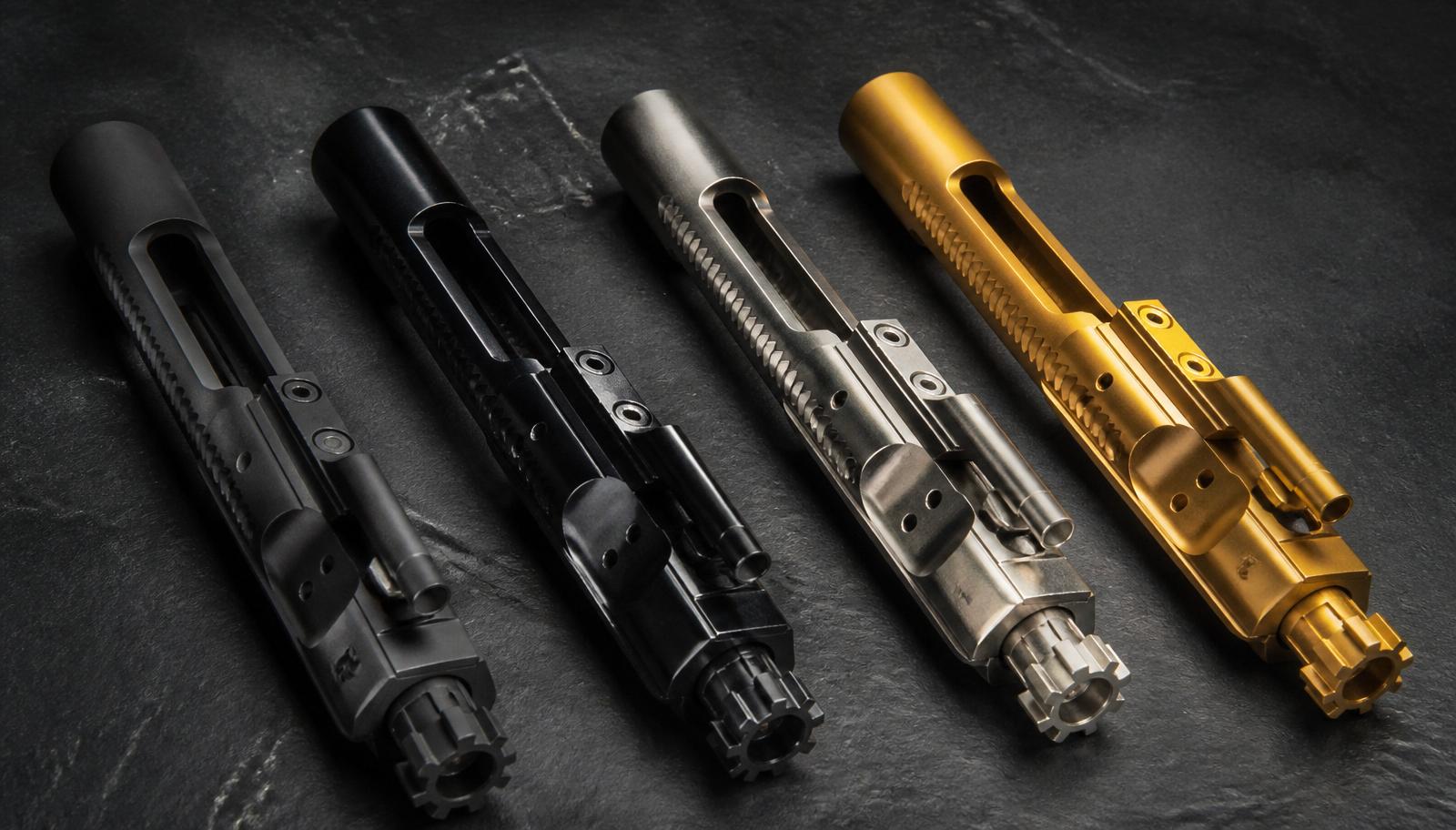
Phosphate, nitride, nickel boron, DLC, TiN, and NP3 all coat AR-15 bolt carriers. Here's how they compare on wear, cleaning, and cost.
BCG coatings are one of the areas where the AR-15 market has genuinely improved over the last decade. Phosphate was the only real option for 40 years, then nitride became mainstream, then nickel boron went from exotic to common, and now DLC and TiN sit at the premium tier. Every coating on the market today works. The question is which set of tradeoffs you're buying.
Why BCG Coatings Matter
Every BCG coating does the same three jobs, just at different levels:
- Hardness: Resists wear from bolt cycling and cam pin travel
- Lubricity: Reduces friction so the bolt cycles smoothly with less lube
- Corrosion resistance: Protects the steel from rust and fouling attack
Beyond the core three, coatings differ on:
- Color and appearance (matters aesthetically, not functionally)
- Cleaning ease (fouling releases more easily from slicker coatings)
- Cost ($30 differences between tiers are typical)
- Long-term durability (some coatings are near-permanent; others wear thin over decades)
Reliability differences between quality coatings are marginal. Maintenance differences are meaningful.
Phosphate (Parkerizing)
Phosphate (specifically manganese phosphate, also called parkerizing) is the mil-spec coating and the original AR-15 finish. Applied by dipping the steel in a phosphoric acid bath, it creates a porous matte-black surface that:
- Holds lubricant well (the porosity is a feature)
- Provides moderate corrosion resistance
- Has 60+ years of combat-proven track record
- Costs the least to apply
Downsides: it's softer than modern coatings (about 40 to 45 HRC on the surface), wears through visibly over time, and requires the most lubrication to run smoothly. Cleaning is straightforward but slower because carbon bonds into the porous surface.
Buy phosphate if you want the mil-spec baseline, want the lowest cost, or specifically prefer the traditional matte look. It works, and it will keep working for the life of your rifle.
Black Nitride (Melonite, QPQ)
Black nitride goes by several names (Melonite, QPQ, ferritic nitrocarburizing, salt bath nitride). All refer to a process that diffuses nitrogen and carbon into the steel surface, creating an integral hardened layer rather than a separate coating layer.
Nitride's advantages over phosphate:
- Much harder (60 to 70 HRC on the surface)
- Slicker (reduces friction meaningfully)
- Better corrosion resistance
- Similar cost (has commoditized)
- Cleans more easily because fouling doesn't bond into a porous surface
Nitride is the modern default for AR-15 BCGs. Toolcraft, BCM, Sons of Liberty, Aero Precision, and virtually every major manufacturer offers nitride as their standard or upgraded option. If you're not sure what to buy, buy nitride.
Nickel Boron (NiB) and NP3
Nickel boron (NiB) is an electroless plating that deposits a nickel-boron alloy on the surface. NP3 is a related nickel-based plating with slightly different properties. Both are silver in color and dramatically slicker than nitride.
NiB and NP3 advantages:
- Very slick surface (reduces friction significantly)
- Fouling wipes off easily rather than needing scrubbing
- Runs cleaner and cooler than nitride
- Excellent corrosion resistance
- Distinctive silver appearance
Tradeoffs:
- Costs $50 to $150 more than nitride
- Can chip if impacted hard (though this rarely happens in normal use)
- Some shooters find the silver appearance too flashy
Buy NiB or NP3 if you shoot suppressed frequently, hate cleaning, or want the maintenance advantage. WMD Guns, JP Enterprises, and Fail Zero are the most common sources.
DLC and TiN: The Premium Options
DLC (Diamond-Like Carbon) is a hard black coating deposited by physical vapor deposition. It's harder than nitride, slicker than NiB, and produces a distinctive deep black or dark grey appearance. DLC BCGs run $300 to $500+ and target the top end of the market. JP Enterprises, LMT, and specialty makers offer DLC options.
TiN (Titanium Nitride) is a gold-colored coating (though variations include gray and rose gold) deposited similarly to DLC. Hardness and slickness are excellent. TiN is popular as a bolt-only coating within a nitride or NiB carrier for that visual gold accent. $200 to $400+ for full TiN BCGs.
Buy DLC or TiN if:
- You want the absolute top-tier coating for longevity and maintenance
- Aesthetics matter to you (both look distinctive)
- You're building a premium upper where the BCG should match
For everyone else, the performance jump from NiB to DLC is smaller than the price jump.
Coating Comparison Table
Which Coating Should You Pick
Buy phosphate if:
- You want mil-spec authenticity
- Budget is the primary constraint
- You don't mind more lube and slower cleaning
Buy black nitride if:
- You want modern performance at a reasonable price
- You don't have a strong preference (this is the safe default)
- You're building a general-purpose duty or range rifle
Buy nickel boron or NP3 if:
- You shoot suppressed regularly
- You genuinely hate cleaning your BCG
- You want measurable friction reduction
Buy DLC or TiN if:
- You're building a premium upper and want a matching BCG
- You want the top-tier coating for longevity
- Aesthetics matter to you
The honest answer for most people: nitride. It's 90% of what premium coatings offer at 40% of the price, and every quality manufacturer produces excellent nitride BCGs.
Browse quality BCGs across all coating types at ar15parts.com.