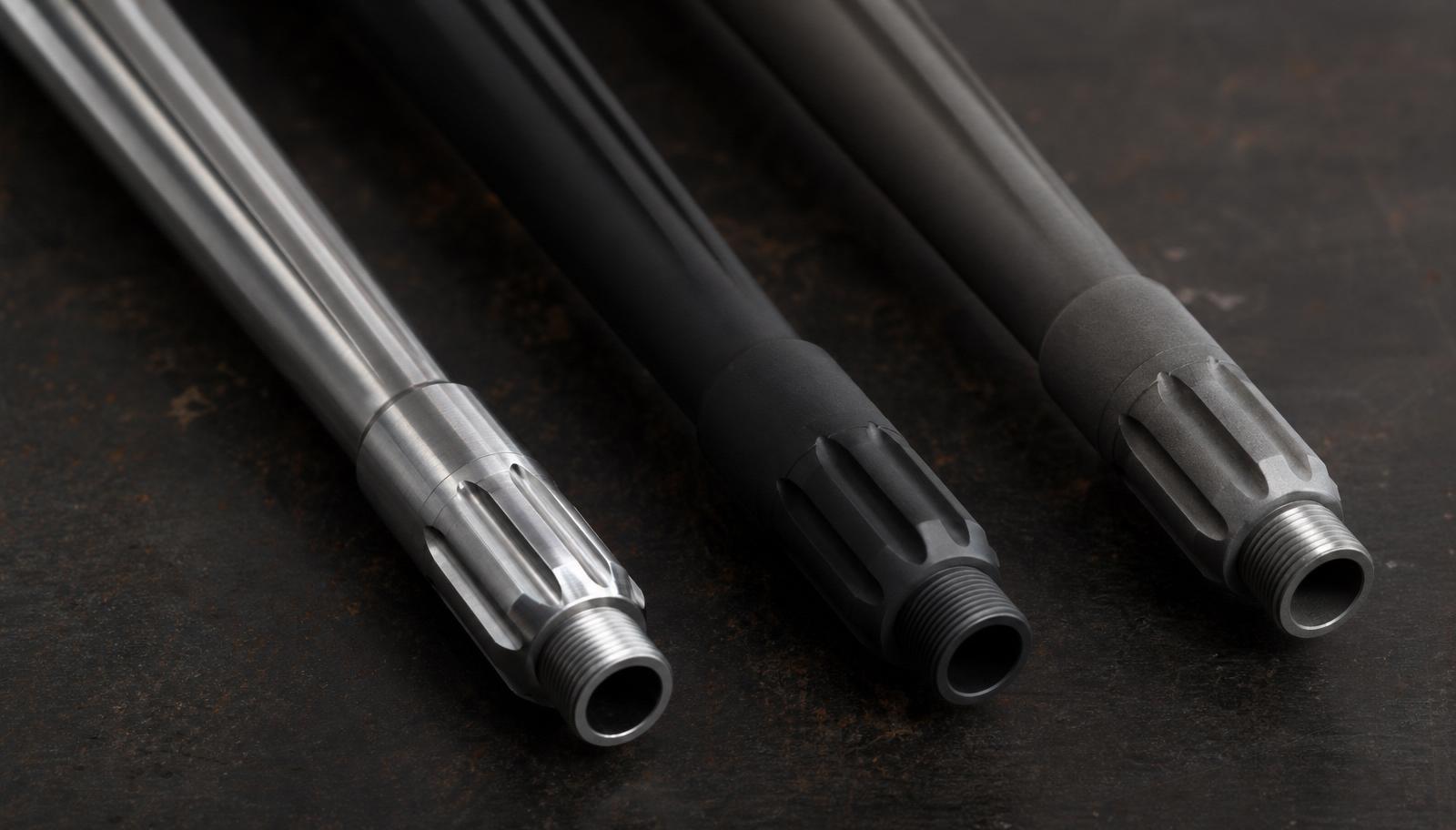
How chrome-lined, nitride, and stainless AR-15 barrels differ on accuracy, barrel life, cost, and maintenance, and which one is right for your build.
"Chrome-lined, nitride, or stainless" is one of the top three barrel decisions on any AR-15 build, and one of the most-debated. Each treatment optimizes for a different priority: chrome-lined for durability under military-grade abuse, stainless for accuracy, and nitride for a modern balance of both at lower cost. This guide covers how each is made, what it actually does, and how to pick.
How the Three Compare
Chrome-Lined: Mil-Spec Standard
Chrome lining is a hard chromium plating applied to the interior of a rifle bore and chamber. The process is decades old and remains the military standard for good reason: chrome-lined barrels handle sustained fire, high round counts, and neglect better than any other treatment.
Why the military uses it:
- Excellent corrosion resistance under field conditions
- Very high heat tolerance (chrome melts around 3,400°F, well above rifle operating temperatures)
- Long service life, easily 20,000+ rounds with quality ammo
- Easy to clean, powder fouling doesn't stick to chrome
Tradeoffs:
- Slight accuracy penalty because chrome plating is applied unevenly at the microscopic level. A chrome-lined barrel typically shoots 1 to 1.5 MOA, which is fine for combat and general use but noticeable versus a match barrel.
- More expensive than nitride for comparable quality.
- The chrome layer can eventually degrade at extreme round counts, though this takes tens of thousands of rounds.
Best for: Duty rifles, home defense guns, hard-use range guns, and any rifle you might neglect. Cold hammer forged (CHF) chrome-lined barrels from brands like BCM, FN, and Daniel Defense are the gold standard for reliability at extended round counts.
Nitride: Modern Civilian Default
Nitride treatment (often called QPQ, Melonite, or Tenifer, all variations of the same process) is a heat-based nitriding process that infuses nitrogen into the surface of the barrel steel, creating a very hard, corrosion-resistant surface layer that's part of the steel itself, not a coating.
Advantages:
- Comparable durability to chrome-lined, easily 15,000 to 20,000 rounds
- Better accuracy than chrome-lined because the treatment doesn't alter bore dimensions unevenly
- Excellent corrosion resistance, comparable to chrome
- Lower cost than chrome-lined for comparable barrel quality
- Cannot chip or flake because it's an integral part of the steel
Tradeoffs:
- Slightly less proven under extreme institutional-scale round counts (chrome has decades of military data behind it)
- Some early nitride processes were inconsistent in quality; modern QPQ from reputable makers is very consistent
- Marginally less accurate than premium stainless match barrels
Best for: The default choice for modern civilian AR-15 builds. Delivers 90% of chrome-lined's durability with better accuracy and lower cost. If you're building a range rifle, a home defense gun on a budget, or a general-purpose AR-15, nitride is the sweet spot.
Stainless: The Accuracy Choice
Stainless steel barrels (typically 416R stainless for match-grade use) receive no bore treatment. The steel itself resists corrosion well enough that a treatment isn't required, and the raw bore surface produces the most consistent bullet-to-bore contact, which is what gives stainless its accuracy advantage.
Advantages:
- Best precision potential of any AR-15 barrel type
- No bore treatment to introduce microscopic inconsistencies
- 416R stainless is easy to machine to tight tolerances, which is why match barrel makers prefer it
- Attractive polished finish (though most builders parkerize or Cerakote the outside for corrosion resistance)
Tradeoffs:
- Shorter service life than chrome or nitride, typically 5,000 to 10,000 rounds before accuracy degrades noticeably
- Wears faster under sustained rapid fire because there's no protective layer
- Not immune to corrosion, requires more attentive cleaning and oiling
- Usually more expensive than nitride at comparable quality tiers
Best for: Precision rifles, match and competition guns, and any build where sub-MOA accuracy is a real priority. Not the right choice for a duty rifle or a high-volume training gun.
Which Barrel Should You Actually Buy?
The clean decision framework:
- General-purpose 5.56 rifle, first build, range gun: Nitride. Best price-to-performance, no meaningful downsides for civilian use.
- Home defense or duty-analog rifle: Chrome-lined if you can afford the premium (CHF chrome-lined from BCM, FN, or Daniel Defense). Nitride is an excellent second choice.
- Precision or match rifle where sub-MOA matters: Stainless match barrel. Accept the shorter service life for the accuracy gain.
- Hunting rifle with limited round counts: Either nitride or stainless. Nitride costs less; stainless shoots slightly better.
- Suppressor host or high-volume training: Chrome-lined or nitride. Both handle the heat better than untreated stainless.
The old debate of "chrome-lined vs stainless" was more meaningful when nitride wasn't a mature option. Today, nitride gives most civilian shooters the best of both worlds: durability that approaches chrome-lined with accuracy that approaches stainless, at a price point that beats either.
Browse barrels and complete uppers by treatment at ar15parts.com.