Cold hammer forged and button rifled AR-15 barrels are made differently and last differently. Here's how they compare on accuracy, longevity, and cost.
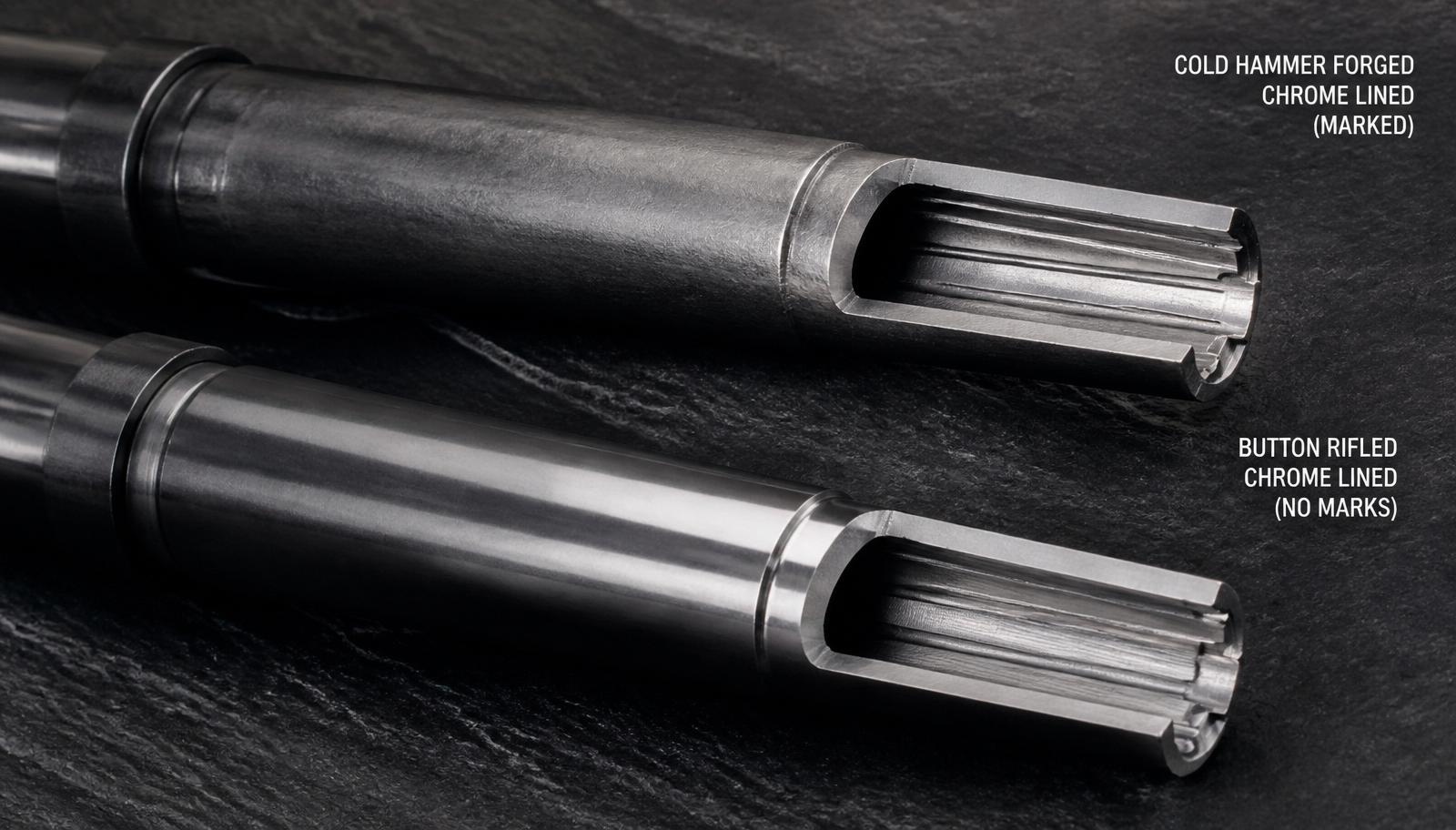
Cold hammer forged (CHF) and button rifled are the two dominant methods for making AR-15 barrels. Both produce excellent barrels, but they're optimized for different things: CHF for durability and longevity, button rifling for accuracy potential. Understanding the difference helps you pick a barrel that matches how you actually shoot.
How Each Process Works
Cold hammer forging starts with a rough barrel blank and a hardened mandrel machined with the reverse image of the rifling. The blank is placed over the mandrel and hammered by four rotating hammers that compress the steel around the mandrel. In a single pass, this operation forms:
- The rifling grooves and lands
- The chamber (sometimes)
- The exterior barrel contour
The hammering process work-hardens the steel, creating a denser and more durable structure than the original blank. Chrome lining is typically applied as a separate step after forging.
Button rifling starts with a smooth-bore blank that has been drilled and reamed to precise dimensions. A hardened tungsten carbide button, shaped with the negative of the rifling, is pulled or pushed through the bore under high pressure. The button displaces steel to create the rifling grooves without cutting away material.
Button rifling is faster and less capital-intensive than CHF, which is why match barrel makers (Bartlein, Krieger, Proof Research on their standard barrels, most stainless match makers) predominantly use it. It also produces very smooth, consistent bores that pair well with stainless steel for accuracy.
The Practical Differences
Both methods can produce excellent barrels. The difference is what you optimize for.
Accuracy: Button Rifled Usually Wins
Button rifling produces smoother bore surfaces and tighter dimensional consistency, which translates directly into accuracy potential. Combined with stainless steel (which resists throat erosion better than chrome-moly) and a match chamber like .223 Wylde, button-rifled barrels routinely deliver:
- 0.5 to 0.75 MOA with match ammo
- Consistent groups across long strings
- Predictable point-of-impact shift as the barrel warms
Cold hammer forged barrels have closed the gap significantly in the last 15 years. Modern CHF from FN, DD, BCM, Faxon, and IWI can deliver 1 MOA with match ammo when the barrel is unlined or lightly lined. Chrome-lined CHF barrels typically sit at 1 to 1.5 MOA, which is more than adequate for duty and defense use but not competitive with dedicated match barrels.
If you need sub-MOA groups, buy button-rifled stainless. If 1 to 1.5 MOA is fine and you want the barrel to still shoot that way at 20,000 rounds, buy CHF.
Longevity: CHF Wins
The work-hardening from the hammer forging process is the reason CHF barrels last so long. The steel is denser, more uniform, and more resistant to throat erosion than button-rifled barrels of the same alloy. Add chrome lining (which is standard on duty CHF barrels), and the throat erosion resistance goes up dramatically.
Documented CHF barrel life:
- FN CHF chrome-lined M4 barrels: 20,000 to 25,000 rounds before accuracy degrades to unacceptable levels
- Daniel Defense CHF chrome-lined: similar or slightly better
- BCM CHF chrome-lined: similar
- Military M4 CHF barrels: documented past 40,000 rounds in some cases
Match button-rifled stainless barrels typically show accuracy loss at 5,000 to 10,000 rounds because the throat erodes faster in stainless and match tolerances are tighter (so degradation is more visible sooner). This is a feature, not a bug: match barrels aren't designed for 25,000 round lives.
What About Cut Rifling?
Cut rifling is a third method where a single cutter is drawn through the bore, cutting a fractional depth of one groove at a time. The barrel is indexed, and the process repeats until all grooves reach full depth. It's the slowest and most expensive method.
Cut rifling advantages:
- Zero stress on the barrel (no displaced or hammered steel)
- Extremely consistent dimensional accuracy
- Best-in-class potential accuracy
Bartlein, Krieger, and Rock Creek are the notable cut rifling makers. Cut rifled barrels are the gold standard for precision applications but priced accordingly ($500 to $1,000+). For AR-15 uppers, they show up on custom precision builds and top-tier match uppers.
For 99% of AR-15 buyers, cut rifling is more barrel than you need. Button rifled or CHF are the practical choices.
Which Should You Buy
Buy cold hammer forged (typically chrome lined) if:
- You're building a duty, defense, or general-purpose rifle
- You want a barrel that shoots the same at 20,000 rounds as at 2,000
- You'll shoot high round counts in training
- 1 to 1.5 MOA accuracy is enough for your use
Buy button rifled (typically stainless with .223 Wylde) if:
- Accuracy is the primary goal
- You want sub-MOA groups with match ammo
- You're building a DMR, precision, or competition upper
- You accept a shorter service life for accuracy potential
Buy cut rifled if:
- You're building a top-tier match or long-range precision upper
- Money isn't the primary constraint
- You want the absolute best barrel available
For most AR-15 buyers, CHF and button rifled cover 95% of use cases. Pick based on whether you value longevity or accuracy more.
Browse complete uppers and standalone barrels in both CHF and button-rifled configurations at ar15parts.com.