The bolt carrier group is the heart of your AR-15, and picking the wrong one can mean reliability problems, excessive fouling, or a part that wears out faster than it should. If you shoot outdoors in North Texas, where summer humidity bakes carbon onto every surface inside your upper, that choice matters even more.
Here you'll find AR-15 BCG types, coatings, and how to choose the right one for your build, whether you're running a standard mil-spec setup or something purpose-built. We handle BCGs every day at our shop in Denison, TX, and everything here comes from years of building, installing, and testing carriers across dozens of manufacturers, not from a spec sheet. Have a BCG question or need help speccing out your next build? Reach out to our team.
Pull a bolt carrier group off the bench and you're holding the mechanical heart of your AR-15. It chambers the round, fires it, extracts and ejects the spent case, and cocks the hammer for the next shot, all in a fraction of a second, every time you pull the trigger. If you want a full breakdown of how that cycle works from the ground up, read What Is a Bolt Carrier Group and Why Does It Matter for Your AR Build? first. This guide picks up where that one leaves off.
We'll walk through every variable that actually matters: BCG profiles including full-auto, semi-auto, and low-mass carriers; steel grades from Carpenter 158 to 9310 to 8620; and every major coating from phosphate to nickel boron to DLC. We'll also cover certification testing, how to match your BCG to your caliber, and how to keep it running in the kind of heat and humidity you get around Grayson County every summer.
Pick the wrong BCG for your build and you're not just wasting money. You're trading reliability.
What Are the Different BCG Profiles and Which One Fits Your Build?
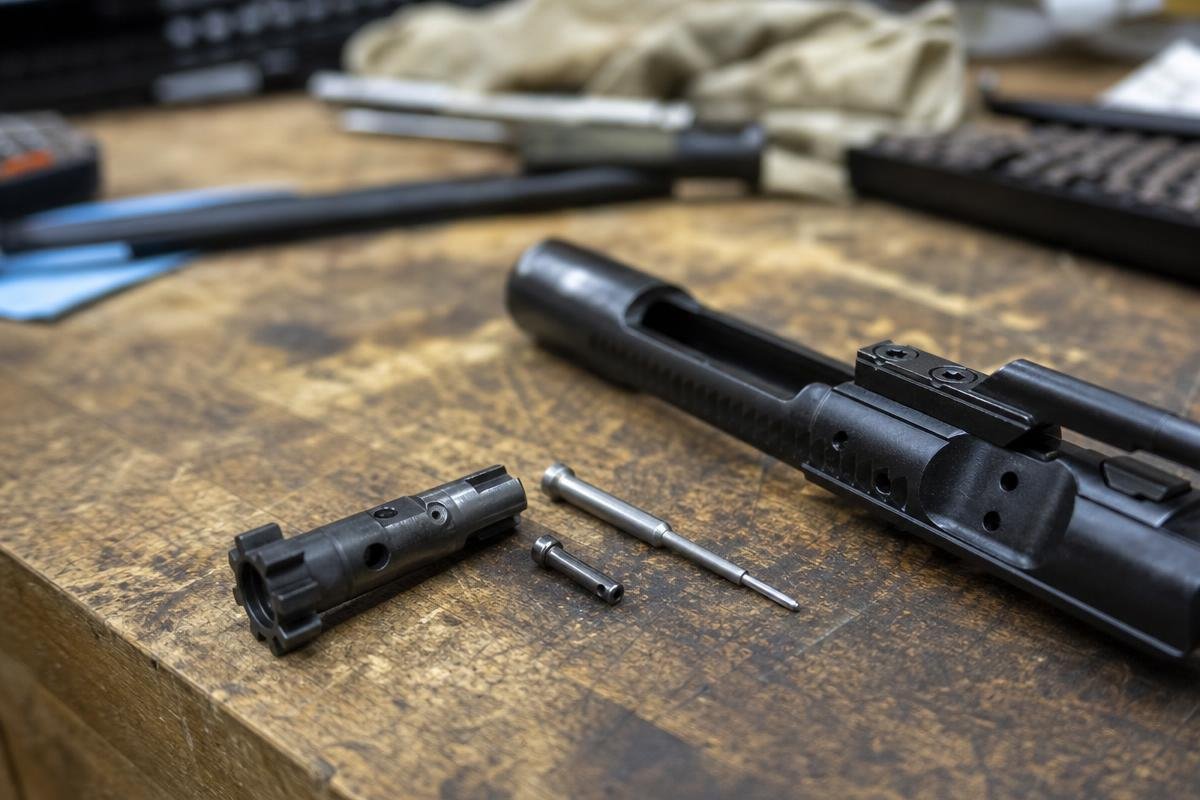
There are three AR-15 bolt carrier group types you need to know: full-auto (M16), semi-auto, and low-mass. Each has a different weight, a different tolerance for adverse conditions, and a different ideal use case. Pick the wrong one for your build and you will chase reliability problems that have nothing to do with your ammo or gas system.
Full-Auto (M16) BCG: The Preferred Choice for Most Builds
The M16 carrier has a solid rear section that retains the auto sear trip shelf. That extra material adds mass, putting a standard steel M16 carrier at roughly 11.5 to 12 oz. It is 100% legal in any semi-auto AR-15. The added weight slows the carrier's rearward velocity slightly, which gives the action more time to extract and eject before pressure drops too low. That matters on suppressed builds, mid-length gas systems, and short-barreled rifles where dwell time is already reduced.
For outdoor shooters in Grayson County dealing with red clay dust and post oak savanna particulate, the M16 carrier's extra mass keeps cycling consistent even when the BCG is running dirtier than ideal. This is the profile we recommend for duty rifles, home defense builds, and general-purpose AR-15s.
Semi-Auto (AR-15) BCG: Lighter but More Demanding
The semi-auto carrier has the auto sear shelf milled away. That removes roughly 1 to 1.5 oz of reciprocating mass. Where the M16 carrier forgives a slightly under-gassed system, the semi-auto carrier exposes it. If your gas system length and port size are dialed in, the semi-auto carrier runs fine. If they are not, you will see short-stroking, especially with a suppressor attached or in cold weather.
Low-Mass and Skeletonized BCGs: Competition Tool, Not a Defensive Rifle Part
JP Enterprises-style low-mass carriers cut reciprocating weight aggressively to reduce felt recoil and tighten split times on a competition stage. They work well with consistent factory ammo and a tuned adjustable gas block. Put one in a home defense rifle or a 300 Blackout suppressed upper and you are asking for feeding failures when conditions get dirty or ammo lots vary. Save the low-mass carrier for the competition gun. Run the M16 carrier everywhere else.
BCG Steel Grades: Carpenter 158 vs. 9310 vs. 8620
Not all bolt steel is the same. The bolt face takes a direct hit every single cycle, and the alloy behind it determines how long it holds up under that repeated stress. Here is what the spec sheets actually mean.
Carpenter 158: The Mil-Spec Bolt Steel Standard
Carpenter 158 is the bolt steel specified under MIL-B-11595E. It is a chrome-moly-vanadium alloy selected specifically for fatigue resistance under cyclic loading. Every time your rifle fires, the bolt flexes. Carpenter 158 is engineered to handle that flex over tens of thousands of cycles without cracking.
One critical point: a Carpenter 158 bolt must be tested to the mil-spec standard to actually earn the label. If a manufacturer lists Carpenter 158 without listing that testing, that is a red flag. The steel grade alone does not make it mil-spec. The testing does. The Magnetic Particle Inspection and High Pressure Testing section below covers exactly what those stamps verify.
9310 Steel: A Legitimate High-Tensile Alternative
9310 is a nickel-chromium-molybdenum alloy. Its tensile strength runs roughly 180,000 psi compared to around 150,000 psi for Carpenter 158. That is a real difference, and it makes 9310 a legitimate choice for high round count builds, including 5.56 NATO complete uppers that see sustained range use.
A certified bolt beats an uncertified one every time, regardless of alloy. Certification matters more than the steel grade. If you are putting high round counts through a rifle at a Grayson County outdoor range in July heat, buy the certified bolt whether it is Carpenter 158 or 9310.
8620 Steel: The Right Material for the Carrier Body
8620 steel is used for the carrier body, not the bolt. The carrier does not experience the same cyclic stress at the bolt face, so 8620 is the correct material for that part. Seeing 8620 on a spec sheet is not a downgrade. It is the right call for that component. A carrier built from 8620 paired with a certified Carpenter 158 or 9310 bolt is a properly spec'd assembly.
AR-15 BCG Coatings Compared: Phosphate, Nickel Boron, DLC, and More
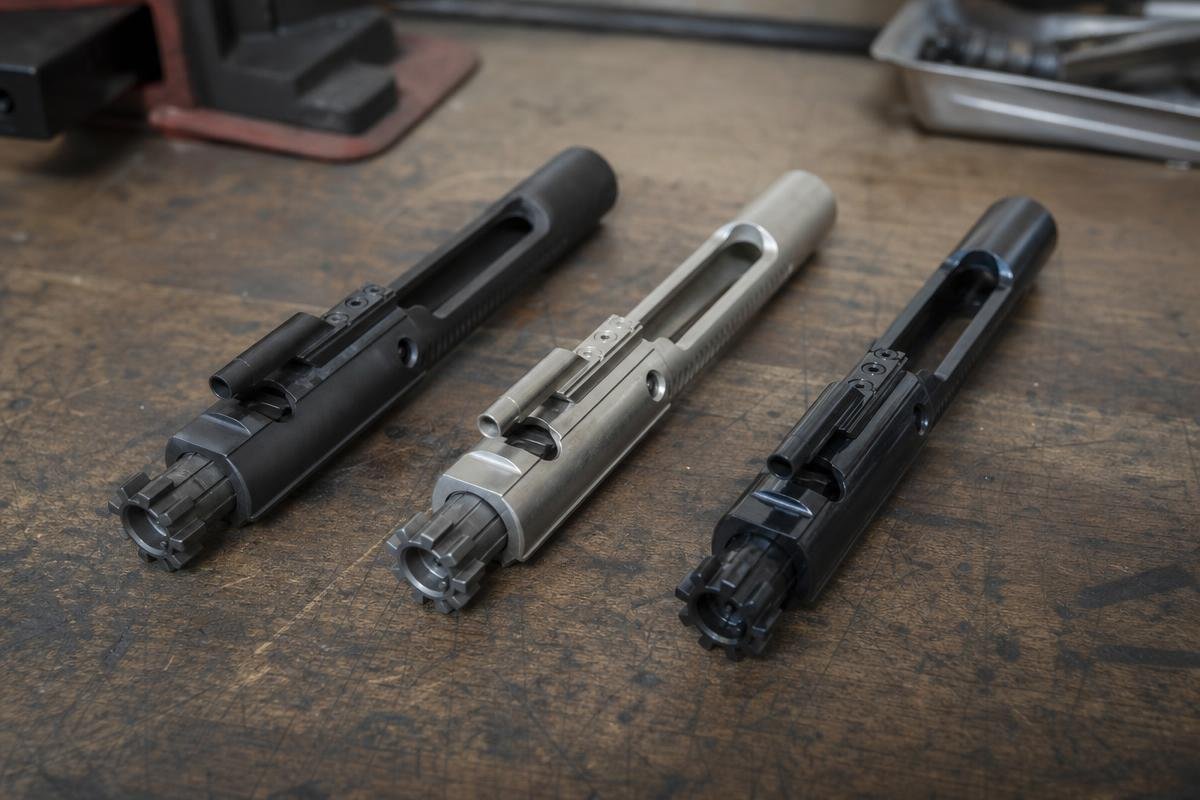
The coating on your BCG affects friction, corrosion resistance, cleaning time, and how fast carbon bakes on in heat and humidity. Here is what each finish actually does, with real numbers, not marketing copy.
Phosphate (Parkerizing): The Mil-Spec Baseline
Manganese phosphate is the mil-spec standard. It gives you a matte gray-black surface with a porous texture that holds oil well. Surface hardness runs roughly 40 to 50 HRC. It works. Generations of service rifles have proven that. The trade-off is that phosphate requires consistent lubrication. Let it run dry and friction climbs fast.
Here in North Texas, that matters more than it does in drier climates. Lake Texoma pushes July and August humidity to 70 to 80 percent relative humidity in Grayson County. Combined with summer heat, carbon bakes onto a phosphate BCG faster than it would in, say, West Texas. If you are shooting outdoors at local ranges in peak summer, you will be cleaning more often. Phosphate is still correct for a well-maintained rifle. It just demands the maintenance.
Nickel Boron (NiB): Low Friction and Easy to Clean
Nickel boron is electroless-deposited and bonds at the molecular level. Surface hardness reaches approximately 70 HRC. The coefficient of friction drops to roughly 0.08 compared to phosphate's 0.2. Carbon does not bond aggressively to the NiB surface, so wipe-down cleaning is genuinely faster. We see this play out firsthand in the Denison summer: a NiB carrier that spends August at a lakeside range wipes clean in a fraction of the time a phosphate carrier takes after the same round count.
Can you run NiB dry? Technically yes, for a limited round count. We still recommend light lubrication. Quality varies significantly between manufacturers. Thickness and adhesion matter. A thin NiB application from a budget source will not perform like a properly applied one. This is the most practical coating upgrade for shooters running 5.56 NATO complete uppers in high-humidity conditions.
DLC and Nitride (Melonite/QPQ): The Premium Tier
Nitride (salt bath ferritic nitrocarburizing, sold as Melonite or QPQ) diffuses into the steel rather than sitting on top. It cannot flake or peel. Hardness runs 60 to 65 HRC. Corrosion resistance is excellent, which is a real advantage during humid North Texas summers where a stored rifle can develop surface rust on lesser finishes. The appearance is matte black, similar to phosphate, but lubricity is significantly better.
DLC (Diamond-Like Carbon) is PVD-applied and reaches up to 90 HRC surface hardness. Friction is the lowest of any BCG coating available. It is the right choice for competition builds and precision rifles where every variable matters. Is DLC worth the cost over nitride? For a duty or hunting rifle, nitride gives you 90 percent of the performance at a lower price.
For a competition or precision build, DLC earns its premium. The nickel boron versus phosphate decision is easy; the nitride versus DLC call depends on your use case.
Chrome-Lined, Titanium Nitride, and Cerakote: What They Actually Do
Chrome lining adds corrosion resistance and reduces wear on the bore and chamber. On a BCG specifically, it helps in wet environments. Titanium nitride (TiN) gives you that gold appearance and reaches roughly 80 HRC, but at the BCG level it is primarily cosmetic. The gold finish looks sharp on a 300 Blackout upper build, but it does not change how the carrier functions.
Cerakote adds corrosion resistance and color options. It does not change the base metal's hardness. Do not mistake it for a performance upgrade. It is a surface protectant and a cosmetic option. Nothing more.
Building a suppressed 300 Blackout for the deer woods around Denison? We stock BCGs matched for that setup and can pair one to your upper before it ships.
MPI, HPT, and Other Quality Certifications: What the Stamps Actually Mean
A BCG can be stamped "mil-spec" and still be a liability if the manufacturer skipped the testing that makes mil-spec mean something. Two certifications matter above everything else: Magnetic Particle Inspection (MPI) and High Pressure Testing (HPT). If a spec sheet doesn't list both, walk away.
MPI: Magnetic Particle Inspection and Why It Is Non-Negotiable
MPI magnetizes the bolt and floods it with ferromagnetic particles. Those particles migrate to any crack, including subsurface cracks you cannot see with your eyes or a loupe. A bolt with a hidden stress fracture will eventually fail under fire. It is not a matter of if. MPI is the only way to catch it before that happens.
Any AR-15 bolt carrier group marketed as mil-spec without MPI certification is not mil-spec by definition. That is a safety issue, not a preference. The stamp matters.
HPT: High Pressure Testing and the Sequence That Matters
HPT fires a proof load that generates over 70,000 PSI of chamber pressure. Standard 5.56 NATO runs 55,000 to 58,000 PSI. HPT deliberately stresses the bolt beyond normal operating pressure to expose any weakness in the steel. The sequence is critical: HPT runs first, then MPI. Any cracks induced by the proof load get caught in the inspection step. Reverse the order and you miss them. Both tests must be performed, in that order, on every bolt. Not batch-tested. Not sampled. Every bolt.
Reading a BCG Spec Sheet: The Six-Point Checklist
Buying a BCG online means you cannot handle the part before it ships. Grayson County shooters ordering for builds chambered in 5.56 NATO or 300 Blackout need a concrete way to evaluate what they're actually getting. Run this checklist against every spec sheet:
- Bolt steel grade: Carpenter 158 or 9310 only
- MPI certified: listed explicitly, not implied
- HPT certified: listed explicitly, performed before MPI
- Carrier steel: 8620 or equivalent
- Gas key staking: must say "staked to mil-spec"
- Coating type: phosphate, nitride, nickel boron, or DLC
Gas key staking is the one most buyers miss. The gas key screws back out under repeated fire if it is not staked. A loose gas key causes the rifle to short-cycle. The fix is cheap at the factory and expensive after the fact. If the listing doesn't say "staked to mil-spec," assume it isn't.
Have questions about BCG certifications or need help confirming a spec sheet before you buy? Call us at (888) 706-0633 and we'll give you a straight answer.
How to Match Your BCG to Your Caliber and Build Purpose
Picking the right BCG is not just about coatings and steel grades. The bolt face, carrier profile, and operating system all have to match your caliber and how you plan to run the rifle. Get this wrong and you are looking at failures to feed, headspace problems, or a BCG that physically will not fit your upper.
Standard 5.56 and .223 Wylde Builds: The Correct Baseline
For a standard 5.56 NATO upper or a .223 Wylde upper, the correct baseline is a full-auto M16-profile carrier with a Carpenter 158 bolt in phosphate or nitride finish. That combination is proven, mil-spec, and cost-effective for most shooters. If you shoot high volume at the range, step up to nickel boron or DLC for easier cleaning and reduced friction.
The full-auto versus semi-auto question matters here: the M16 carrier's extra mass improves reliability across gas system lengths, even in a semi-auto-only rifle.
Large-Frame, AR-10, and Pistol-Caliber Carbine Considerations
A standard AR-15 BCG will not fit a .308 or 7.62x51 build. AR-10-pattern rifles use a larger, heavier BCG that is not interchangeable with an AR-15 BCG. This is one of the most common and expensive mistakes we see. Order the wrong one and nothing cycles correctly.
Pistol-caliber carbines chambered in 9mm or .45 ACP use dedicated blowback BCGs. The operating design is completely different from a gas-operated AR-15 BCG. They are not cross-compatible.
Big-bore calibers like 450 Bushmaster and 458 SOCOM use a standard AR-15 bolt face, but headspace requirements vary by upper manufacturer. Always confirm compatibility before you order.
Suppressed and Short-Barreled Builds: Where BCG Choice Really Matters
Suppressors generate significantly more backpressure. That increases bolt carrier velocity, raises the risk of carrier tilt, and accelerates wear on your BCG and buffer system. The M16-profile carrier's added mass helps absorb that extra energy. An adjustable gas block is strongly recommended on any suppressed build.
300 Blackout is the most popular suppressed caliber in this area, especially among hunters working the post oak terrain south and west of Denison. Our 300 Blackout uppers are built with suppressor use in mind. Under the higher heat and carbon load a suppressor produces, NiB and DLC both outperform phosphate. Either finish cleans faster and holds up longer in that environment.
BCG Maintenance: How to Clean and Inspect Your Bolt Carrier Group
A dirty BCG is the fastest path to malfunctions. Carbon bakes onto the bolt tail and inside the carrier every time you shoot, and if you run your rifle at outdoor ranges near Lake Texoma during July or August, the 70 to 80 percent humidity in that area accelerates that bake-on significantly. Clean more often than you think you need to.
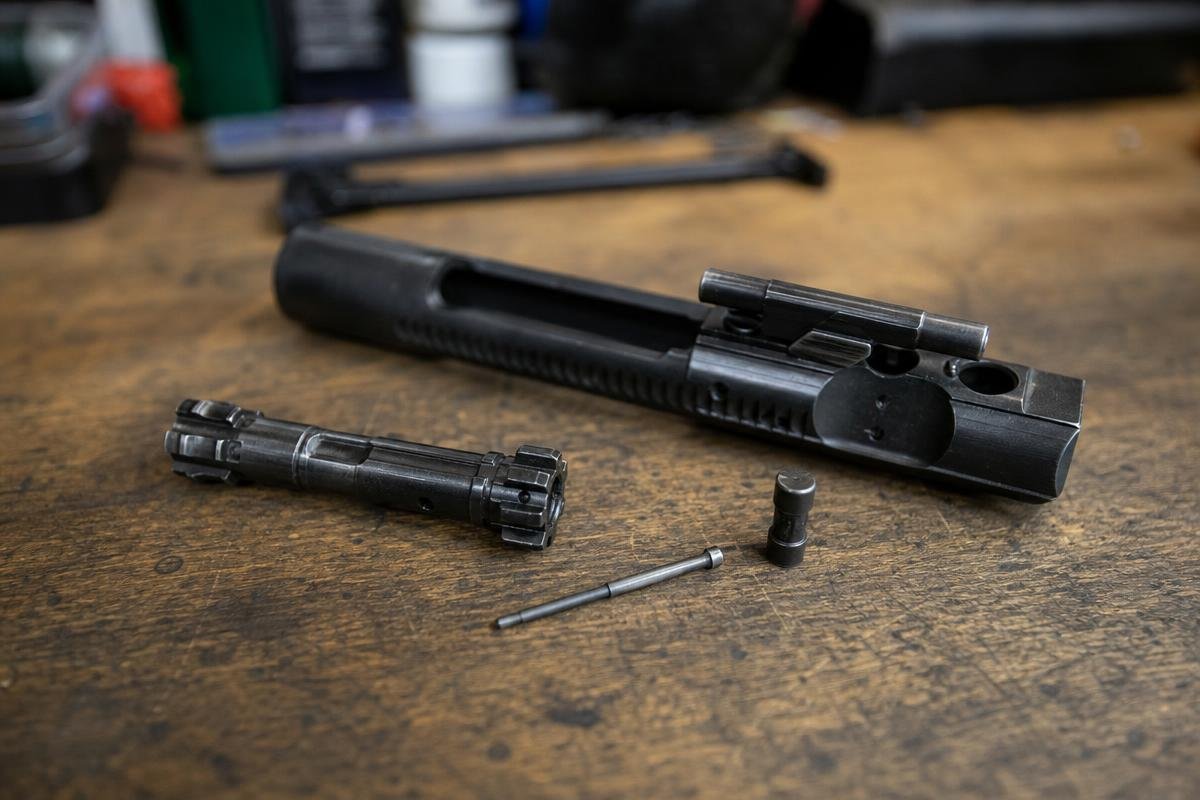
Field Strip and Disassembly: Step by Step
- Remove the BCG from the upper receiver and set the upper aside.
- Pull the bolt fully forward out of the carrier.
- Note the cam pin orientation before you touch it. Rotate it 90 degrees and lift it straight out.
- Push the firing pin rearward and out. On some designs, remove the firing pin retaining pin first.
That's it. Four steps. Don't force anything. If the bolt won't pull forward cleanly, carbon buildup on the bolt tail is usually the cause.
What to Inspect at Every Cleaning
- Carbon buildup on the bolt tail, gas key, and inside the carrier body.
- Gas rings: stagger the gaps so they are not all aligned. Three rings with gaps lined up will bleed gas and cause cycling failures.
- Extractor spring and insert for cracking or deformation.
- Ejector for proper spring tension. Press it in. It should push back firmly.
- Bolt face for erosion or pitting around the firing pin hole.
- Gas key screws for tightness. Loose screws mean lost gas pressure.
Gas ring gap alignment is the most commonly missed inspection point. Check it every single time.
Lubrication: The AR-15 BCG Runs Wet
The AR-15 is not a dry-run platform. Apply oil to the bolt body at the gas rings, the cam pin hole, the inside carrier rails, and the charging handle contact area. More lubrication is better than less in most conditions.
NiB and DLC coatings need less lube than phosphate. Less does not mean none. A dry BCG will malfunction regardless of what coating is on it.
AR-15 Builds in Denison and North Texas: Local Conditions That Affect Your BCG Choice
If you shoot outdoors around Denison or anywhere near Lake Texoma, humidity is a real factor. Summer relative humidity in this area regularly hits 70 to 80 percent through July and August. That moisture, combined with Texas heat, bakes carbon onto a phosphate BCG faster than you'd see in drier climates. A nickel boron or DLC coating is not just a nice upgrade here. For a rifle that sits in a truck or sees regular field use near the lake, it's a practical call.
The post oak savanna terrain around Denison also kicks up fine red clay particulate. That dust works into every gap in your rifle. A properly lubricated full-auto profile BCG with a slick coating sheds that contamination far better than a dry or under-lubricated carrier. This applies whether you're running 300 Blackout uppers in the timber or a standard 5.56 NATO complete upper at an outdoor range. Keep it wet, keep it clean, and pick a coating that makes cleaning easy.
We're based at 2022 S Crockett St, Sherman, TX 75090, a short drive from Denison. If you have questions about matching a BCG to your specific build and how you shoot locally, call us at (888) 706-0633. We're happy to talk it through.
Ready to put the right BCG in your build? Browse our full selection of complete uppers and rifle components at AR15Parts.com. Call us at (888) 706-0633 or stop by 2022 S Crockett St, Sherman, TX 75090. We are a short drive from Denison and serve shooters across the area. We will give you a straight answer, not a sales pitch.