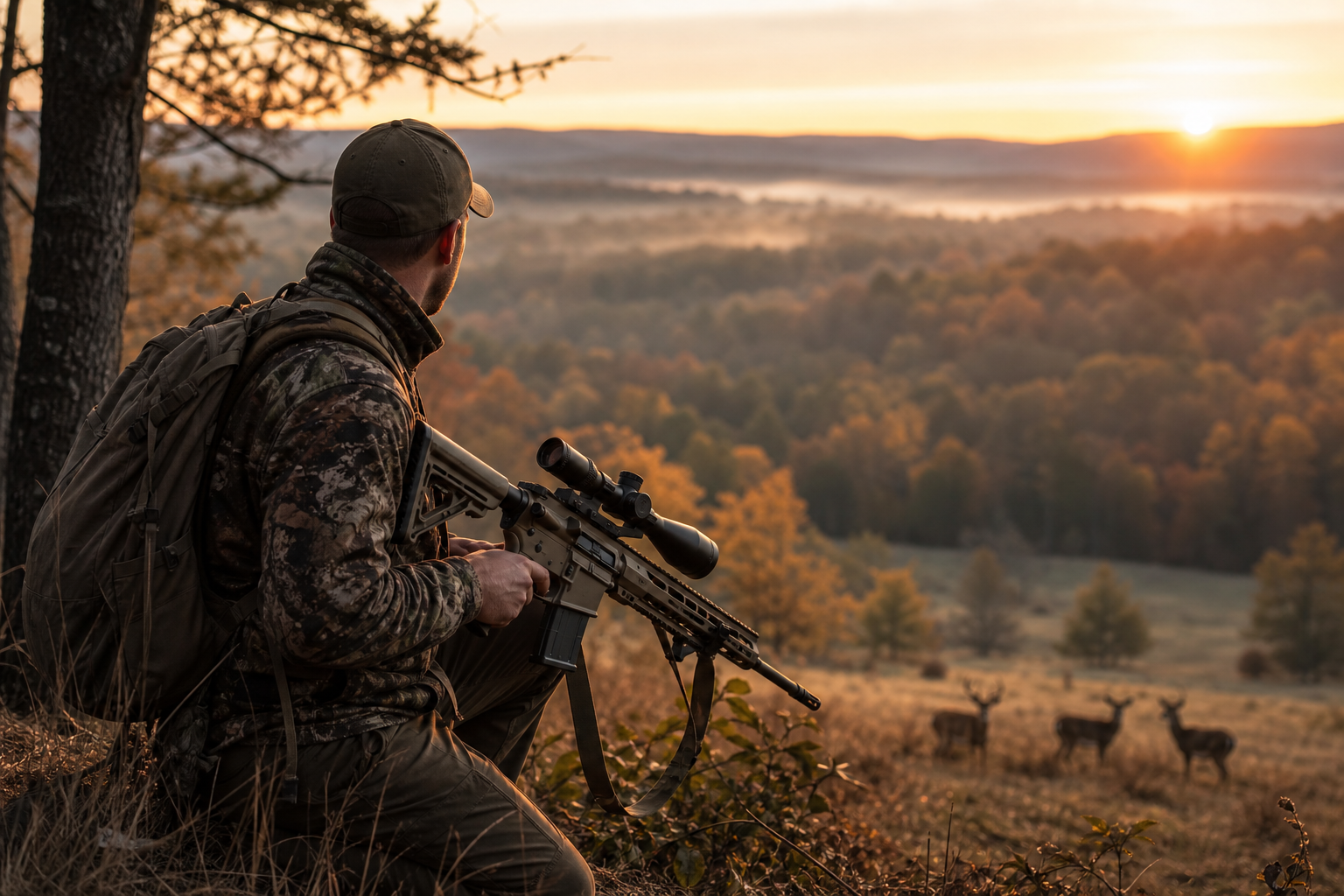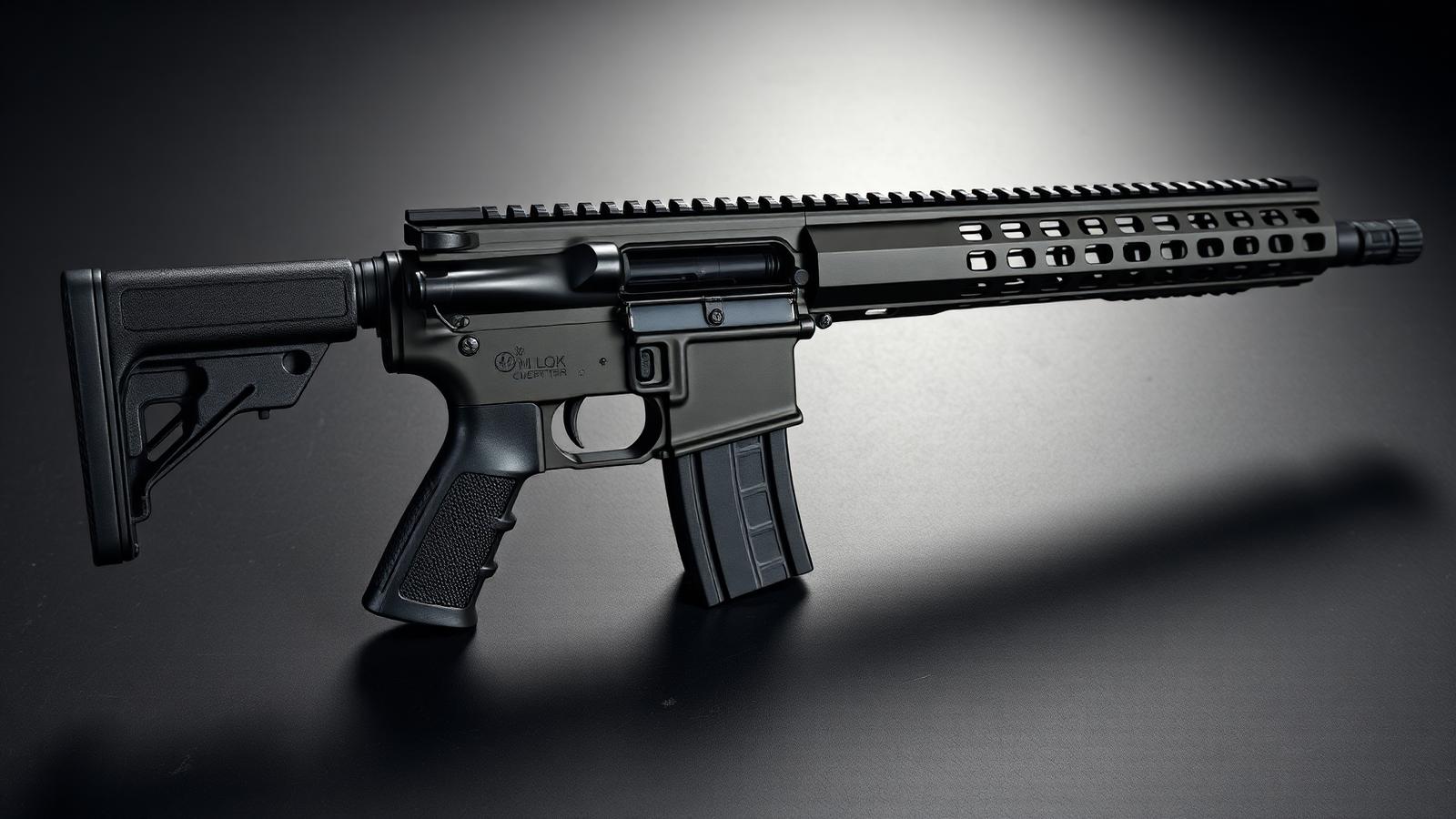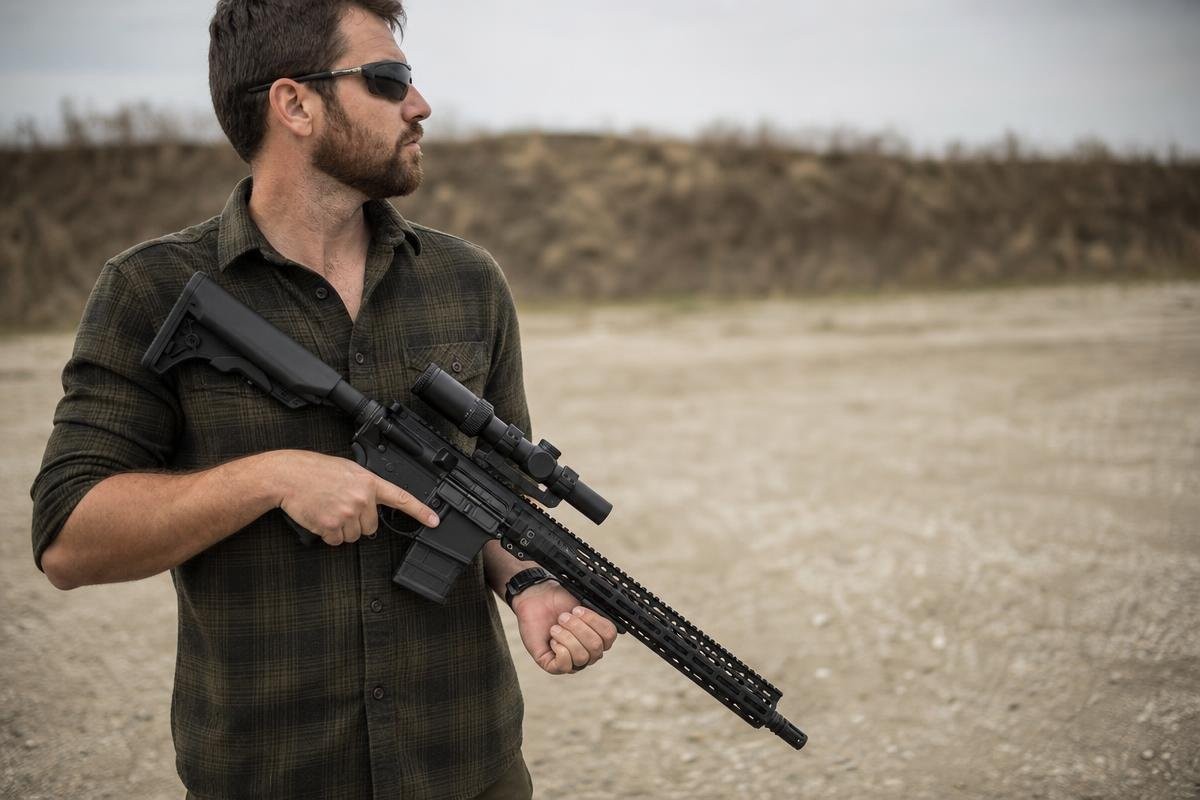
If you shoot in mixed terrain around Grayson County, a fixed-power optic leaves you compromised at one end of the range or the other. A low power variable optic fixes that. This AR-15 LPVO guide covers the best low power variable options across every price tier, from budget-friendly 1-6x scopes to premium 1-10x glass, so you can pick the right optic for your build and your shooting distances.
We build and ship complete uppers to order from our Sherman, TX shop and can answer questions about any optic or upper we carry. Have questions about mounting an LPVO on your AR build? We can help you spec it out.
Red dot or magnified scope. For years, AR-15 owners treated that as an either/or decision. It isn't. A low power variable optic covers both ends of the problem on a single platform, from a wooded creek bottom at 40 yards to open pasture pushing 400. That's exactly the terrain Grayson County shooters deal with around Denison and Lake Texoma, and it's why the LPVO has replaced both red dots and fixed-power scopes for so many AR owners.
This guide is written from a builder's perspective. We're not reviewing optics in a vacuum. We're talking about how magnified glass pairs with your upper, your caliber, and your intended role. Whether you're running a 5.56 NATO complete upper for general use or something heavier from our complete AR-15 uppers in 19+ calibers, the right optic choice changes depending on what's underneath it.
We'll cover magnification ranges, first versus second focal plane, reticle types, mount height, and how to match the optic to the role. No filler. Just the information you need to make a smart decision before you spend the money.
What Is an LPVO and Why Does It Belong on an AR-15?
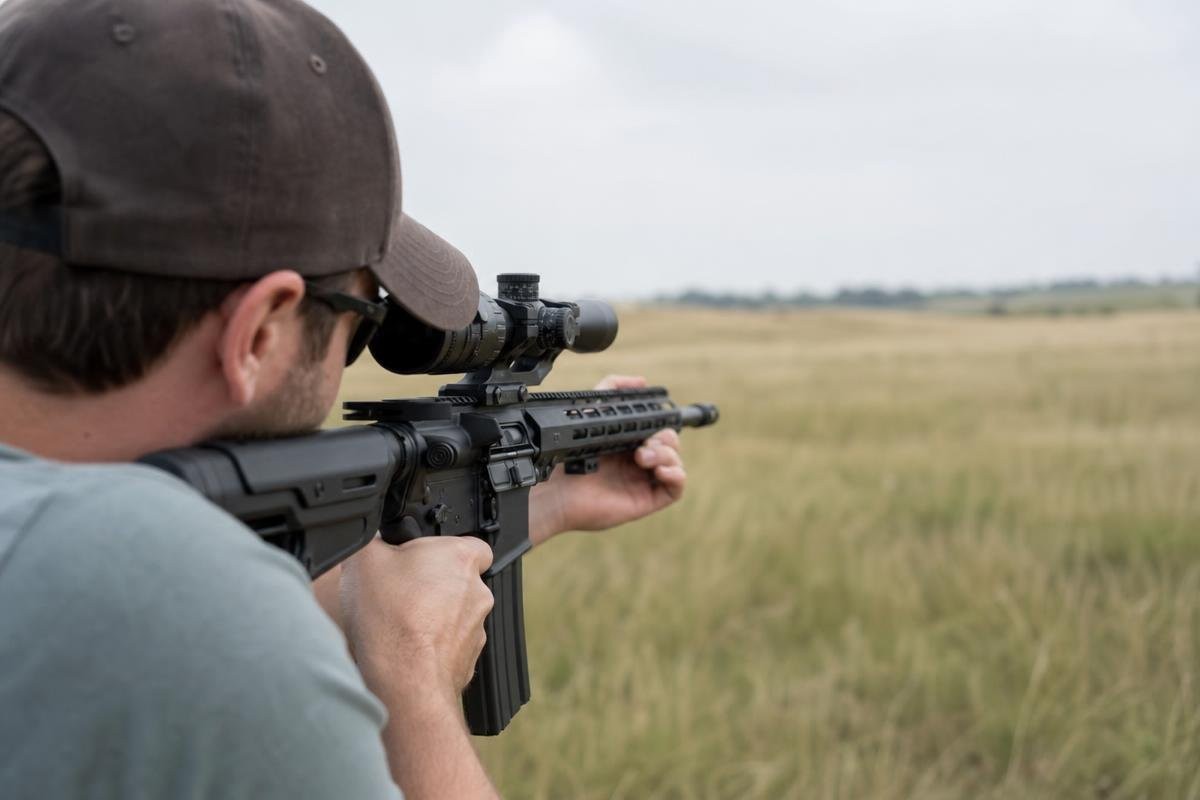
A low power variable optic is a riflescope with a lower magnification bound at or near 1x and an upper bound typically between 4x and 10x. That range is the whole point. One optic covers close brush work and reaches out past 300 yards without a swap. For a shooter moving from brushy draws to open pasture in the same afternoon, that flexibility is not a luxury. It is the practical answer to mixed-terrain shooting around Denison and the Lake Texoma corridor.
Pairing quality glass with one of our complete AR-15 uppers changes your effective engagement envelope dramatically. A 5.56 or 300 Blackout build goes from a one-distance tool to a genuine do-everything rifle.
How LPVOs Differ from Red Dots and Fixed-Power Scopes
A red dot gives you the fastest target acquisition available. Zero magnification, both eyes open, point and shoot. But a red dot does nothing past 200 yards on a small target. A fixed-power scope is the opposite problem. It is excellent at one distance and slow or useless at every other. An LPVO sits between both. Dialed to 1x it runs like a red dot. Turned up to 6x or 8x it reaches out like a dedicated precision optic.
True 1x vs. Approximate 1x: Why This Detail Matters
True 1x means zero parallax distortion and both-eyes-open shooting that feels identical to a red dot. Approximate 1x produces a fish-eye effect at the edges and slows your target acquisition noticeably. Budget scopes frequently advertise 1x but deliver something close to 1.1x or 1.2x. That gap matters in a fast-moving situation.
Check manufacturer specs carefully, then read user reviews specifically for 1x performance before you buy. Marketing language and real-world performance are not always the same thing.
First Focal Plane vs. Second Focal Plane: Which LPVO Is Right for You?
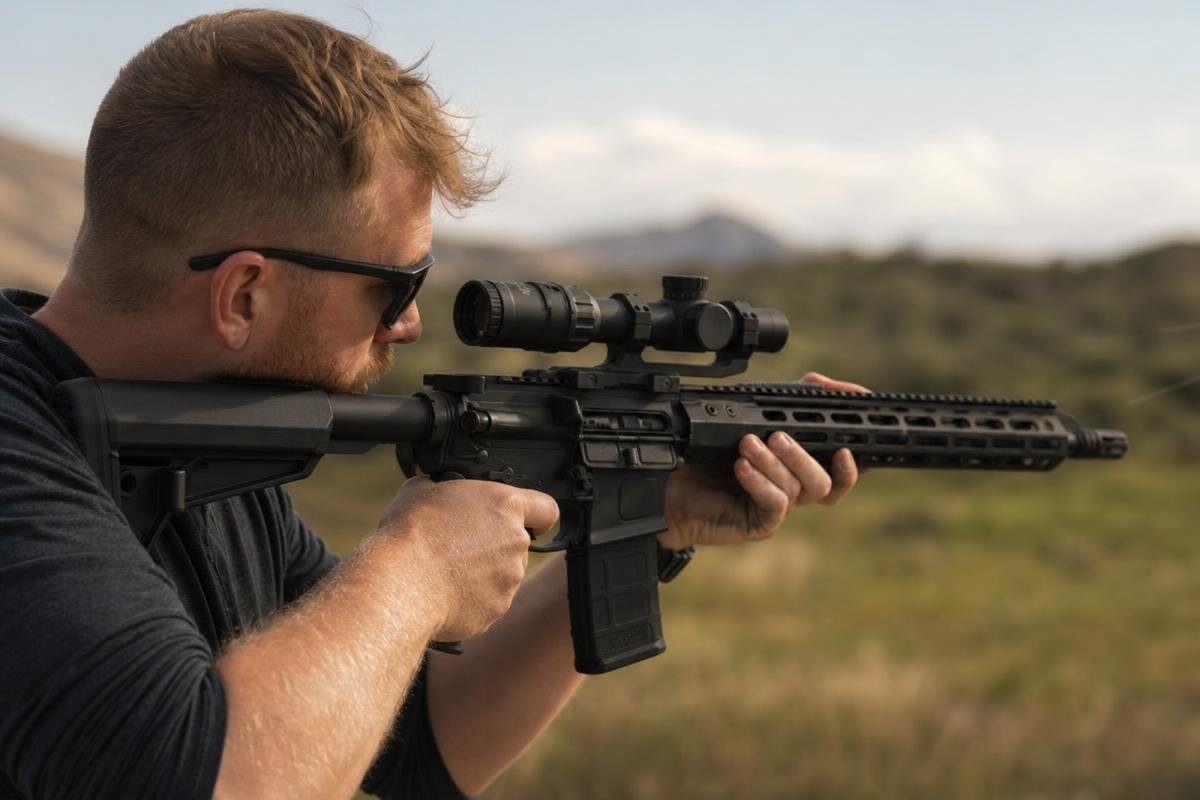
This is the question that trips up more buyers than any other in the LPVO category. The short answer for a general-purpose AR-15 build used inside 300 yards: second focal plane. Here is why that matters, and why the cheap FFP alternative is a trap worth naming directly.
First Focal Plane (FFP): Accurate at Every Power Setting
An FFP reticle scales with the image. Turn the magnification up, the reticle grows. Turn it down, it shrinks. That means your MOA or MRAD hash marks stay accurate at every power setting. If you are ranging targets at unknown distances or dialing holdovers past 300 yards, FFP is the correct tool. It is the standard on precision rifles and longer-range builds for exactly that reason.
The tradeoff is real, though. At 1x, that reticle gets small. In low light, it can nearly disappear. For a hunter pushing through post oak country at dusk, that is not a spec-sheet problem. That is a missed shot.
Second Focal Plane (SFP): Full-Size Reticle at 1x
An SFP reticle stays the same apparent size regardless of magnification. The subtensions are only accurate at the manufacturer-calibrated power setting, typically maximum magnification. At 1x, the reticle is full-size, bright, and fast to pick up. For CQB, hunting in mixed terrain, or any general-purpose build where most shots happen inside 300 yards, SFP is more practical.
Pair a quality SFP scope with a 5.56 NATO complete upper and you have a versatile setup that works from 10 yards to 300 without the reticle fighting you at low power.
The Cheap FFP Trap: Why Budget FFP Scopes Often Disappoint
Budget FFP scopes in the entry-level tier earn bad reviews for a consistent reason. The reticle is nearly invisible at 1x in daylight and washes out entirely in low light. Add edge distortion and poor glass transmission, and you have paid for a feature you cannot actually use.
If you want FFP, buy quality. Brands like Primary Arms, Vortex, and Nightforce execute FFP correctly at higher price points, and they are worth considering when your build genuinely calls for it. If the budget does not stretch that far, a quality SFP scope at a lower price point beats a compromised FFP every time.
Do not let the spec sheet sell you a scope your eyes cannot use in the field. Not sure which LPVO fits your upper? Browse our complete AR-15 uppers and we'll help you match the glass to your build and your distances.
Magnification Ranges Explained: 1-4x vs. 1-6x vs. 1-8x vs. 1-10x
Magnification range is the first spec to nail down before you shop for an LPVO. Get it wrong and you either cap your effective range or add unnecessary weight and cost to a build that never needed it. Match it to your actual shooting distances and your build's caliber, and the optic disappears into the rifle.
1-4x: Home Defense and Close-Quarters Competition
A 1-4x is the lightest and shortest LPVO option. It excels inside 200 yards, which covers home defense, 3-gun stages, and most run-and-gun competition. At true 1x, target acquisition is fast. At 4x, a calibrated reticle puts you on man-sized targets out to roughly 300 yards. It pairs naturally with a 5.56 NATO complete upper or a 300 Blackout upper optimized for speed over distance.
If your shots stay inside 300 yards, a 1-4x is all you need.
1-6x: The General-Purpose Standard
The 1-6x is the best LPVO for AR-15 builds that need to do everything. At 6x, a flat-shooting cartridge and a quality reticle reach 500 yards reliably. That covers 3-gun, PRS Tactical, deer hunting inside 400 yards, and home defense without swapping optics. In North Texas, where a pasture shot near Lake Texoma can stretch to 300 yards and a shot in the creek bottom comes at 40, the 1-6x handles both without compromise.
For most AR-15 owners, this is the answer.
1-8x and 1-10x: Extended-Range Builds
The 1-6x vs 1-8x debate comes down to one question: are you shooting past 500 yards? At 8x, a 6.5 Grendel upper or a 224 Valkyrie build can reach 700 to 800 yards with a capable shooter behind it. The tradeoffs are real: heavier glass, longer tube, higher cost, and budget 1-8x scopes frequently have the worst 1x performance in the class.
A 1-10x blurs the line between LPVO and traditional variable power optic entirely, and it demands a more solid mount to hold zero under recoil. Only go to 1-8x or 1-10x if your build and your range genuinely require it.
How to Choose the Best LPVO for Your AR-15 Build
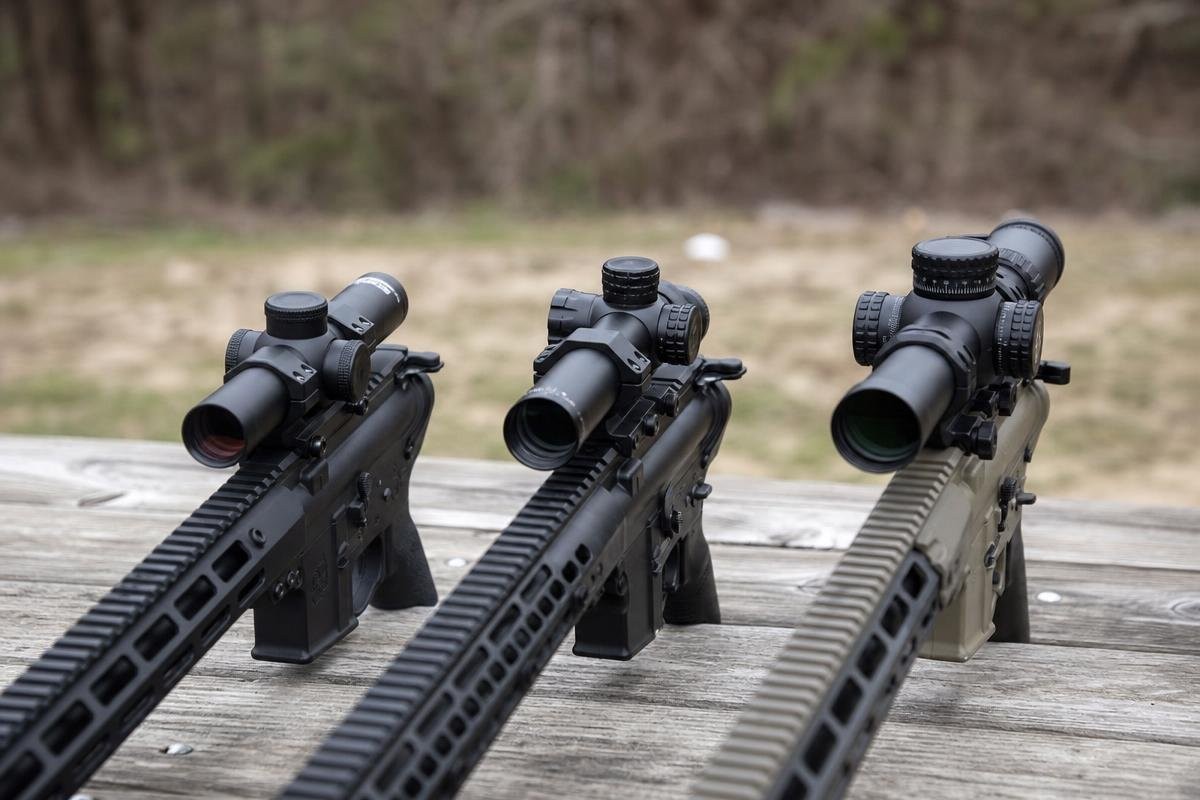
The best LPVO for your AR-15 is the one that matches your actual use case, not the one with the most features on paper. Start with the role. Everything else follows from that decision.
Match the Optic to the Role
Four build archetypes cover most shooters. First, home defense and truck guns need a true 1x, an illuminated reticle, and a 1-4x or 1-6x range. Keep weight under 24 ounces. Second, 3-gun competition builds need the same true 1x with a fast throw lever and a 1-6x range. SFP works well here because your reticle stays full size at 1x. Third, hunting builds inside 400 yards benefit from 1-6x or 1-8x with quality glass that transmits light at dawn and dusk.
Wooded creek bottoms around Denison can close your shot window to seconds. A budget scope that washes out in low light is a liability, not a savings. A 350 Legend upper for hunting builds pairs naturally with a 1-6x FFP optic in that terrain. Fourth, precision and general-purpose builds need FFP, 1-8x, and an MRAD or MOA reticle with holdover marks.
Reticle Types: BDC, Christmas Tree, and Duplex
BDC reticles are caliber-specific and fast. They work well if you shoot one load consistently. Christmas tree reticles are MRAD-based with windage holds built in. They are precise but require real training to use under pressure. A simple duplex is the fastest reticle available, with zero ranging capability.
Match your reticle unit to your turret unit. MOA turrets with an MRAD reticle creates confusion at the worst moment. MOA equals roughly 1 inch per 100 yards. MRAD equals roughly 3.6 inches per 100 yards. Pick one system and stay in it. Illuminated reticles are worth the premium on any build used in low light.
Mount Height and Eye Relief
Mount height is not a preference issue. It directly affects your cheek weld and how fast you get on target. Most AR-15 flat-top receivers need a 30mm or 34mm ring mount or a cantilever mount. LPVO eye relief runs typically 3.5 to 4 inches. Lower 1/3 co-witness lets you use backup iron sights through the lower third of the optic window.
Absolute co-witness puts your irons directly on the reticle center. Confirm mount height before you buy the optic, not after. Not sure which optic setup fits your build? Call us at (888) 706-0633 and we'll help you match the right LPVO to your rifle before you spend a dollar.
Budget, Mid-Range, and Premium LPVOs: What You Actually Get at Each Price Tier
Price buys glass. That is the simplest way to understand LPVO tiers. Every other feature, turrets, illumination, reticle quality, true 1x performance, flows from the quality of the glass inside the tube.
Budget Tier (Entry-Level Tier): Know the Tradeoffs
Glass quality is the first casualty at this price point. Expect edge distortion, chromatic aberration, and noticeably poor light transmission at dawn and dusk. The 1x setting is frequently approximate, not true 1x, which matters in close-quarters situations. Turret repeatability is inconsistent. These optics are acceptable for range training and budget AR builds where you are still learning your preferred setup.
The better-known budget makers, Primary Arms among them, offer the strongest glass in this tier. If you are building a 5.56 NATO complete upper for range days and casual use, a budget scope gets you started. For hunting across open Texas pasture or mixed-terrain shooting from 30 to 300 yards, it will leave you wanting more.
Mid-Range Tier ($400-$900): Where LPVOs Become Serious Tools
This is the correct tier for most AR-15 builders. Glass quality improves markedly. True 1x becomes achievable. Turrets track reliably, and daylight illumination is adequate for real use. The Vortex Strike Eagle and Primary Arms SLx 1-6x are frequently cited examples in this bracket. For a shooter building a hunting or competition rifle in the Denison and Pottsboro area, this tier covers the range of scenarios you will actually face.
Premium Tier ($900+): Built for Professional and Competition Use
The Nightforce ATACR 1-8x, Vortex Razor HD Gen III, and Schmidt and Bender ShortDot represent the top of the market. High light transmission, accurate color rendering, minimal distortion, and turrets precise to sub-MOA. True 1x is standard, not a marketing claim. You are paying for an optic that will not fail under hard use, low light, or competition pressure.
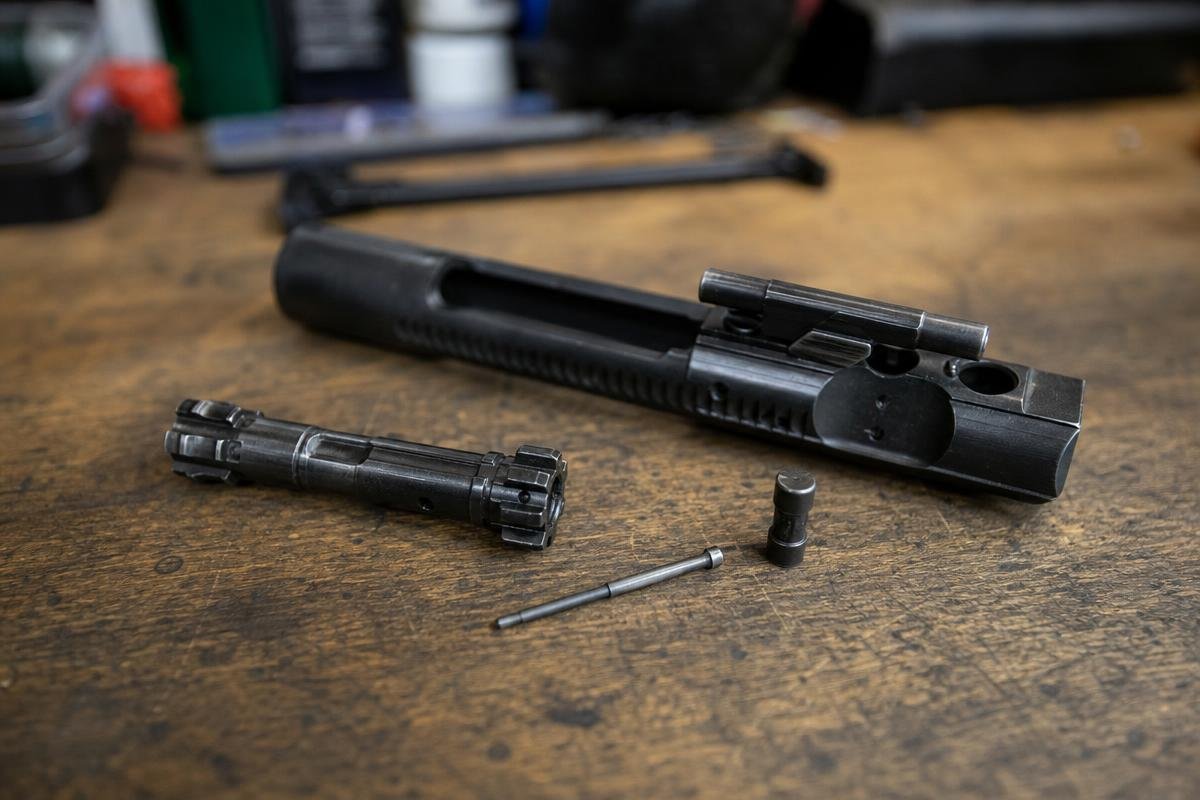
Spending $900 or more makes sense when the rifle is a primary tool, not a range toy. A quality optic also deserves quality components underneath it. Pair it with a reliable bolt carrier group; our AR-15 parts selection covers everything from BCGs to complete builds.
Pairing an LPVO with the Right AR-15 Upper: Caliber and Role Alignment
The optic and the upper have to match. A 1-6x variable optic on a suppressed 300 Blackout is the wrong tool. A 1-4x on a 6.5 Grendel leaves real capability on the table. Caliber drives the optic decision, and getting that pairing wrong costs you performance at the ranges your build was designed for.
5.56 NATO and .223 Wylde: The Standard Pairing
A 1-6x LPVO is the natural match for a 5.56 NATO or .223 Wylde build. On a 16-inch barrel, a 55gr to 77gr 5.56 load stays effective to 500 yards. Six power gives you enough magnification to work at that distance without losing the wide field of view you need up close. The .223 Wylde complete upper is worth specifying here: it chambers with the accuracy of .223 Remington but handles 5.56 NATO pressure loads without complaint. That flexibility pairs well with a 1-6x and a BDC reticle zeroed at 50 or 100 yards.
6.5 Grendel and 224 Valkyrie: Extended-Range Builds
Both of these cartridges were built to push the AR-15 platform past what 5.56 can do. The 6.5 Grendel upper holds supersonic velocity past 800 yards. The 224 Valkyrie upper runs high-BC bullets optimized for long-range competition. Both builds call for a 1-8x LPVO, and both benefit from a first focal plane reticle so your holdovers stay accurate at whatever magnification you dial in.
If you want more context on what the Grendel does well and where it fits, our breakdown of what 6.5 Grendel is good for covers the full picture. Open-pasture shots in the 400 to 800 yard range are where these uppers earn their keep, and the optic needs to match that intent.
300 Blackout and Suppressed Builds
Subsonic 300 Blackout operates almost entirely inside 200 yards. At roughly 1,050 fps, holdover at 200 yards is significant, so a BDC reticle calibrated for subsonic loads matters. A 1-4x with true 1x and an illuminated reticle is the correct pairing for a suppressed build running subsonic. Supersonic 300 Blackout extends your effective range to around 400 yards, where a 1-6x makes more sense. Either way, start with the right 300 Blackout complete upper and build the optic choice around how you plan to run it.
Building in North Texas: Why Denison Shooters Choose AR15Parts.com
North Texas terrain makes the LPVO question easy to answer. Grayson County gives you cedar thickets and creek bottoms where shots break at 30 yards, then opens into pasture where deer cross at 300 yards or better. That swing in distance is exactly what a 1-6x LPVO is built for. Fixed-power optics leave you compromised at one end or the other. A quality variable power scope does not.
We ship complete uppers built to order out of Sherman, TX, at 2022 S Crockett St, Sherman, TX 75090, serving Denison, Pottsboro, Van Alstyne, Whitesboro, and the surrounding area. Every upper ships headspaced, assembled, and function-checked before it leaves our shop. No FFL required on upper receivers. It ships directly to your door. If you want a platform that is already dialed in and ready to mount an optic, browse our complete AR-15 rifles or pick a caliber-specific upper that fits your role.
Pairing the right LPVO with the right upper is a system decision. Barrel length, gas system length, and caliber all affect how the rifle tracks and recovers under magnification. A 6.5 Grendel upper running a mid-length gas system behaves differently under a 1-8x than a short-barreled 5.56 with a carbine system. Get the rifle right first. The optic follows from there.
Ready to pair a quality optic with a quality upper? We ship complete AR-15 uppers built to order in 19+ calibers, directly to your door from Sherman, TX. No FFL required. Call us at (888) 706-0633 to talk through your build before you order.