Buying an AR-10 or .308 upper: DPMS vs. Armalite patterns, barrel length, gas system, and how to make sure the upper actually fits your lower.
The AR-10 fills the gap between the AR-15's light, high-velocity role and a bolt-action hunting or precision rifle. Chambered in .308 Winchester, 6.5 Creedmoor, or similar large cartridges, it hits harder, reaches farther, and handles medium and large game the AR-15 shouldn't. The catch: unlike the AR-15, the AR-10 platform was never fully standardized. Two incompatible "patterns" dominate the market, and getting them wrong is the fastest way to end up with an upper that won't fit anything you own. Here's how to buy one correctly. As always, verify your federal, state, and local laws before buying, building, or modifying any firearm or upper.
AR-10 vs. AR-15: What's Actually Different
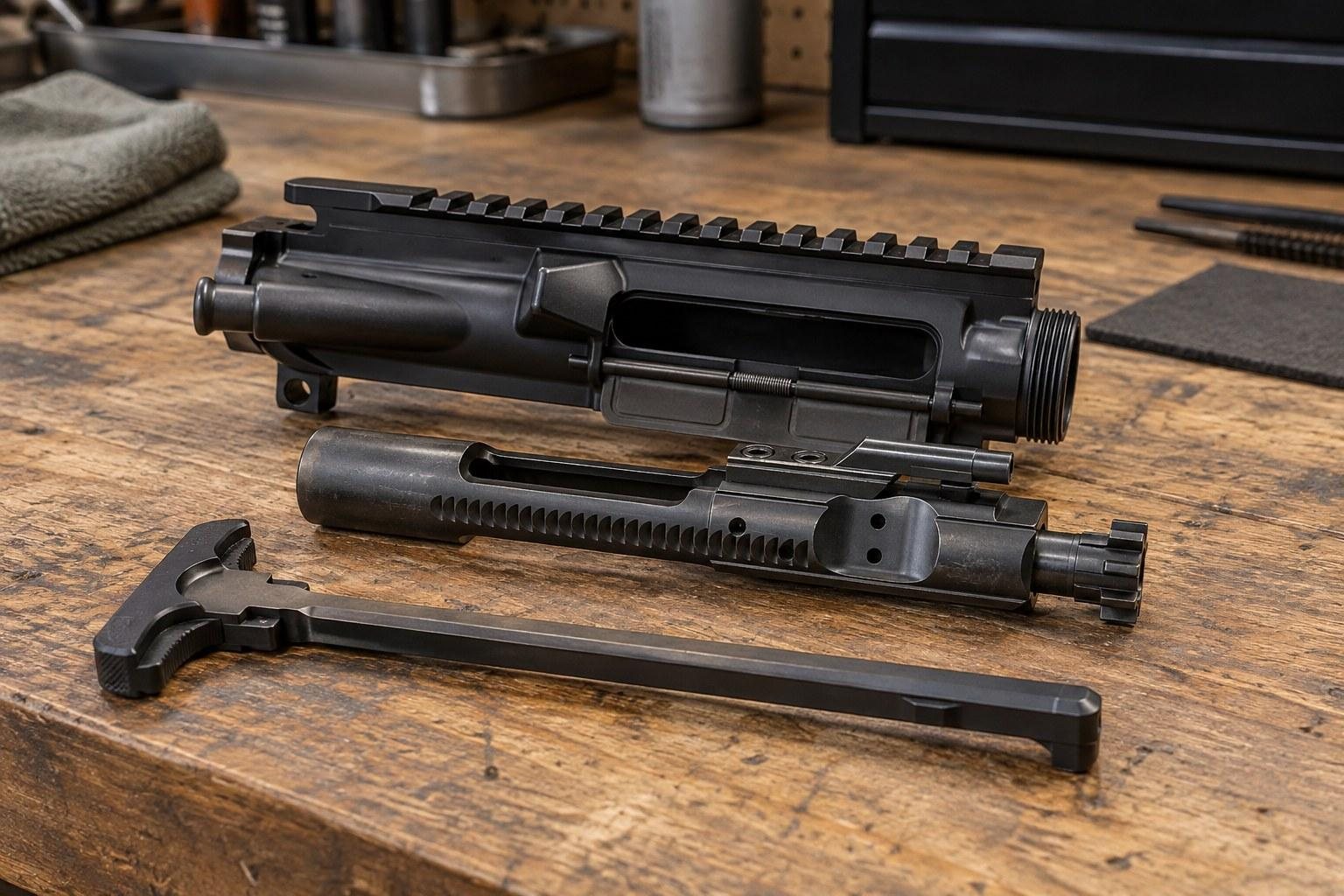
Everything is bigger. The receiver, magazine well, BCG, barrel, and buffer system all scale up to handle .308-class pressures and case dimensions. A .308 upper won't fit an AR-15 lower and vice versa, they're completely separate platforms that just share design lineage and looks. Every major dimension, from receiver length to bolt face diameter, changes between the two platforms, which is why parts never cross over no matter how similar they look on a shelf.
The controls (charging handle, safety, mag release) all work the same way. If you can shoot an AR-15, you can shoot an AR-10. It just weighs more, recoils harder, and holds fewer rounds per magazine (typically 20 vs. 30).
Magazines are another place the two platforms part ways. Most DPMS-pattern lowers accept SR-25 style magazines such as the Magpul PMAG 20 LR/SR, while Armalite-pattern rifles have historically used their own magazine designs. Confirm which magazine your specific lower takes before stocking up. For a part-by-part breakdown of what does and doesn't cross over, see our AR-15 vs. AR-10 compatibility guide.
DPMS vs. Armalite Patterns
The most important thing to understand before buying any AR-10 part: there are two incompatible patterns.
- DPMS-pattern (also called "DPMS Gen 1" or "SR-25"): The dominant pattern in the modern US market. Aero Precision, Palmetto State Armory, Ruger SFAR, most Anderson/PSA-adjacent brands, and Bravo Company all use DPMS-pattern uppers and lowers.
- Armalite-pattern: The original AR-10 design. Used by Armalite themselves and a handful of boutique brands. The takedown pin geometry and receiver dimensions differ enough that DPMS and Armalite parts are not interchangeable.
An AR-10 upper's "pattern" is not optional trivia, it determines whether the upper will physically fit your lower.
If you already own an AR-10 lower, verify its pattern with the manufacturer before buying any upper. If you're building from scratch, buy a matched upper and lower from the same brand, that guarantees fit and saves the confusion. If you're assembling from a stripped receiver rather than buying a complete rifle, plan the whole parts list around the pattern first, everything downstream (barrel extension, BCG, even some handguard mounting systems) depends on that one decision.
There's a second wrinkle inside the DPMS world: low-profile vs. high-profile upper receivers. The difference is at the front of the receiver, where the height and shape of the upper where it meets the handguard changes. A handguard made for a low-profile upper can leave a visible gap or misaligned top rail on a high-profile receiver, and vice versa. Most current production uppers are low-profile, but if you're buying a handguard separately, check which receiver profile it was designed for.
Barrel Length and Gas System for .308
.308 Winchester needs barrel length to reach full velocity. Unlike 300 Blackout, which is designed for short barrels, .308 loses meaningful velocity when the barrel drops below 18 inches.
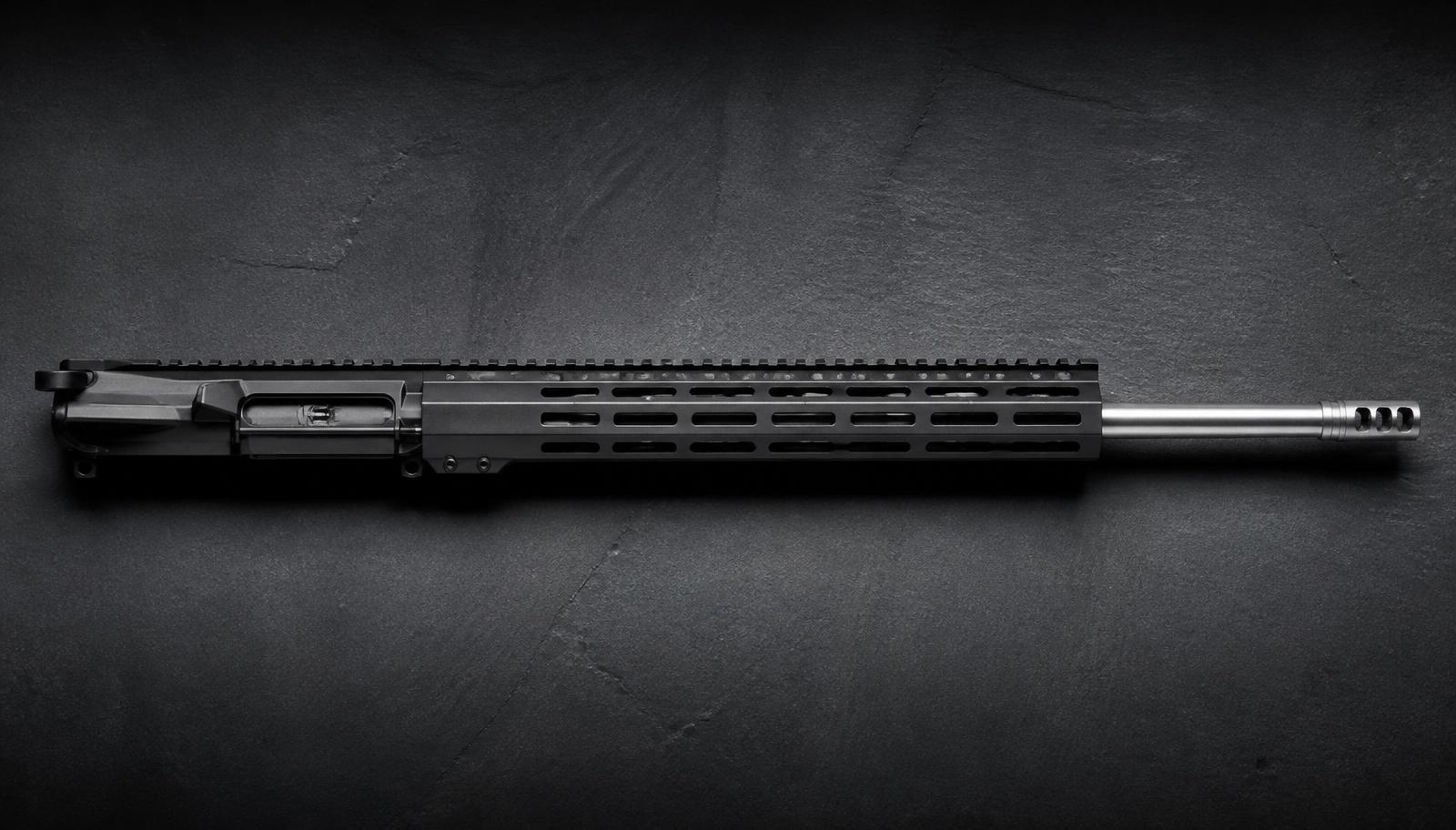
For most builds, 18 to 20 inches with a rifle-length gas system is the sweet spot. It captures nearly all the velocity .308 has to offer and keeps recoil impulse smooth. 16-inch .308 uppers exist and work, but they're loud, flashy, and give up 100 to 150 feet per second compared to 20 inch. The same length-vs-gas-length tradeoffs that apply to AR-15 builds apply here too; our gas system length guide covers the underlying mechanics.
Complete AR-10 and .308 uppers at ar15parts.com are almost all built around the 18 to 20 inch rifle-gas configuration.
Barrel contour matters as much as length on a .308. Heavy or bull contours hold zero better as they heat up during long strings of fire, which is why precision uppers use them, but they add a pound or more over a lightweight profile. Hunting barrels usually run a lighter contour because they're fired a few rounds at a time and carried for hours. Material follows the same logic: stainless steel is the common choice for accuracy-focused barrels, while nitrided or chrome-lined 4150 CMV favors durability for general-purpose use.
A note on short barrels: a .308 upper with a barrel under 16 inches installed on a rifle lower creates a short-barreled rifle under the NFA, which requires ATF approval and registration before assembly. Pistol builds with braces remain a changing area; the 2023 ATF pistol brace rule was vacated by federal courts, but state laws vary and federal policy can shift, so check current federal and state law before buying a short .308 upper.
Twist Rate for .308 and 6.5 Creedmoor
Twist rate determines which bullet weights a barrel can stabilize, and it matters more on large-frame ARs because the cartridge options span a wider range of bullet lengths than AR-15 calibers do.
- .308 Winchester: 1:10 twist is the standard and handles the full range of common bullet weights, from 110 grain varmint loads up through 175 grain match bullets. 1:11 and 1:12 also exist on older or lighter-focused barrels but are less flexible.
- 6.5 Creedmoor: 1:8 twist is standard. The long, heavy-for-caliber bullets that make 6.5 Creedmoor effective past 600 yards need the faster spin to stabilize.
- 6mm Creedmoor / .243: Typically 1:7.5 to 1:8, again driven by longer high-BC bullets.
If you're choosing between a fixed-barrel upper and building around a takeoff barrel, match twist rate to the bullet weights you'll actually shoot, not just the cartridge name. Our general twist rate guide explains the stabilization math in more depth, and it applies the same way to large-frame barrels.
Twist rate also comes into play if you plan to swap calibers later. Because 6.5 Creedmoor, .243 Winchester, and 6mm Creedmoor share the .308 case head, a .308 upper can usually be rebarreled for them using the same bolt. The barrel's twist is chosen for the new cartridge, so treat a caliber change as a barrel purchase, not just a new box of ammo, and have headspace checked after the swap.
BCG, Buffer, and Recoil Management
.308 ARs use a larger, heavier BCG than AR-15s and pair it with a heavier buffer and stiffer buffer spring. The pattern (DPMS vs. Armalite) determines which BCG fits, don't try to cross-fit.
Adjustable gas blocks are more valuable on an AR-10 than an AR-15 because .308 uppers tend to run over-gassed from the factory to guarantee reliability with weak surplus ammo. Tuning the gas down improves felt recoil, reduces brass wear, and extends parts life. An adjustable block also matters if you plan to run a suppressor, since the added back-pressure makes an already over-gassed .308 cycle even harder. Our adjustable gas block guide walks through the tuning process step by step.
Buffer systems vary more between .308 manufacturers than they do on AR-15s. Some DPMS-pattern rifles use a carbine-length tube with a brand-specific heavy buffer, others use a rifle-length system. If you're pairing a new upper with an existing lower, ask the upper's manufacturer what buffer weight and spring they recommend, and start there before swapping parts. Signs you're over-gassed include brass ejecting far forward of the 3 o'clock position, heavy dents on case mouths, and harsh felt recoil even with a brake.
Finally, if you buy a bare barrel and bolt separately rather than a complete upper, check headspace with go and no-go gauges before firing. Barrels are marked either .308 Winchester or 7.62x51 NATO, and the two chamber specs differ slightly. Our headspacing guide covers the gauge procedure, which works the same way on large-frame bolts.
Handguards and Total Upper Weight
A complete .308 upper typically runs 6 to 8 pounds bare, versus 3 to 4 pounds for a comparable AR-15 upper. That extra weight comes from the receiver, barrel, and BCG, and handguard choice is where you can claw some of it back.
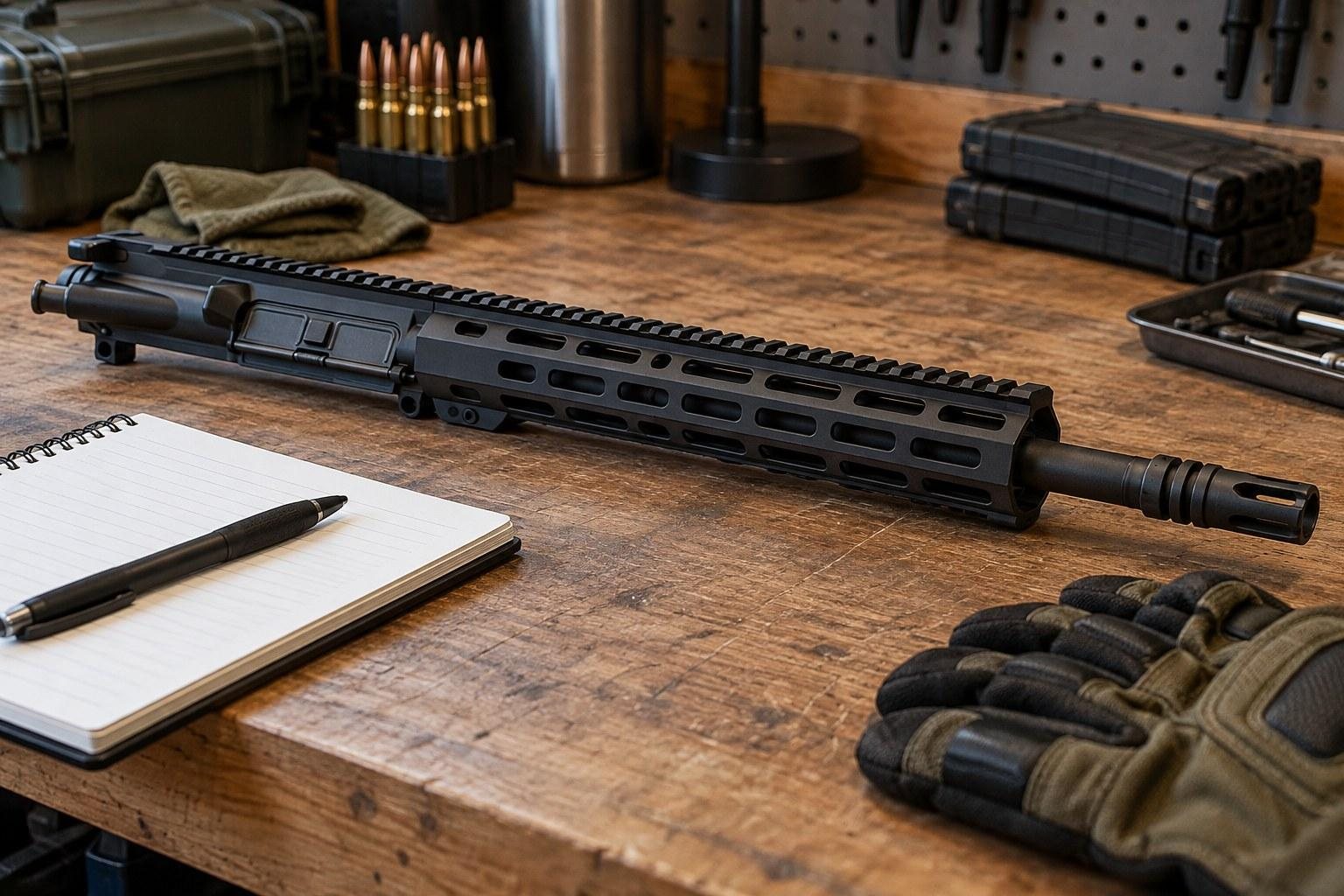
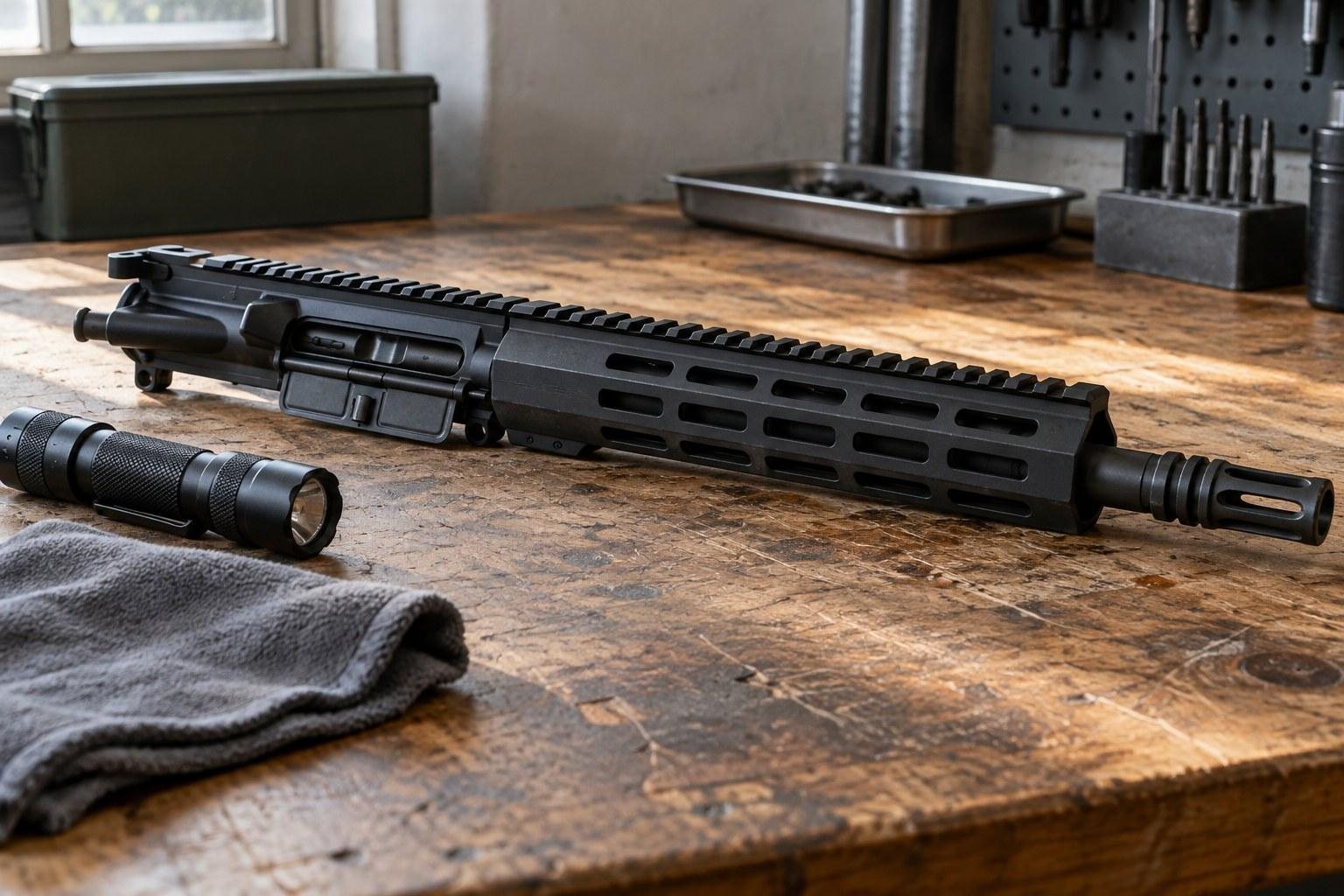
Free-floating M-LOK handguards in the 13 to 15 inch range cover most 18 to 20 inch barrels without extending past the muzzle, and lightweight aluminum or carbon-wrapped options shave several ounces over heavier steel-reinforced designs. Longer handguards (15 inch-plus) help on precision builds where a bipod or extra rail space for a light matters more than trimming ounces. Shorter, thinner handguards suit hunting builds where carrying weight all day outweighs rail real estate. See our handguard buying guide for material and attachment tradeoffs that carry over directly to AR-10 builds.
A finished rifle with optic, mount, and sling commonly lands between 9 and 11 pounds. That's heavier than most bolt guns in the same caliber, but it buys semi-auto follow-up shots and, on precision builds, a more stable shooting platform.
Optic mounting deserves attention on a .308 upper. Use a one-piece cantilever mount or quality rings rated for heavy recoil, torqued to the manufacturer's spec, and keep the optic on the receiver rail rather than bridging the receiver and handguard. Long-range shooters often choose a mount with built-in 20 MOA of elevation to leave more adjustment for distant targets.
Matching the Upper to Hunting or Precision Use
.308-class AR-10s split into two common roles, and the "right" spec sheet differs between them.
Hunting builds favor an 18-inch barrel, a lighter free-float handguard, and a moderate-weight muzzle device or none at all if legal in your state. Weight matters most here because the rifle gets carried far more than it gets fired; a 16 to 18 inch barrel with a lighter contour keeps the whole package under 9 pounds with optic. See our deer hunting calibers guide for how .308 stacks up against other AR-platform hunting cartridges.
Precision and long-range builds favor a 20 to 24 inch heavy-contour barrel, a longer handguard for bipod placement, and often 6.5 Creedmoor over .308 for its flatter trajectory and better retained energy at distance. Our 6.5 Creedmoor vs. .308 comparison breaks down that tradeoff in detail if you're deciding between the two before ordering a barrel.
A general-purpose upper, useful for range time, home defense, or occasional hunting, usually splits the difference: 18 inch barrel, mid-weight handguard, adjustable gas block, and a muzzle brake to tame recoil for faster follow-up shots.
For precision work, set a realistic accuracy expectation. A quality .308 AR upper with match ammunition commonly groups around 1 MOA, and some premium barrels do better, but semi-auto actions generally give up a little consistency compared to a well-built bolt gun. If you need consistent sub-half-MOA groups, spend your budget on the barrel first, then the trigger in the lower, then optics.
Picking a Complete .308 Upper: Checklist
Buying checklist for a complete .308 upper:
- Pattern: DPMS or Armalite. Match your lower. If starting fresh, buy DPMS.
- Barrel: 18 to 20 inch, 1:10 twist for standard .308 loads (1:8 if going 6.5 Creedmoor), 4150 CMV or stainless steel.
- Gas system: Rifle length, standard or adjustable gas block.
- BCG: Pattern-matched, MPI/HPT tested, properly staked gas key.
- Handguard: Free-floating M-LOK, 13 to 15 inch or longer for full barrel coverage, sized to your use case.
- Muzzle: 5/8x24 threading is standard for .308. Muzzle brake dramatically reduces felt recoil.
- Weight target: Under 9 pounds bare for a hunting build, 9 to 11 pounds finished for a general-purpose or precision build.
- Use case: Decide hunting, precision, or general-purpose before you shop, it drives every other choice on this list.
Expect to pay noticeably more for a .308 upper than for a comparable AR-15 upper. Without a true mil-spec driving volume, prices vary widely by brand, and the barrel and BCG account for most of the difference. If your budget is tight, prioritize a quality barrel and a properly tested BCG over premium handguards or cosmetic finishes, since those two parts decide accuracy and reliability.
Once the upper arrives, inspect it before the first range trip. Confirm the barrel nut and gas block are tight, the gas key screws are staked, and the bolt moves freely through its full travel. Lubricate the BCG generously, since large-frame bolts run hotter and dirtier than AR-15 bolts, and fire a few single rounds before loading a full magazine.
For caliber tradeoffs including .308 vs. 6.5 Creedmoor and 6mm ARC, see the caliber comparison guide. For how the receiver itself is manufactured, see the billet vs. forged guide.