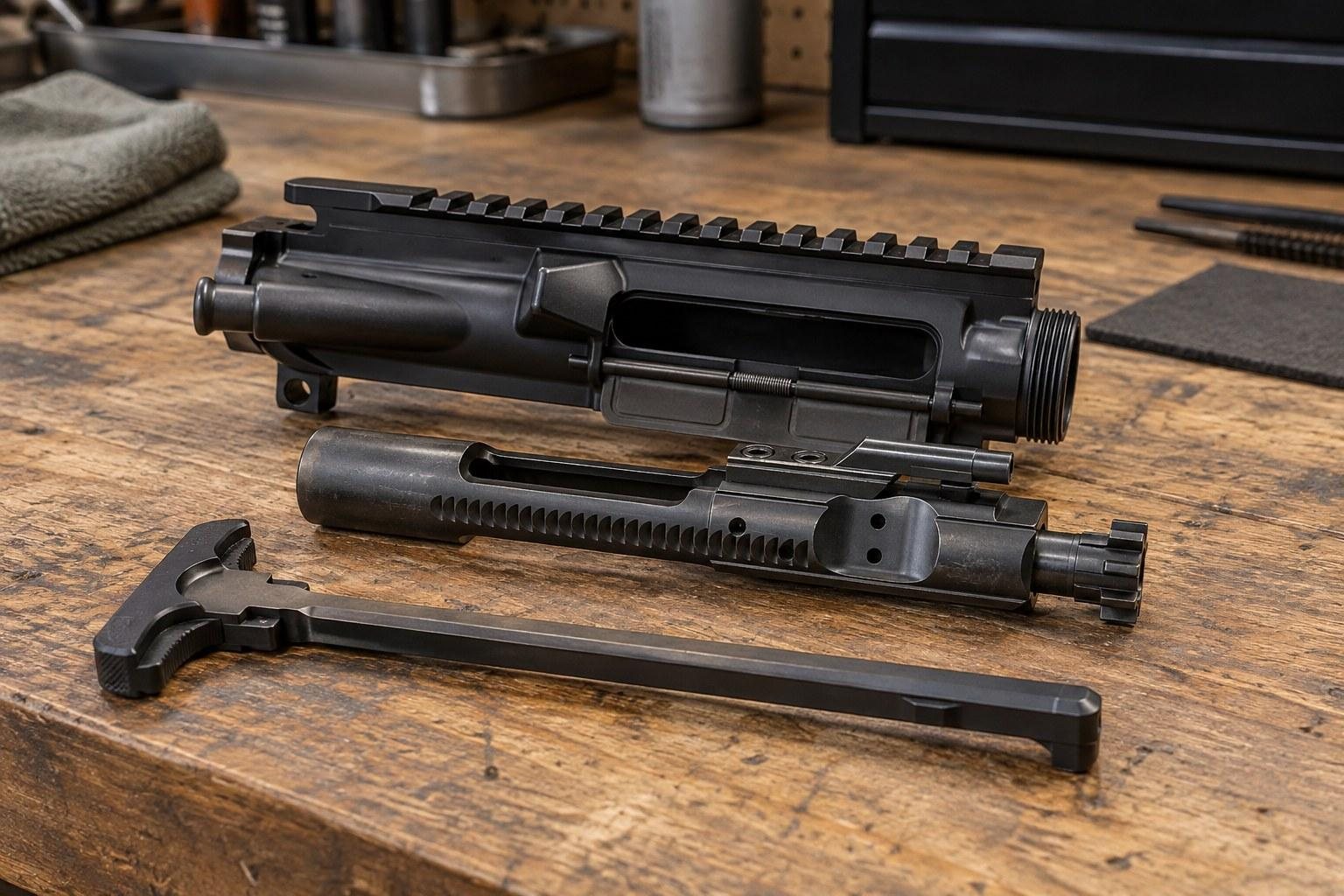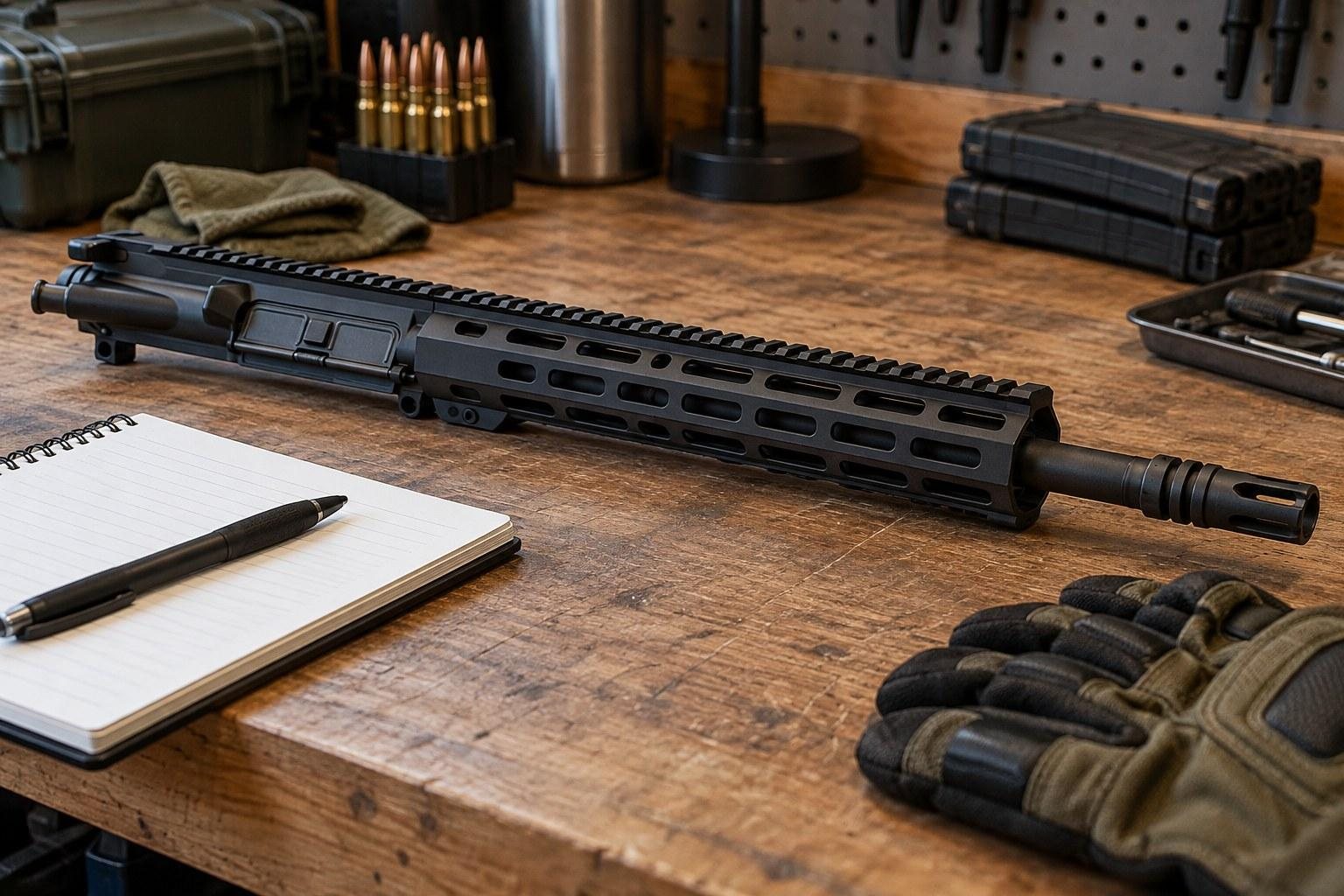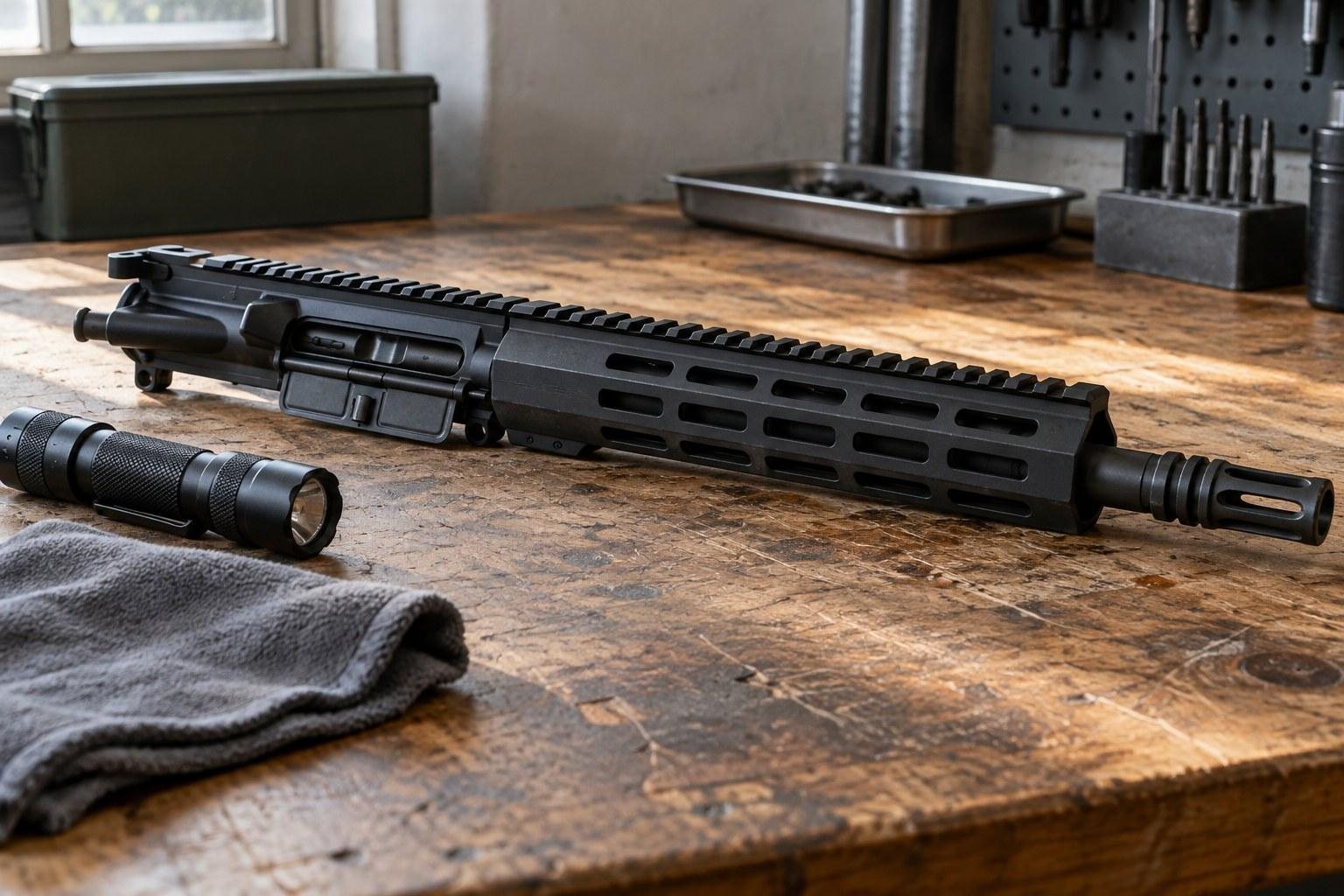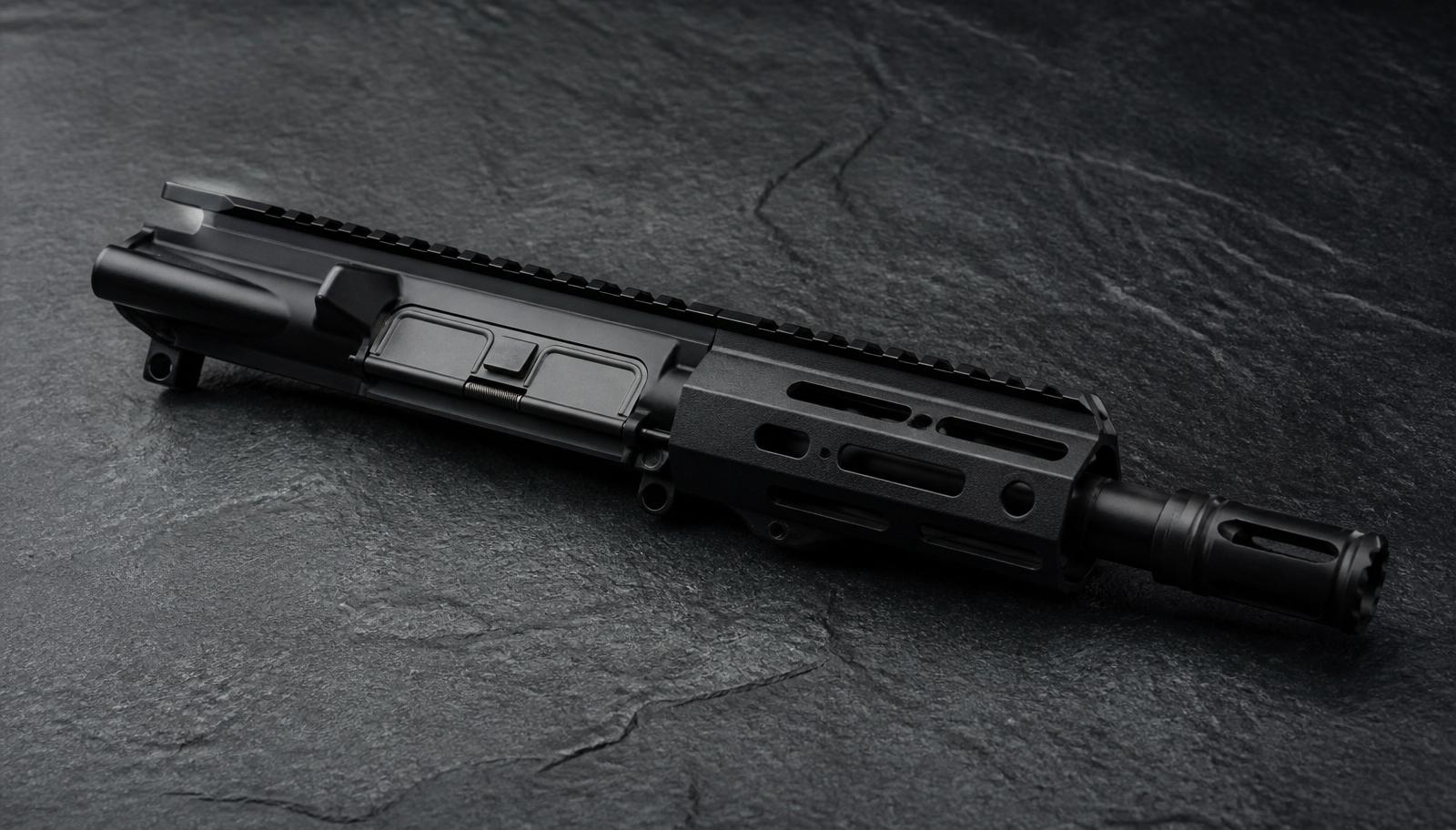
AR-15 pistol upper guide: NFA rules, barrel and gas system pairing, caliber choice, and the brace vs. stock legal landscape.
An AR-15 pistol is a short, maneuverable, sub-16-inch AR that is legally not a rifle. Done right, it is an excellent home-defense and truck-gun platform: compact enough to run through doorways, powerful enough to matter, and often easier to suppress than a longer rifle. Done wrong, it is an unreliable, loud, over-gassed mess with a legally ambiguous status. Here is how the NFA rules actually work, how to pair barrel length with gas system, which caliber fits your barrel, and where the brace-versus-stock question stands today.
What Actually Makes an AR a Pistol
The pistol classification is about the lower receiver's history and the assembled configuration, not the upper. Any AR-15 upper can technically bolt onto a pistol lower or a rifle lower; the resulting configuration is what the ATF looks at.
A pistol AR-15 must meet all of these:
- Built as a pistol from the start. The lower has never had a shoulder stock attached. Once a stock has been on it, the ATF treats that lower as a rifle receiver permanently, even if you remove the stock later.
- Barrel shorter than 16 inches. Most pistol uppers run 7.5 to 11.5 inches, though longer "pistol-ish" builds up to just under 16 inches exist.
- No vertical foregrip. A handgun is legally defined as a firearm designed to be fired with one hand. ATF has long taken the position that adding a vertical foregrip to a pistol means it is no longer designed for one-handed use, which can turn it into an "any other weapon" (AOW) that requires NFA registration. Angled foregrips and handstops have generally been treated differently, but check current guidance before adding anything to the front of the gun.
- Overall length considerations. The National Firearms Act's 26-inch overall length threshold is most relevant when a folding or telescoping stock (or brace) is in play. Builders should not assume a long handguard or muzzle device automatically clears any length requirement; the barrel-length and no-stock rules are the ones that matter for a straightforward pistol build.
If a rifle lower (one that has ever worn a stock) is paired with a sub-16-inch barrel and no NFA registration, the result is an unregistered short-barreled rifle, a felony. Registering that same configuration properly requires an approved ATF Form 1 (making one from parts you already own) or Form 4 (transferring an already-registered SBR), and that approval must be granted before final assembly, not after. The federal making and transfer tax for SBRs dropped from $200 to $0 on January 1, 2026, but the registration requirement did not go away. Processing times have varied from a few weeks to several months depending on ATF workload, and e-filing through the ATF eForms system is generally faster than paper.
An upper receiver by itself is not a pistol or a rifle, it is the lower's history and the full assembled configuration that determines the legal category.
For the full legal breakdown of upper receivers as firearms, see Is an AR-15 upper considered a firearm?. As always, verify current federal law and your own state and local laws before you build; regulations and interpretations change, and this article is general education, not legal advice.
Barrel Length and Gas System
Pistol uppers cluster around a handful of barrel lengths, each paired with a gas system length that gives the bolt carrier enough dwell time to cycle reliably. Get the pairing wrong and you get short-stroking, failures to lock back, or an over-gassed, beating-itself-apart action.
10.5 inches with a pistol-length gas system is the most common pistol upper configuration, and for good reason: it balances handling, velocity, and reliability better than the extremes. 7.5 and 8.5 inch are specialty lengths that are really only worth it in 300 Blackout or as a dedicated PDW build where size matters more than ballistics. 10.3 inch is functionally close to 10.5 and shows up on a lot of Mil-spec-pattern builds.
As a general rule, run pistol-length gas on anything 10.5 inches and under. At 11.5 inches you can go either way; many manufacturers default to carbine-length gas at that barrel length because the longer gas system has lower port pressure, which gives a softer impulse and less bolt carrier velocity, while an 11.5 inch barrel still provides enough dwell time to cycle it reliably. At 12.5 inches and up, carbine gas is standard.
Two failure modes to watch for: a carbine-length gas system on a 7.5 to 10.5 inch barrel usually short-strokes because there is not enough time for pressure to build before the gas port passes the bullet. A pistol-length gas system on a 14.5 to 16 inch barrel over-gasses badly, battering the bolt carrier and increasing felt recoil and wear. Stick to the standard pairings unless you have a specific, tested reason to deviate. The most common reason is a suppressor: a can adds back pressure, which makes short pistol-gas uppers run noticeably harder and dirtier, with more gas blowing back toward the shooter's face. An adjustable gas block lets you tune gas flow down for suppressed use and back up for unsuppressed or weaker ammunition, and it is one of the most useful upgrades on a short 5.56 or 300 BLK pistol.
Barrel length also drives muzzle blast and noise. The shorter the barrel, the more unburned powder exits the muzzle, so a 7.5 inch 5.56 is dramatically louder and flashier than a 10.5 or 11.5 inch barrel firing the same load. That is a practical consideration for indoor use, not just a comfort issue.
For the complete length-vs-gas-system pairing chart and troubleshooting notes, see the barrel length guide and the dedicated guide to choosing the right gas system length.
Caliber Choice for Short Barrels
Short barrels change the caliber math. A cartridge that shines in a 16 or 20 inch rifle barrel can be mediocre or worse at 7.5 to 10.5 inches, so pick based on the barrel length you are actually building, not on 5.56's reputation from a full-length rifle.
5.56 NATO in a 10.5 inch barrel works and is popular, but it loses roughly 300 to 400 feet per second compared to a 16-inch barrel, produces a sharp muzzle blast and pronounced flash, and has reduced terminal performance at the shorter distances short barrels are already limited to. It is a well-supported, ammunition-flexible configuration, but not the optimal choice if you are building shorter than 10.5 inches.
300 Blackout in a 9 to 10.5 inch barrel was engineered for exactly this length. It reaches full intended velocity in barrels far shorter than 5.56 needs, produces less muzzle flash, and offers genuinely strong subsonic and suppressed performance, which is a big part of why it has become the default short-barrel-pistol caliber for a lot of builders. If you are building shorter than 10.5 inches, or building specifically for a suppressor, strongly consider 300 BLK over 5.56. Full breakdown in the 300 Blackout upper guide.
9mm is worth considering for a different reason: it is not a rifle-caliber pistol build at all, it is a pistol-caliber carbine (PCC) built in AR-pistol form. A 9mm AR pistol typically uses a blowback or direct-blowback action (no gas system to tune), runs handgun magazines through a dedicated lower, has very mild recoil, and is easy to suppress quietly with common pistol-caliber suppressors. It trades power and range for compactness, low cost per round, and a soft shooting experience, which makes it a reasonable home-defense or range-fun choice, though it is not a rifle-caliber solution for longer-range work.
6.5 Grendel and other mid-size rounds sit at the opposite end from the ultra-short-barrel calibers. Grendel was designed for longer-range performance and does not shine in a 7.5 to 10.5 inch barrel; it wants 12.5 to 16 inches to deliver on its ballistic advantages. If your goal is a compact pistol for close-range work, Grendel is not the efficient choice; if your goal is a slightly longer pistol build (12.5 inch and up) that still hits harder at distance than 5.56, it becomes reasonable. See the caliber comparison guide for how Grendel and other options stack up against 5.56 and 300 BLK across barrel lengths.
Shop short AR-15 pistol uppers in multiple calibers at ar15parts.com.
Braces, SBRs, and the Legal Landscape
The legal status of AR-15 pistols with stabilizing braces has changed repeatedly since 2021, and it remains an area where builders need to check current guidance rather than rely on what was true a year or two ago.
In short: the ATF issued a rule in 2023 that would have reclassified many braced pistols as SBRs requiring registration. That rule was challenged in multiple lawsuits, and in Mock v. Garland the U.S. District Court for the Northern District of Texas vacated the rule nationwide in June 2024, with related litigation such as Britto v. ATF continuing to shape how brace-equipped pistols are treated. As of this writing the 2023 rule is not in effect, but the ATF (or a future rule, or an appeals court) could change that picture again, and several states impose their own restrictions on braces or SBRs independent of federal status.
Given how much this has moved, three principles hold up regardless of the current rule:
- The upper you buy doesn't determine legality. It is the assembled configuration (barrel length, stock or brace, and the lower's history) that matters.
- SBR registration is always an option and removes the ambiguity. Since January 1, 2026 an ATF Form 1 carries a $0 federal tax (down from $200) and lets you legally build an AR with any barrel length and a genuine shoulder stock, brace question or not. Processing times through eForms vary, and demand surged after the $0 tax took effect, so plan ahead.
- State law can be stricter than federal law. Several states restrict or prohibit SBRs, braces, or both regardless of federal status. Verify your own state's and locality's laws in addition to federal rules.
Before you configure a pistol upper into a functioning firearm with any kind of brace or stock, check the current ATF guidance and your state's laws. This article is general education on how the rules have worked historically and is not legal advice; when the stakes are a felony charge, confirm with current official ATF guidance or a firearms attorney rather than a blog post.
Setting Up a Pistol Upper to Run Well
A pistol upper is only half of the rifle, so a few supporting choices on the lower and the accessories determine how well the finished gun actually works.
Buffer and spring. Pistol lowers use a pistol buffer tube, which has no stock-position detents but typically takes a standard carbine buffer and carbine spring. That combination runs most 5.56 and supersonic 300 BLK pistol uppers. If a short, over-gassed upper is battering itself or ejecting far forward, a heavier H or H2 buffer is a common first fix. Blowback 9mm uppers are different: they need a heavy 9mm-specific buffer because there is no locked breech to slow the bolt, so do not assume a standard carbine buffer will work.
Optic. Most pistol builds are close-range guns, so a compact red dot or a low-power prism fits the role better than a large scope. Without a stock, your head position varies from shot to shot, and a red dot is far more forgiving of that than magnified glass with tight eye relief. A 50-yard zero is a practical starting point for a short-barrel 5.56 or supersonic 300 BLK home-defense gun; confirm the point of impact at the distances you expect to use it, since short barrels change your trajectory compared to a 16 inch rifle.
Sling. A single-point or convertible two-point sling tensioned against the body adds real stability to a pistol that has no stock, and it keeps the gun attached to you when you need both hands. Make sure the lower or buffer tube has a QD sling attachment point before you finish the build.
Suppressor planning. If you might ever add a suppressor (itself an NFA item requiring its own approved Form 4 or Form 1), pick the muzzle thread pitch and muzzle device mount now. Buying an upper with a barrel that already matches your intended suppressor mount saves an adapter and keeps the overall package shorter. The suppressor-ready upper guide covers what to look for.
Picking a Pistol Upper
Buying checklist for a complete AR-15 pistol upper:
- Barrel: 7.5 to 11.5 inch, 1:7 or 1:8 twist for 5.56, 1:7 or 1:8 for 300 BLK (twist needs differ by load, check subsonic vs. supersonic use), 4150 CMV or 4150 nitride for durability.
- Gas system: Pistol length for 10.5 inch and under, pistol or carbine for 11.5 inch, carbine for 12.5 inch and up.
- BCG: Mil-spec dimensions, staked gas key, magnetic-particle or high-pressure tested if you can find that documented.
- Handguard: Free-floating M-LOK, sized to end near the muzzle to leave room for a light or foregrip without crowding the muzzle device.
- Muzzle device: A blast can or linear compensator is worth the extra cost if you will ever shoot indoors or in a defensive scenario; it redirects blast forward instead of back toward the shooter. 5/8x24 threading is standard for 300 BLK-pattern barrels, 1/2x28 for 5.56.
- Caliber-to-barrel match: Don't default to 5.56 out of habit. If you are building 10.5 inches or shorter and care about flash, blast, or suppressed performance, 300 Blackout or 9mm will likely serve you better.
For related reads, the use-case-driven upper guide covers home-defense builds in more depth, and the upper buying guide covers general selection criteria beyond the pistol-specific rules covered here.