The AR-15 vs AR-10 key differences come up constantly, and for good reason. These two platforms share DNA but are built for different jobs, and picking the wrong one for your build means buying parts twice. We build complete uppers and rifles to order out of our shop in Sherman, TX, using barrels from Ballistic Advantage, Wilson Combat, and Satern.
Whether you are hunting the Red River bottoms or building a long-range precision rig, knowing the differences between the AR-15 and AR-10 before you order saves you time and money. We build to order, not off a shelf. Browse our complete uppers and parts, or reach out and we will help you pick the right platform for your build.
Why Platform Choice Matters Before You Buy Parts

AR15Parts.com builds and ships complete uppers, barrels, and parts for both the AR-15 and AR-10 platforms from our shop at 2022 S Crockett St in Sherman, TX, just up US-75 from Denison. We get this question across the counter every week: are these just two sizes of the same rifle? Short answer: no. They share Eugene Stoner's gas-operated, direct-impingement DNA, but they are not interchangeable in any meaningful sense.
The receiver geometry is different. The bolt carrier group is different. The magazine well is different. If you buy the wrong lower first, you will be buying the wrong upper, the wrong magazines, and potentially a second stripped lower before you realize the mistake. Platform choice is not a detail you sort out after the parts arrive.
Here in Grayson County, that decision is real. Hunting dense brush along the Red River bottoms calls for a different answer than running hogs on the open ranch country north and west of Lake Texoma. Here you'll find the AR-15 vs AR-10 key differences every shooter needs to know before spending a dollar: platform origins, physical dimensions, caliber families, parts compatibility, and practical use-case guidance for home defense, hunting, and long-range work.
If you are weighing a 6.5 Grendel upper against a .308 Winchester upper, start here. The answer depends on what you are building and why.
What Is the AR-10 and Where Did It Come From?
The AR-10 is a 7.62x51mm NATO rifle designed by Eugene Stoner in 1956 for ArmaLite, and it is the ancestor of the entire AR platform family. The goal was a lightweight infantry rifle to replace the M1 Garand. The U.S. military chose the M14 instead, and the AR-10 lost the contract. That decision changed the course of the platform entirely.
Stoner took the AR-10 design and scaled it down to accept the smaller 5.56x45mm cartridge. That scaled-down rifle became the AR-15. So the AR-10 is not a derivative of the AR-15. It is the other way around. Here is where it gets complicated for builders. There is no single universal AR-10 standard. ArmaLite, DPMS, and the SR-25 pattern all use slightly different receiver dimensions.
That means a lower from one manufacturer may not mate correctly with an upper from another. This is the core reason AR-10 vs AR-15 parts compatibility becomes such a frequent headache, and we cover it in detail in a later section. If you are planning a large-frame build, knowing the pattern matters before you order a single part.
Civilians can absolutely build AR-10 pattern rifles. The platform is legal, popular for hunting and long-range work, and available in a wide range of chamberings beyond the original 7.62x51mm. We offer complete AR uppers in multiple calibers for both AR-15 and large-frame AR-10 pattern builds, covering everything from .308 Winchester to 6.5 Creedmoor, and we spec our large-frame barrels from makers like Ballistic Advantage and Satern.
What Is the AR-15 and Why Did It Dominate?
Eugene Stoner's original AR-10 design was scaled down in the late 1950s to chamber the 5.56x45mm NATO cartridge. The U.S. military adopted that scaled-down version as the M16 in the 1960s. The civilian semi-auto AR-15 followed, and it never looked back. Today it is the most popular rifle platform in the United States, and the reasons are straightforward: modularity, a massive aftermarket, manageable recoil, and lower ammunition cost than any comparable .308 platform.
The AR-15 vs AR-10 size and weight difference alone explains a lot of the AR-15's dominance. A standard AR-15 build runs 6 to 7 pounds unloaded. A comparable AR-10 build comes in at 8 to 9 pounds or more. Over a long morning glassing the bottoms outside Denison, that difference is real and you feel it.
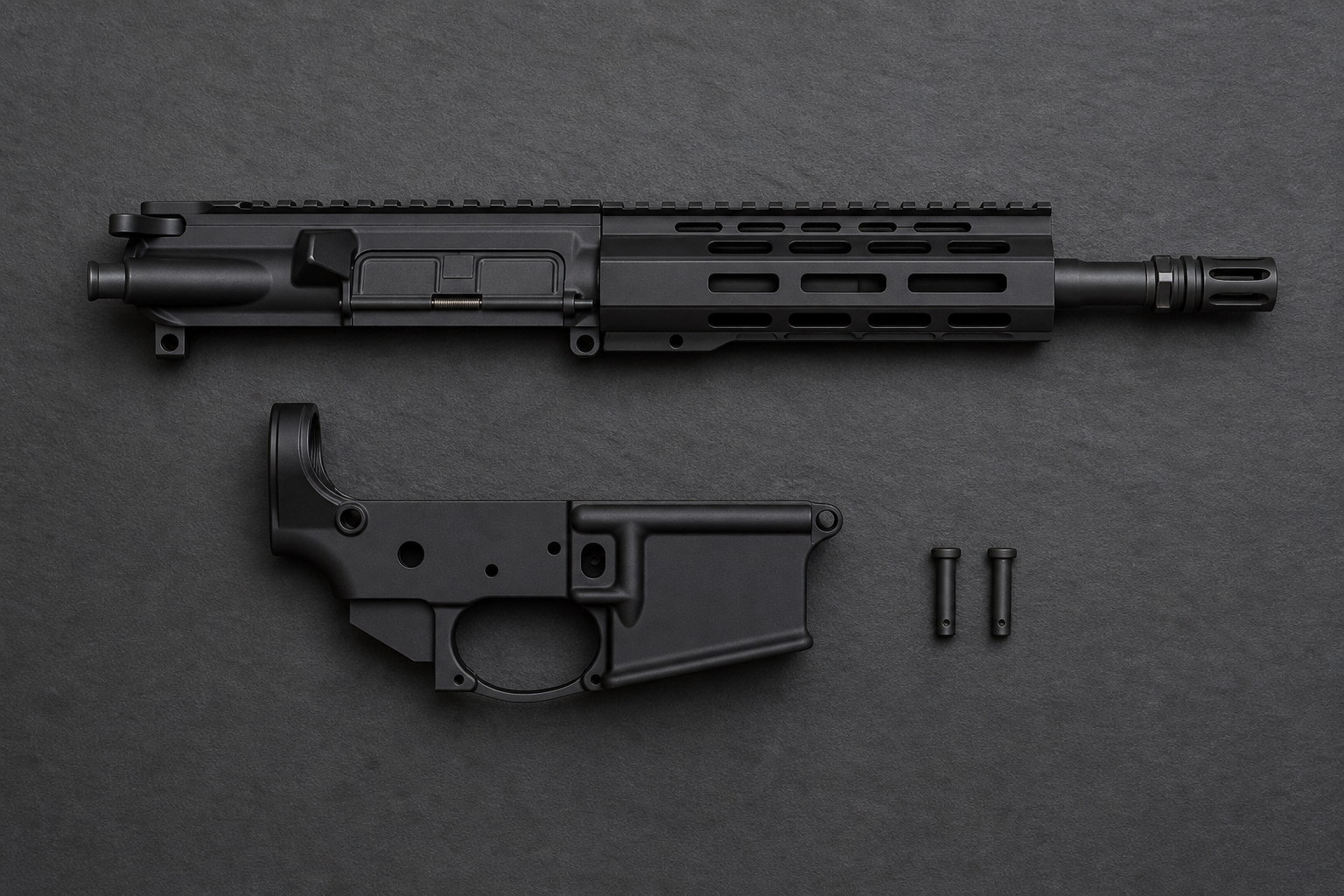
One of the AR-15's biggest advantages is how the law treats it. The lower receiver is the serialized firearm. The upper is not. That means you can swap a 300 Blackout upper or a 6.5 Grendel upper onto your existing lower with zero paperwork. No FFL transfer. No waiting. The same lower you use for home defense can run a hunting caliber the next morning.
Beyond 5.56, the AR-15 lower supports calibers including 300 Blackout, 6.5 Grendel, 350 Legend, and 450 Bushmaster. For Grayson County hunters working shots inside 250 yards in dense brush, that flexibility matters. The AR-10 gives you more power. The AR-15 gives you more options.
AR-15 vs AR-10: The Physical Differences That Actually Matter

The AR-10 vs AR-15 size and weight gap is bigger than most people expect until they hold both. The AR-15 lower receiver runs approximately 7 inches long. The AR-10 lower stretches to 8 or 8.5 inches depending on the manufacturer. That inch and a half affects handguard fit, stock fit, and overall rifle length across the entire build.
Weight
A complete AR-10 build runs 1.5 to 2.5 lbs heavier than a comparable AR-15. On a bench that sounds manageable. Still-hunting whitetail through tight cover on a 95-degree Grayson County afternoon, that extra weight adds up with every step. If you are hunting brush at close range, the lighter AR-15 platform in a hard-hitting caliber like 450 Bushmaster or 6.5 Grendel is worth considering before you commit to an AR-10 build.
Magazine Well and Magazines
AR-10 magazines are longer and wider to seat .308-length cartridges. They will not fit an AR-15 magazine well. These are not interchangeable. Full stop.
Buffer, BCG, and Gas System
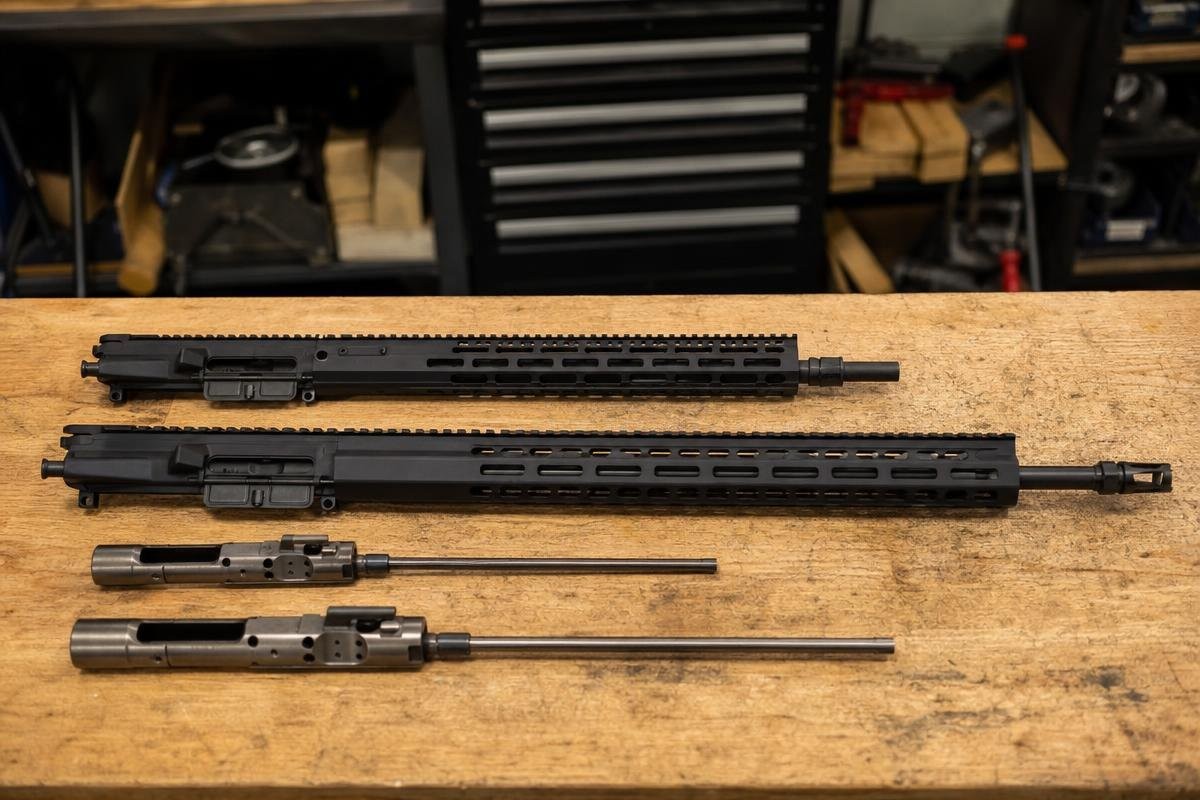
The bolt carrier group is not interchangeable between platforms. Neither is the buffer. AR-10 builds require a heavier buffer, typically an H2 or H3, to manage the higher bolt carrier mass and recoil impulse. Drop an AR-15 buffer into an AR-10 and you will have reliability problems immediately. Gas system lengths differ too. AR-15 builds commonly run carbine (7 inch), mid-length (9 inch), or rifle-length (12 inch).
AR-10 builds almost always run mid-length or rifle-length because the longer action needs the extra dwell time. That is one reason we spec our Ballistic Advantage and Wilson Combat large-frame barrels with rifle-length gas: it keeps the heavier action running smoothly across a range of loads. If you are still sorting out gas system selection for an AR-15 build, this guide on choosing the right gas system length for your AR-15 covers it in detail.
Building an AR-10? Lead times vary by caliber and barrel, so contact us before you order parts and we will build your upper to spec.
AR-15 vs AR-10 Calibers: What Each Platform Actually Shoots
This is where the two platforms diverge most for hunters and practical shooters. The AR-15 lower accepts a wide range of calibers by simply swapping the upper. The AR-10 runs a different, larger receiver set and handles cartridges that the AR-15 frame physically cannot.
AR-15 Caliber Family
One AR-15 lower can run all of these by swapping uppers: 5.56x45mm NATO, .223 Remington, .223 Wylde, 300 Blackout, 6.5 Grendel, 6mm ARC, 338 ARC, 224 Valkyrie, 350 Legend, 450 Bushmaster, 458 SOCOM, 50 Beowulf, and 7.62x39. The lower stays the same. Only the upper changes.
For whitetail hunters working the wooded draws around Hagerman National Wildlife Refuge, that matters. The brush country here does not require a magnum. A 450 Bushmaster upper or a 350 Legend upper drops deer cleanly and stays legal under Texas state law, which sets no minimum caliber. Grayson County adds no additional restrictions. You have real flexibility here.
AR-10 Caliber Family
The AR-10 platform requires the larger receiver set and runs cartridges in a different class: .308 Winchester, 7.62x51mm NATO, 6.5 Creedmoor, .243 Winchester, .260 Remington, and .338 Federal. No, you cannot run 6.5 Creedmoor on an AR-15 lower. The case length and bolt face require the AR-10 receiver.
For hunters pushing past 400 yards or targeting larger game, a 6.5 Creedmoor upper or a .308 Winchester upper on an AR-10 platform delivers the energy levels the AR-15 family cannot match. We build these on Satern and Ballistic Advantage barrels for shooters who want match-grade consistency at distance.
Which Caliber Family Fits Your Needs?
For AR-10 vs AR-15 calibers, the decision usually comes down to range and target size. The AR-15 platform covers everything from varmints to whitetail at practical hunting distances, at lower weight and lower cost per round. The AR-10 is the correct answer for long-range precision, elk-class game, or any application where .308-level energy is the floor, not the ceiling.
For a deeper look at AR-15 vs AR-10 for hunting, read our guide to the best deer hunting calibers for AR platforms.
Not sure which caliber or platform fits your build? Call us at (888) 706-0633 and we will point you in the right direction before you order a single part.
AR-10 vs AR-15 Parts Compatibility: What Swaps and What Does Not
This is where AR-10 vs AR-15 parts compatibility trips up more builders than any other topic. Some parts cross over cleanly. Others look similar and will not fit. And a few will cause real damage if you force them. Know the difference before you order.
Parts That Work on Both Platforms
Most mil-spec trigger group components transfer directly. Your standard mil-spec trigger, hammer, disconnector, and trigger pins will drop into an AR-10 lower without modification. Confirm your lower's dimensions, but in most cases it is a straight swap. The safety selector, pistol grip, and stock all work the same way.
Both platforms use a standard buffer tube, though the buffer weight and spring rate differ, so do not assume the buffer itself transfers. Muzzle devices are hit or miss. Thread pitch varies by barrel, so check the spec on your AR-10 barrel before ordering a brake or suppressor mount from your AR-15 parts bin.
Parts That Are Not Compatible
The bolt carrier group does not swap. Full stop. The AR-10 BCG is larger, heavier, and built around a different bolt head to handle cartridges like .308 Winchester. Forcing an AR-15 BCG into an AR-10 upper will not work. Read our AR-15 BCG guide if you need to understand how BCG specs affect your build decisions.
Barrels, upper receivers, lower receivers, and magazines are all platform-specific. The AR-10 barrel uses a larger extension and a different barrel nut. The receivers are physically bigger and will not mate with AR-15 components. If you are building in a large-frame caliber like .308 Winchester or 6.5 Creedmoor, you need AR-10 pattern components throughout, top to bottom.
The AR-10 Standardization Problem
The AR-15 has a true mil-spec standard. Every manufacturer builds to the same blueprint. The AR-10 does not. DPMS-pattern and ArmaLite-pattern AR-10 rifles use different receiver dimensions, different barrel nut specs, and different handguard mounting systems. A DPMS-pattern upper will not mate with an ArmaLite-pattern lower.
Parts labeled "AR-10" from one manufacturer may not fit an AR-10 from another. This is the most common and costly mistake in large-frame builds. Whether you are ordering from Sherman, TX or anywhere else, confirm your receiver pattern before you click buy. When in doubt, call us. We will tell you exactly what fits your build.
AR-15 or AR-10: Which Platform Is Right for Your Use Case?
The right platform comes down to three things: where you are shooting, what you are shooting at, and how far away it is. Here is a straight answer for each scenario.
Home Defense
For AR-10 vs AR-15 home defense comparisons, the AR-15 wins for most people. A 16-inch 5.56 NATO rifle or a 10.5-inch 300 Blackout upper is far easier to move through a hallway than a 20-inch .308. Less weight, shorter overall length, and lower recoil all matter when you are under stress in a confined space. The AR-10 is not a bad rifle. It is just not the right tool for inside a house.
Hunting
For AR-15 vs AR-10 for hunting, the answer depends on the animal and the distance. In dense North Texas brush where most shots on whitetail come at close range, an AR-15 chambered in a 6.5 Grendel upper is fully capable. Same goes for hogs in tight country.
For elk, large hogs at distance, or open-country shots past 400 yards, step up to the AR-10. A .308 Winchester upper or a 6.5 Creedmoor upper delivers the retained energy and velocity that bigger game at distance demands. Long senderos in South Texas or open-country hog hunting west of the Metroplex are exactly where the AR-10 earns its weight.
Long-Range Shooting
The AR-10 in 6.5 Creedmoor is the standard choice for precision long-range work. High ballistic coefficient, manageable recoil, and widely available factory match ammunition make it hard to argue against. The AR-15 platform is not out of the running, though. The 224 Valkyrie and 6mm ARC are legitimate options to 800 to 1,000 yards. The 338 ARC is an emerging option for long-range shooting on an AR-15 platform that is worth reading about if you want to stay on a mil-spec lower.
If you are still not sure which platform fits your build, the caliber section above is the place to start.
Shooting in Texas: Platform Choice for Lone Star Hunters and Competitors
Texas sets no minimum caliber for deer, so you have full flexibility on both platforms under state law. That matters for the AR-15 vs AR-10 for hunting decision more than most shooters realize. The right call depends on where you are hunting and how far your shots run.
In the thick cover along the river bottoms north of Sherman, most whitetail shots happen at close range, often under a hundred yards. The AR-15 platform handles that work cleanly. A 450 Bushmaster upper hits hard up close, and a 6.5 Grendel upper stretches your effective range without jumping to a heavier platform. Both are practical, legal, and easy to carry through tight cover.
Push west toward open senderos or run hogs across longer ground, and the AR-10 earns its weight. A 6.5 Creedmoor upper or a .308 Winchester upper gives you the reach and terminal performance for shots past 400 yards that the AR-15 platform simply cannot match.
One thing that hits both platforms equally: North Texas summers.
July highs near 95°F with real humidity accelerate carbon fouling and surface oxidation fast, especially on barrels and bolt carrier groups stored in truck safes. Check your AR-15 cleaning kit guide and apply the same discipline to your AR-10. Heat does not care which platform you run. We ship from Sherman, TX, about 10 miles from Denison, directly to your door. No FFL required for stripped uppers and most parts.