What does an AR-15 dust cover do? Learn how it works, what parts it uses, and when to replace it. Shop dust covers at AR15Parts.com. Call (888) 706-0633.
The AR-15 dust cover is one of the most overlooked parts on the rifle, and one of the most practical. It seals the ejection port against dirt, debris, and moisture when the rifle is not firing, then springs open automatically on the first shot. If you hunt the Red River bottomlands near Lake Texoma or run your rifle through North Texas red clay, that small hinged cover is doing real work. Here you'll find exactly what the dust cover does, how the mechanism works, and whether you actually need one. Have questions about your AR-15 build? We are here to help.
What Is an AR-15 Dust Cover and What Does It Do?
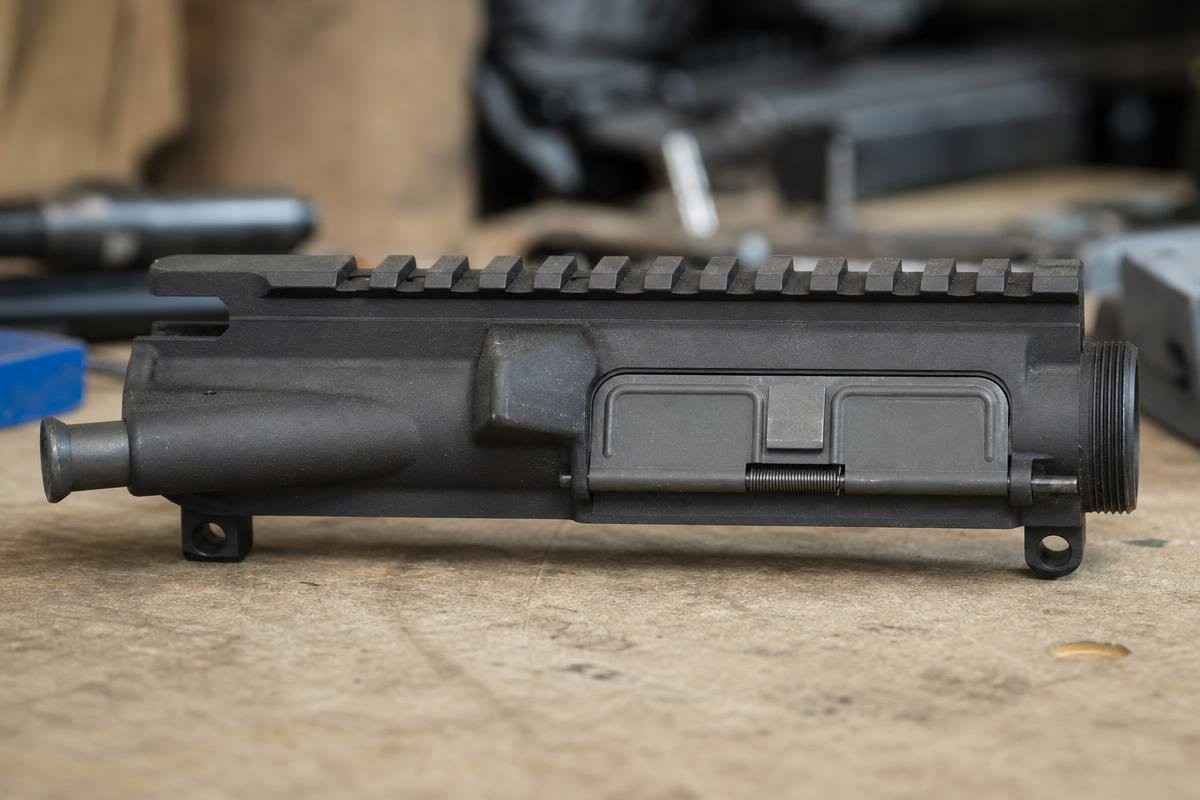
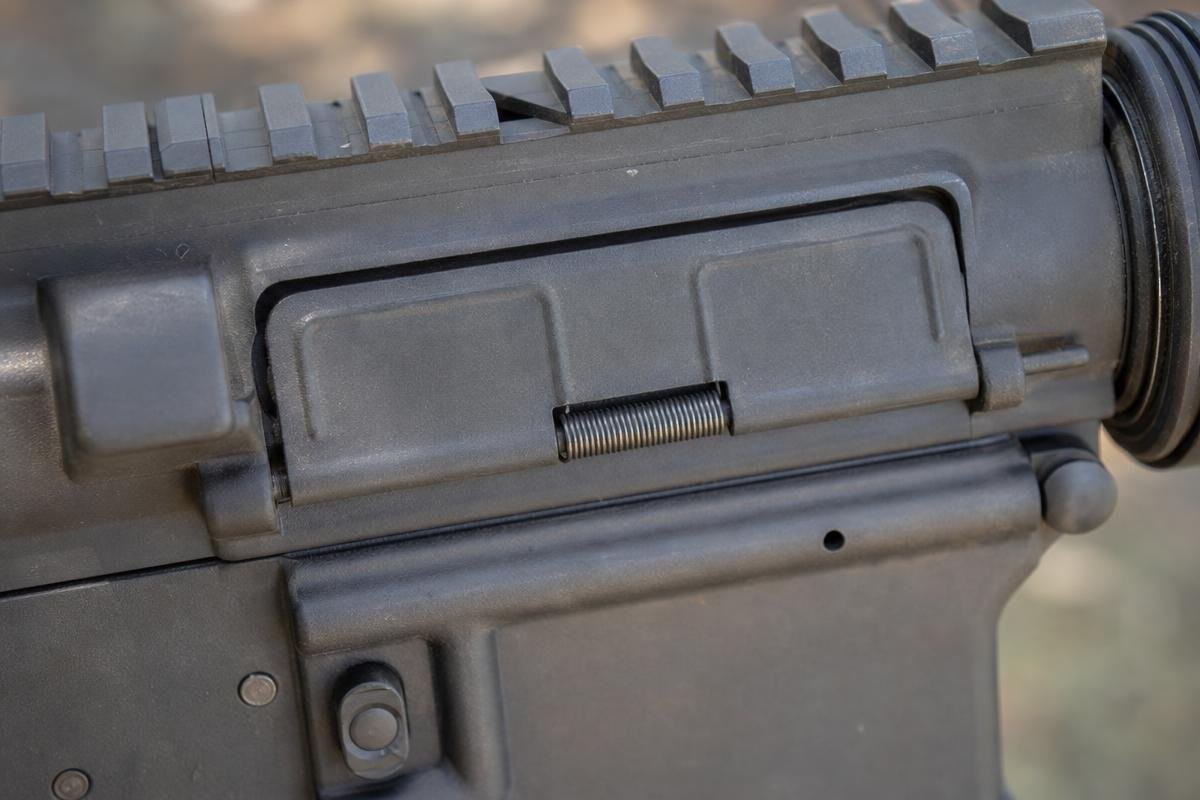
An AR-15 dust cover, also called an ejection port cover, is a spring-loaded panel that seals the ejection port on the right side of the upper receiver. When the rifle is not firing, it blocks dirt, debris, and moisture from reaching the chamber and bolt carrier group. On the first shot, the bolt carrier pushes it open and it stays open for the rest of your string of fire.
Yes, "dust cover" and "ejection port cover" mean the same thing. The technical term is ejection port cover. Most shooters just call it a dust cover. You will see both terms used in this guide.
If you hunt or shoot near Lake Texoma, run your rifle through North Texas red clay, or just store your build in a truck cab through a Denison summer, that small panel is doing real work. Exposed steel and an open chamber are a bad combination in humid, debris-prone field conditions.
Here you'll find the dust cover's components, how the mechanism works, installation steps, material and style options, and basic maintenance. We stock individual AR-15 upper parts including dust cover assemblies, and we also build complete AR-15 uppers assembled and function-checked before they ship, dust cover included.
The Ejection Port: What It Is and Why It Needs Protection
The ejection port is the rectangular opening on the right side of the upper receiver, roughly 1.5 inches long. Every spent case exits through that opening after each shot. It is also a direct path into the chamber and bolt carrier group when the rifle is not firing.
Without an AR-15 ejection port cover in place, that opening stays exposed. In North Texas field conditions, that matters. Red clay dust around Grayson County, humidity off Lake Texoma, and debris in the Red River bottomlands can all work their way into an uncovered port during a morning carry through the brush. Exposed steel inside the upper also picks up surface rust faster in the summer heat and humidity common to the Denison area.
What Happens Inside When the Cover Opens
The dust cover opens automatically through a simple mechanical interaction. A small detent tab on the cover sits in the travel path of the bolt carrier group. As the BCG moves rearward on the first shot, it strikes that tab and pushes the cover open. A spring in the hinge holds it open so brass ejects freely without obstruction for every subsequent round.
If debris gets into the open port before that first shot, it can contaminate the chamber, foul the extractor, or bind carrier movement. That is not a malfunction you want to troubleshoot at first light in the bottomlands. The dust cover costs almost nothing relative to the reliability it protects.
Need a dust cover assembly or a replacement part? Shop AR-15 upper parts shipping same-day from Denison.
The Components of an AR-15 Dust Cover: Every Part Explained
The AR-15 dust cover assembly looks simple from the outside. It is not a single piece. It is a four-part assembly, and losing any one component means the cover will not function correctly. Here is exactly what you are working with.
The Cover Panel Itself
The panel is the flat door that closes over the ejection port. Mil-spec panels are stamped steel, phosphate-coated or parkerized to resist surface rust. Aftermarket options come in machined aluminum, polymer, and titanium. The panel has two key features: a forward tab with a notch that interfaces with the detent, and a rear hinge loop that accepts the hinge rod. The forward tab is what keeps the cover snapped shut during transport. The hinge loop is what keeps it attached to the receiver.
Aftermarket panels are also where you find engraved or stamped text sections. Custom words, unit markings, or logos are cut directly into the panel face. That is purely cosmetic and has no effect on function.
The Hinge Rod and C-Clip
The hinge rod is a small-diameter steel pin. It runs through the ejection port ears on the upper receiver and through the hinge loop on the cover panel. One end seats flush against the receiver. The other end has a small groove machined into it. That groove is where the C-clip seats.
The C-clip, also called a snap ring or retaining clip, is what locks the hinge rod in place. It is also the most commonly lost part during installation. It is small, under spring tension when you seat it, and it will launch across the room if your tool slips. Work over a parts tray or lay a white towel across your bench. This is not optional advice.
The Detent and Spring
The detent is a spring-loaded plunger seated in the upper receiver. It snaps into the notch on the cover panel's forward tab and holds the cover closed. The spring behind it provides the tension. When the bolt carrier group moves rearward on the first round fired, it contacts the cover and overcomes that spring tension, snapping the cover open.
The detent and spring are part of a complete AR-15 upper parts kit and are sometimes sold separately. Lose the spring and the cover will not stay closed. Lose the detent and you have the same problem. Both are small enough to disappear into the carpet. Keep them in a labeled bag until you are ready to install. North Texas builders can find these dust cover components in stock and ready to ship same-day from our Denison-area shop in Sherman.
How to Install an AR-15 Dust Cover: Step-by-Step
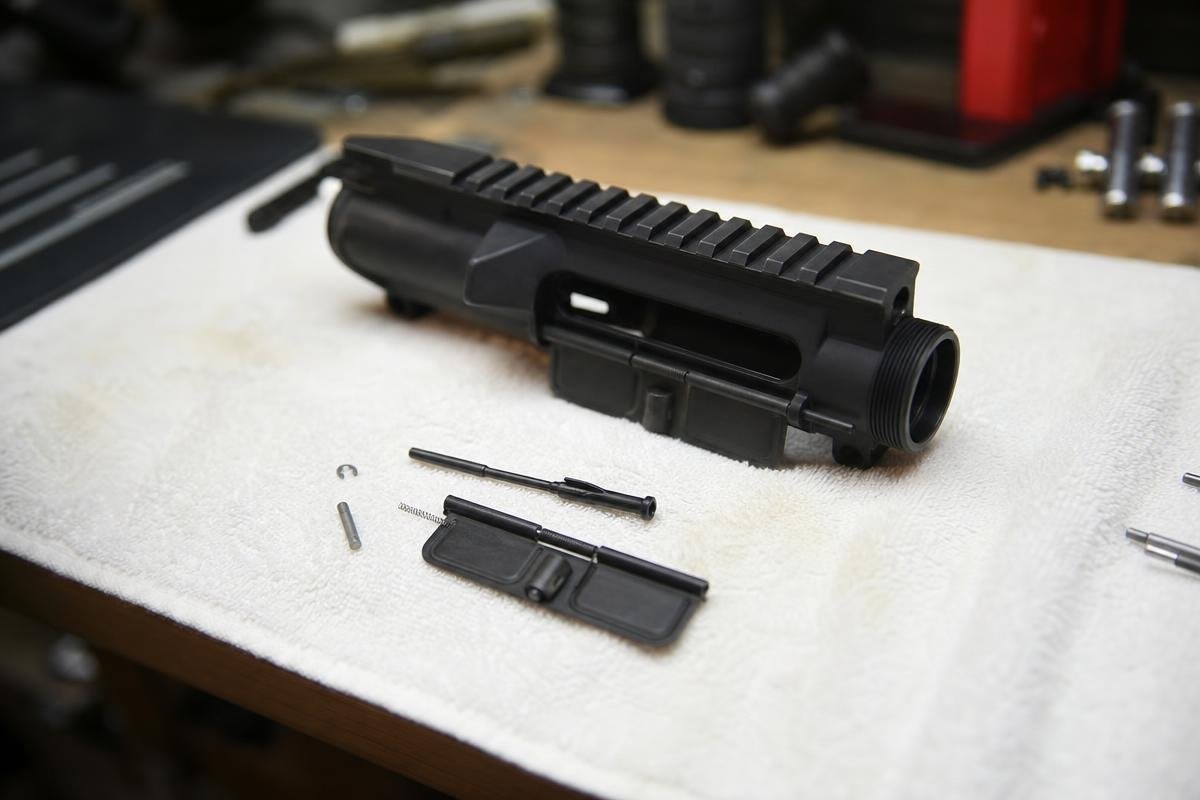
AR-15 dust cover installation is a straightforward bench job. You need the right parts, the right sequence, and a clean workspace. Rush any one of those three and you will be chasing a C-clip across the floor for ten minutes.
Tools and Parts You Need Before You Start
Lay everything out before you touch the receiver. Working over a white towel or a parts tray is not optional. That C-clip is small, fast, and magnetic, so keep a magnet-on-a-stick nearby.
Parts checklist:
- Dust cover panel
- Hinge rod
- C-clip (also called the snap ring)
- Detent
- Detent spring
Tools:
- Small punch or pick
- Small flat-head screwdriver
- Needle-nose pliers (optional but useful)
- Magnet-on-a-stick for C-clip retrieval
The Installation Sequence
Follow this order exactly. Skipping ahead causes problems that require a full teardown to fix.
- Drop the detent spring into the detent hole at the front edge of the ejection port.
- Set the detent on top of the spring.
- Hold the detent down with a punch or pick while you position the cover's tab over it.
- Slide the hinge rod through the receiver ear, through the cover's hinge loop, and out the opposite ear.
- Snap the C-clip into the groove at the end of the hinge rod. Use a punch, not a screwdriver blade.
- Test the cover. It should snap open freely and stay closed under light tension.
If you would rather skip this step entirely, our complete AR-15 uppers ship with the dust cover already installed and function-checked. That is a practical option for North Texas builders who want to go straight to the range at Lake Texoma or the local ranges around Grayson County.
Common Installation Mistakes and How to Avoid Them
Losing the C-clip. Work over a white towel. Keep the magnet close. This is the number one time-waster on this job.
Installing the cover backwards. The tab faces forward, toward the muzzle. If it faces the buffer tube, pull the rod and flip the cover.
Forgetting the detent spring before the detent. If your installation is done but the cover will not stay closed, this is almost always the reason. Tear it down and start the sequence over.
Bending the C-clip. A screwdriver blade torques it out of shape. Use a punch to press it straight into the groove.
Field shooters around Lake Texoma and the Red River bottomlands deal with real debris, red clay dust, and high summer humidity. During Texas dove season in early September and the fall hog and predator runs, a rifle carried through brush picks up grit fast. A properly installed dust cover is not a cosmetic detail out here. It earns its place every time you set the rifle down in the field.
Dust Cover Material and Style Options: What to Know Before You Buy
Not all dust covers are built the same. The material you choose affects weight, durability, and how the cover holds up in real field conditions. Here in North Texas, where summers push past 95 degrees with high humidity off Lake Texoma and winter ice storms roll through Grayson County, that choice matters more than most shooters think.
Mil-Spec Stamped Steel: The Standard
Stamped steel is the right answer for most shooters. It comes phosphate-coated or parkerized, weighs under half an ounce, and fits any mil-spec upper receiver without modification. It handles heat, cold, and hard use without complaint. If you are building a field rifle for hunting the Red River bottomlands or just want a no-drama cover that works, mil-spec steel is where you start. Our complete AR-15 uppers ship with mil-spec steel covers as standard for exactly this reason.
Polymer Dust Covers: Lighter, But Are They Enough?
Polymer covers, like the CMMG polymer kit, are corrosion-proof and shave a few grams off your build. For range use or a general carry rifle, they are adequate. The tradeoff is brittleness. Polymer can crack under hard impact or in extreme cold, and Grayson County does get freezing rain and hard January cold snaps. For a duty rifle or anything that sees rough field conditions, stick with steel. Polymer is a range-day option, not a hard-use solution.
Aftermarket and Custom Options
Strike Industries and similar manufacturers offer stamped steel covers in FDE, blue, red, and black. These are functional equivalents of mil-spec steel, just with color. They fit any mil-spec upper receiver. Custom engraved covers with text or graphics are popular on personalized builds and follow the same dimensional standard. Any mil-spec-dimensioned cover fits any mil-spec upper, full stop.
Titanium covers exist for ultralight competition builds. They offer no functional advantage over steel for the vast majority of shooters. The weight savings on a single dust cover are negligible. Save the titanium budget for parts that actually affect performance, like your barrel or bolt carrier group.
Not sure which cover fits your build? Call us at (888) 706-0633 and we will point you in the right direction.
Complementary Upper Parts That Work Alongside the Dust Cover
The dust cover does not work in isolation. It is one piece of the right-side upper receiver system, and understanding how the surrounding components interact with it makes you a better builder and a better troubleshooter. Here is what you need to know about the parts that live alongside it.
The Charging Handle: What Interacts With the Dust Cover
Pulling the charging handle rearward does not directly open the dust cover. What actually opens it is the bolt carrier group moving rearward and striking the detent tab on the cover panel. The BCG does the work. The charging handle just initiates the cycle.
That said, your charging handle choice still matters here. If you are running your rifle in the field around Grayson County with gloves on during a cold December sit, an extended-latch charging handle gives you a much more positive grip. Fumbling with a standard latch in cold or wet conditions slows everything down. Extended-latch models from brands like Radian or Strike Industries are a straightforward upgrade.
The Forward Assist and Its Role
New builders confuse these two constantly. The forward assist is the serrated button on the right side of the upper receiver, positioned just above and behind the dust cover. It has no mechanical connection to the dust cover at all. Its job is to manually push the bolt carrier group into the battery if it fails to close fully. Two separate components. Two separate functions. Do not mix them up.
Upper Parts Kits: Getting Everything at Once
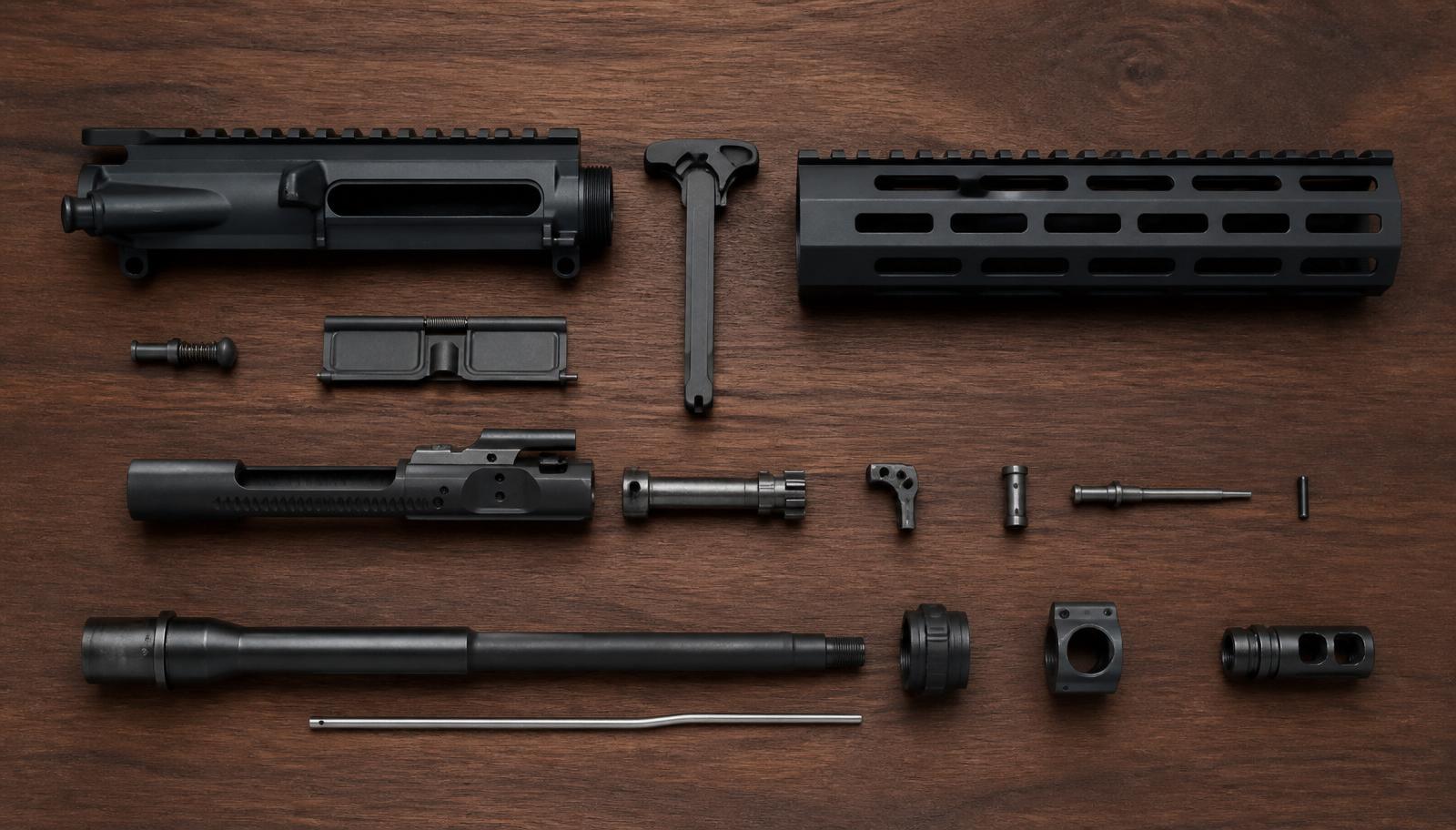
A standard upper parts kit covers the complete dust cover assembly, the forward assist assembly, and typically the barrel nut. Buying a UPK prevents the common mistake of sourcing parts individually and missing a small component like the C-clip or detent spring. One order, everything you need.
If you would rather skip the parts-hunting process entirely, our complete AR-15 upper receivers ship already assembled, headspaced, and function-checked. The dust cover, forward assist, and all upper parts are installed and verified before the box leaves our Denison-area shop.
Dust Cover Maintenance and Troubleshooting
The dust cover is a low-maintenance part, but it does fail in specific ways. Knowing the failure modes saves you a frustrating range session. Here is what to check and when to fix it.
Keeping the Dust Cover Functional During Cleaning
During routine AR-15 parts cleaning, wipe the cover panel and hinge area with a lightly oiled cloth. That is all it needs. Do not spray solvent directly into the detent hole. Solvent will flush out the grease that keeps the detent spring seated, and the cover will start to feel loose over time.
If you shoot near Grayson County's lakes or in the bottomlands south of Sherman, humidity is a real factor.
Surface rust on steel covers builds up faster here than in dry climates, especially through the muggy stretch from June to September. A quick wipe after every field session keeps it clean. Polymer covers skip this issue entirely, but steel covers earn their keep in durability if you stay on top of it.
When the Cover Won't Stay Closed or Won't Open
Three distinct problems show up here, each with a different fix.
Won't stay closed: The detent spring has gone soft or the detent is worn. Replace both. They come in standard upper parts kits and cost almost nothing.
Won't pop open automatically during firing: Inspect your bolt carrier group. The rear face of the carrier that strikes the cover may be gummed up or the cover hinge may be binding. This is a full upper inspection item, not just a cover issue.
Opens but flops back shut during firing: The C-clip is missing or the hinge rod is bent. Pull the rod, check it, and replace the clip.
When to Replace the Dust Cover Assembly
The dust cover is a long-service part under normal use. Replace it when the polymer panel is cracked, the hinge rod is visibly bent, or the cover no longer snaps closed with firm, positive tension. A cover that rattles open during carry is no longer protecting your ejection port from debris. At that point, a new assembly is the right call, not a field adjustment.
Building in Denison, TX: Why Your Upper Assembly Matters in This Climate
Grayson County summers regularly push past 95 degrees with humidity that rolls in from the south. That moisture accelerates surface rust on exposed steel faster than most shooters expect. An uncovered ejection port sitting in those conditions is not a theoretical problem. It is a real one.
Hunters and field shooters working the cross-timbers terrain between Sherman and Denison know what red clay dust does to a rifle. It packs into every opening it can find. The ejection port cover is your first line of defense against that. Close it during carry. Every time. This is not a formality in this part of Texas.
Winter brings ice and freezing rain. Spring brings pollen and more clay dust. A functioning dust cover earns its keep across all four seasons here, not just during summer range days. If you are running a 5.56 NATO complete upper or any other caliber through field conditions in this region, keeping that port sealed during transport is a practical reliability measure.
We are based at 2022 S Crockett St, Sherman, TX 75090, just a few miles south of Denison. Every complete upper we build is assembled, headspaced, and function-checked before it ships to your door, and most in-stock orders leave the same business day.
Ready to build or upgrade? We carry complete dust cover assemblies, upper parts kits, and complete AR-15 uppers assembled and function-checked before they ship. Stop by our shop at 2022 S Crockett St, Sherman, TX, or call us at (888) 706-0633 with any build questions.