Mil-spec vs. commercial AR-15 parts explained: where the difference actually exists (mainly buffer tubes), where it's just marketing, and what to buy.
The mil-spec vs. commercial debate is one of the most misunderstood topics in the AR-15 world. Marketing has stretched "mil-spec" to cover almost every part on the rifle, when in practice there's only one place the distinction creates a real, physical incompatibility: the buffer tube. Everywhere else, "mil-spec" functions as a claim about materials, processes, and testing, a claim that varies in how strictly a given manufacturer actually holds to it. Here's the accurate breakdown, including where the term is legitimate, where it's marketing noise, and how to evaluate a "mil-spec" claim on any given part. As always, verify your federal, state, and local laws before buying, building, or modifying any firearm component.
What "Mil-Spec" Actually Means
"Mil-spec" is short for "military specification." Historically it referred to the Technical Data Package (TDP) the U.S. military maintains for the M16/M4 platform, a set of engineering drawings, material callouts, dimensional tolerances, coatings, and inspection procedures a part has to meet to be accepted for issue. That TDP is not a single, tidy public document a consumer can pull up and check a civilian part against. Portions have been published or leaked over the years, but there's no unified, freely available "mil-spec AR-15 parts list" that a manufacturer's marketing claim can be verified against without direct comparison to government drawings.
Civilian manufacturers adopted "mil-spec" as informal shorthand for "matches the TDP's dimensions and materials as closely as we can determine." Some brands hold to that rigorously, sourcing the correct steel alloys, running the correct heat treatment, and testing to the same standards. Others use "mil-spec" as a pure marketing adjective with no verification behind it at all. There's no enforcement body policing the term on commercial parts, no trademark, and no third-party certification mark equivalent to, say, a NIST calibration stamp.
"Mil-spec" on a civilian AR-15 part is a self-declared claim, not a certification. Quality still depends on the manufacturer standing behind it.
The Real Dimensional Difference: Buffer Tubes
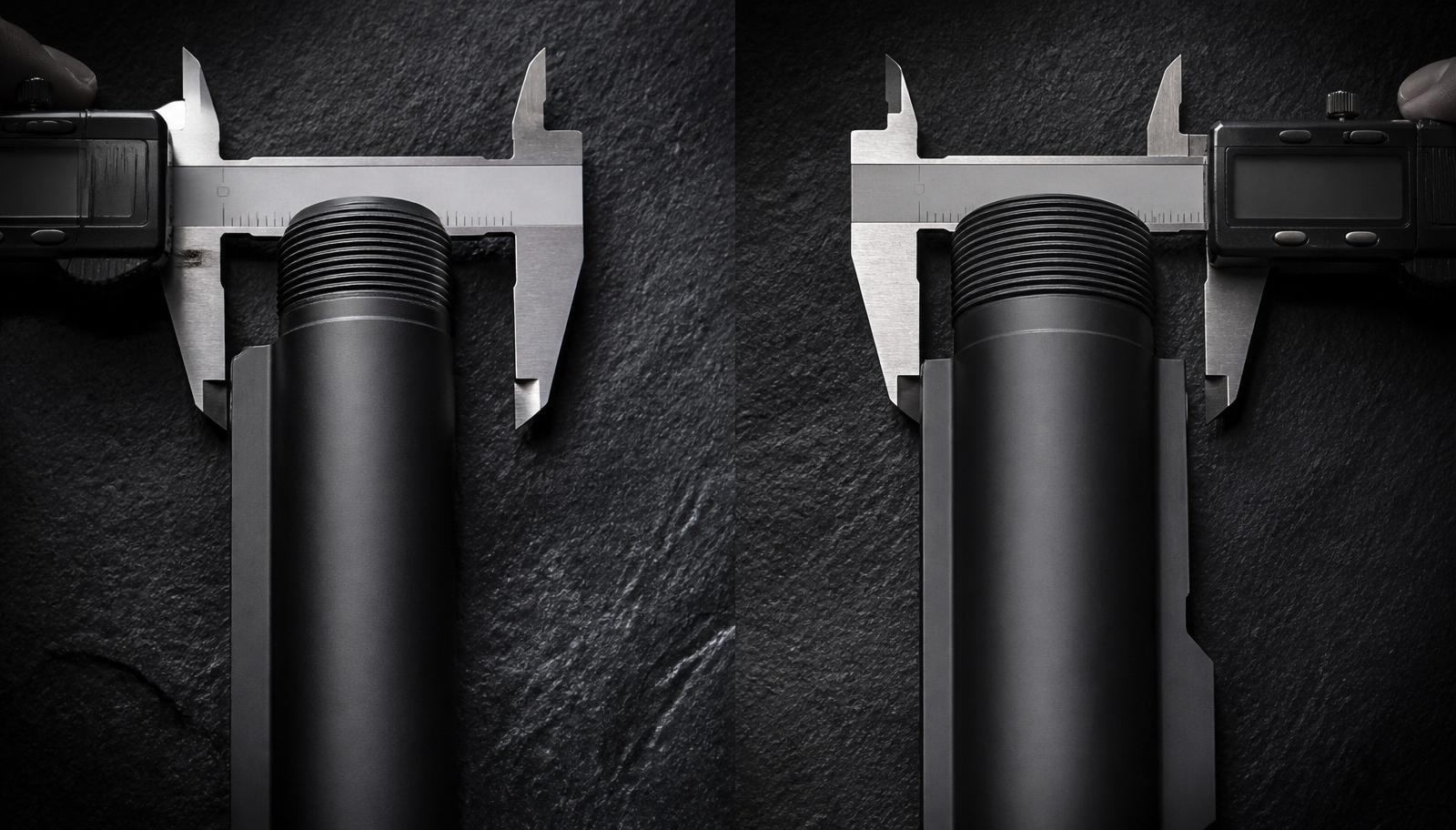
The one place where mil-spec vs. commercial is a hard, physical, non-negotiable difference is the buffer tube, also called the receiver extension. Note this is entirely a lower receiver and stock issue; it has nothing to do with the upper receiver, barrel, or BCG. The two buffer tube types are different outside diameters and use differently sized stocks.
Because the threads at the front of the tube are identical, both types screw into the same lower receiver's threaded extension boss. The mismatch shows up only at the stock. A mil-spec stock slid onto a commercial tube fits loosely, with visible play and no positive lock at the stock's detent. A commercial stock won't slide onto a mil-spec tube at all; the diameters are too far apart to force it.
Most stocks made in the last decade default to mil-spec, and the large majority of new AR-15 rifles ship with mil-spec buffer tubes today. Commercial tubes are still common on some older builds and certain proprietary stock systems. If you're buying a bare stock or a replacement tube, mil-spec is the safer default purely because of parts availability and stock selection, not because it's inherently stronger; the diameter difference alone doesn't make one tube tougher than the other.
What Mil-Spec Means on the Upper Side
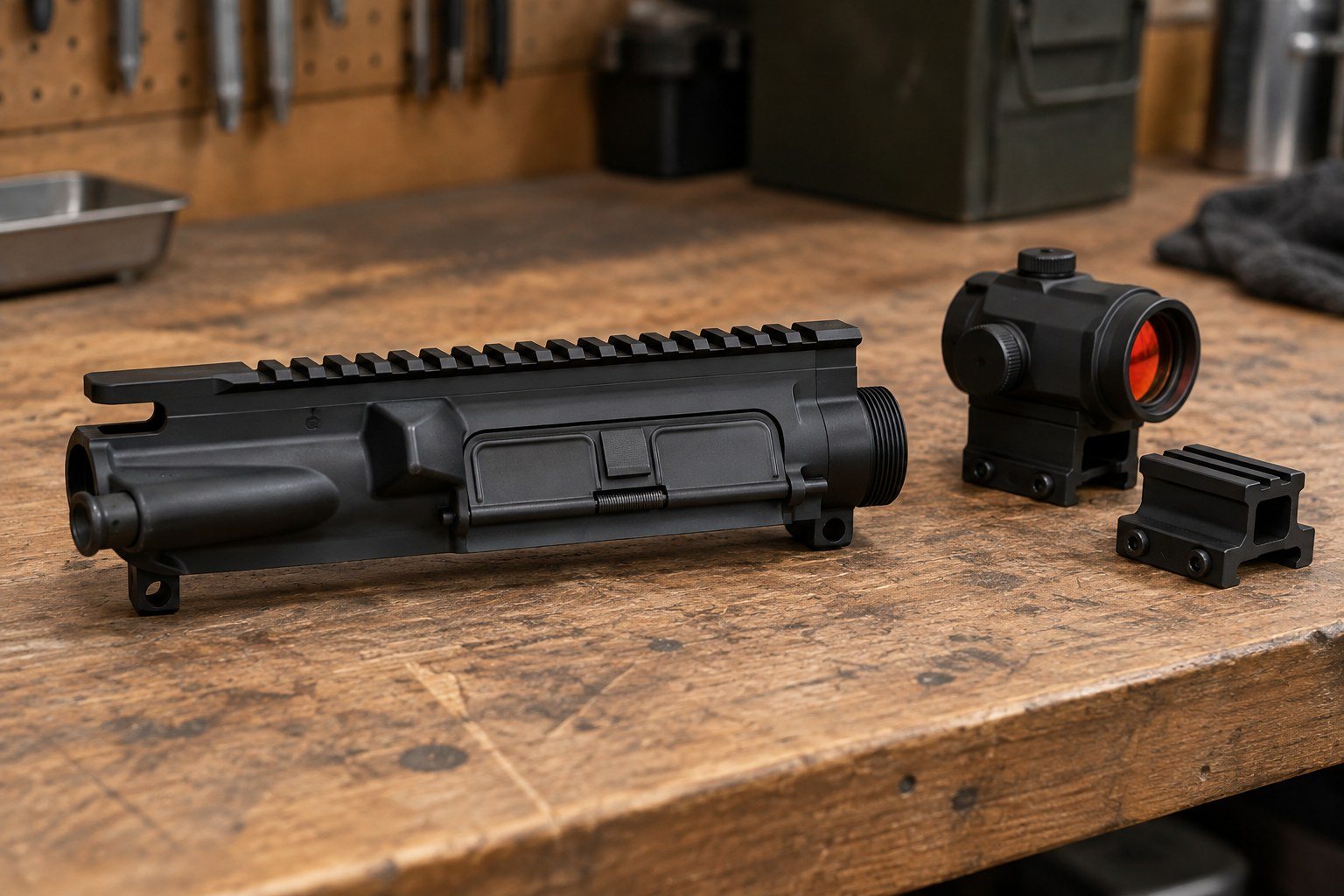
Unlike the buffer tube, there's no separate "commercial dimension" for AR-15 upper receivers. Every complete upper on the market uses the same barrel extension socket, the same bolt carrier channel, and the same takedown pin spacing as the original TDP. What varies between "mil-spec" and lower-tier uppers is process and material quality, not size:
- Forging and alloy. Mil-spec uppers are forged from 7075-T6 aluminum, then machined to final dimensions. Forging aligns the metal's grain structure for strength; some budget uppers are machined from cast or billet 6061, which is workable but generally softer and less fatigue-resistant than forged 7075.
- M4 feed ramps. Mil-spec uppers cut feed ramps partway into the upper receiver itself (extending the barrel extension's ramps), improving feeding reliability with a wider range of magazines and ammunition. Older A1/A2-pattern uppers cut ramps only into the barrel extension.
- Type III hardcoat anodizing. Mil-spec uppers get a Type III, Class 2 hardcoat anodized finish (per the retired MIL-A-8625 standard many manufacturers still reference), which is thicker and harder than the cosmetic Type II anodizing used on some lower-cost parts.
- F-marked front sight base. On builds using a fixed front sight base rather than a low-profile gas block, an "F-marked" base sits roughly 0.050 inch taller to keep the sight picture correct on M4-feed-ramp barrels, which sit slightly higher in the receiver than older barrel profiles.
- Barrel steel and lining. Mil-spec barrels use 4150 chrome-moly-vanadium (CMV) steel, chrome-lined bores and chambers for corrosion resistance and heat tolerance, and a 1:7 twist rate for 5.56 NATO. Stainless and nitride-treated barrels aren't "mil-spec" by the letter of the term but frequently match or exceed it in accuracy and longevity.
- MPI and HPT. Mil-spec barrels and bolts undergo Magnetic Particle Inspection (MPI) to detect subsurface cracks and a High Pressure Test (HPT) firing proof rounds well above standard pressure. These two tests, not the word "mil-spec" itself, are the best objective signal a critical part was actually quality-checked.
Other Parts Marketed "Mil-Spec"
You'll see "mil-spec" applied to nearly every part of an AR-15. Here's what it actually implies for each:
- Bolt carrier group. Mil-spec BCGs use Carpenter 158 steel with a phosphate (parkerized) finish, are MPI/HPT tested, and have a properly staked gas key. Non-mil-spec BCGs may use different steels or coatings and may exceed mil-spec quality (nickel boron, DLC) or fall short of it. Read the actual spec sheet, not the label.
- Lower receiver. Same story as the upper: mil-spec dimensions (pin spacing, magazine well geometry, trigger pocket) are the de facto industry standard across almost every manufacturer.
- Trigger. Mil-spec triggers are the standard single-stage design pulling roughly 5.5 to 8 pounds. Aftermarket "enhanced" triggers are usually lighter and crisper, and aren't trying to be "mil-spec" at all.
- Charging handle. No meaningful mil-spec vs. commercial split here; it's a dimensional non-issue. See the charging handle guide for what actually differentiates charging handles.
How to Evaluate a "Mil-Spec" Claim
Since there's no single public checklist and no certifying body, the practical move is to skip the word "mil-spec" entirely and look for the specifics it's supposed to represent:
- For a barrel, look for the steel type (4150 CMV or better), lining (chrome-lined bore and chamber, or an equivalent nitride process the maker documents), twist rate, and confirmation of MPI/HPT testing.
- For a BCG, look for Carpenter 158 or an explicitly named equivalent, a staked or Loctite-and-staked gas key, a properly staked extractor pin, and MPI/HPT testing.
- For an upper or lower receiver, forged 7075-T6 with Type III hardcoat anodizing is the baseline most reputable brands meet; billet receivers trade that heritage for machining precision and aesthetics rather than sacrificing strength in any way that matters for a typical rifle.
- For a buffer tube, the only question that matters is the measured outside diameter, since that's the one place "mil-spec" versus "commercial" is a real fork in the road.
A listing that names actual materials, coatings, and test procedures is a stronger signal than one that only says "mil-spec" with no supporting detail.
Which Should You Buy?
- Buffer tube: Mil-spec, by default. Broader stock selection and it's the more common standard on new builds.
- BCG: Buy on documented quality signals (MPI/HPT tested, staked gas key, Carpenter 158 or better steel), not the mil-spec label alone.
- Upper and lower receivers: Any reputable manufacturer's forged, mil-spec-dimensioned receiver is a safe baseline. All are dimensionally interchangeable regardless of brand.
- Everything else: The "mil-spec" label doesn't meaningfully narrow your choices. Buy on actual specs and manufacturer reputation, and confirm your local laws cover the build or modification you're planning.
For a deeper look at the upper receiver itself, see the complete upper receiver guide, the billet vs. forged guide, or our BCG buying guide for more on evaluating bolt carrier groups. If you're speccing a full build, our upper anatomy and parts list and gas system length guide cover the remaining decisions.