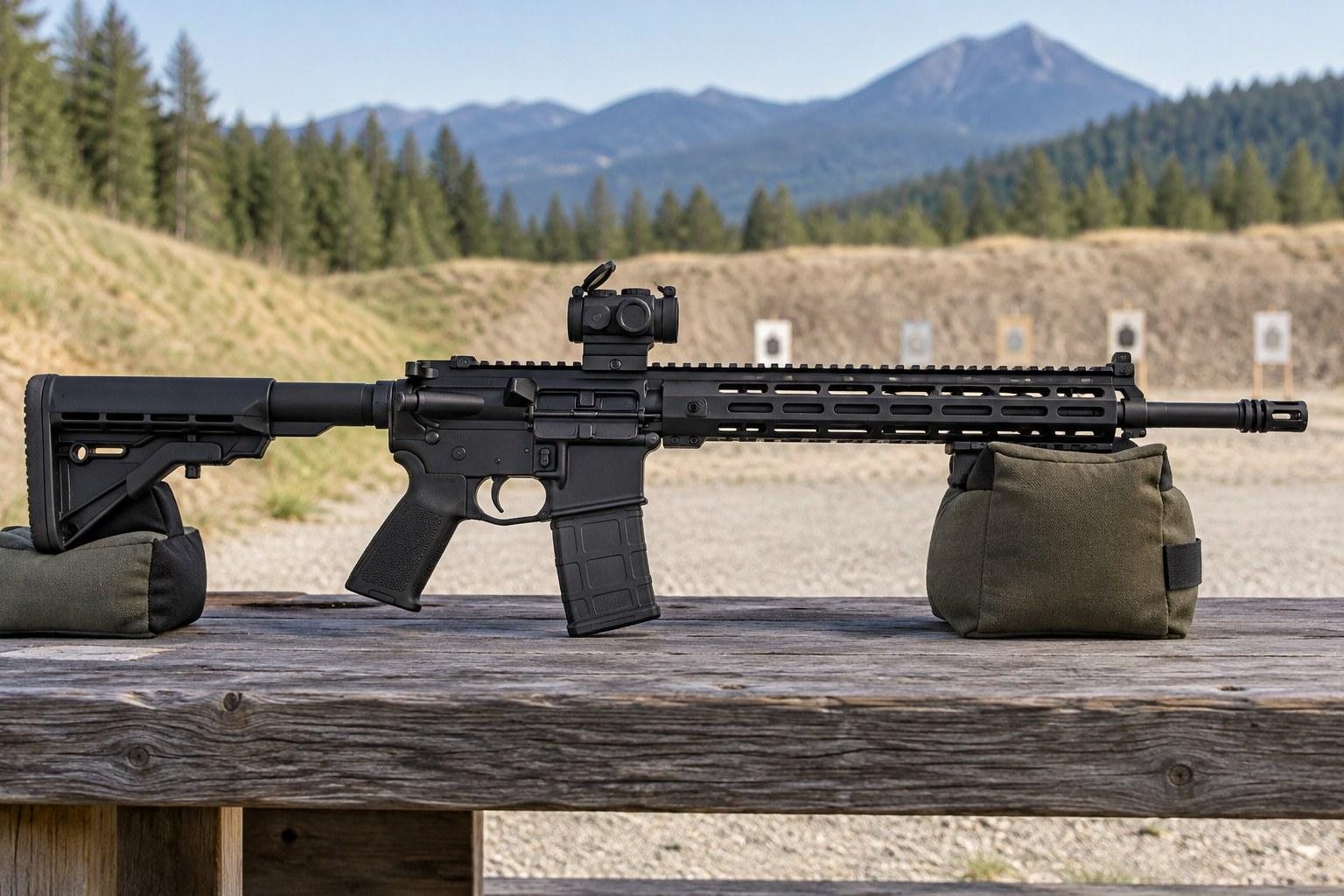
A complete AR-15 upper receiver parts list explaining what each part does, how it interacts with the rest of the group, and where it commonly fails.
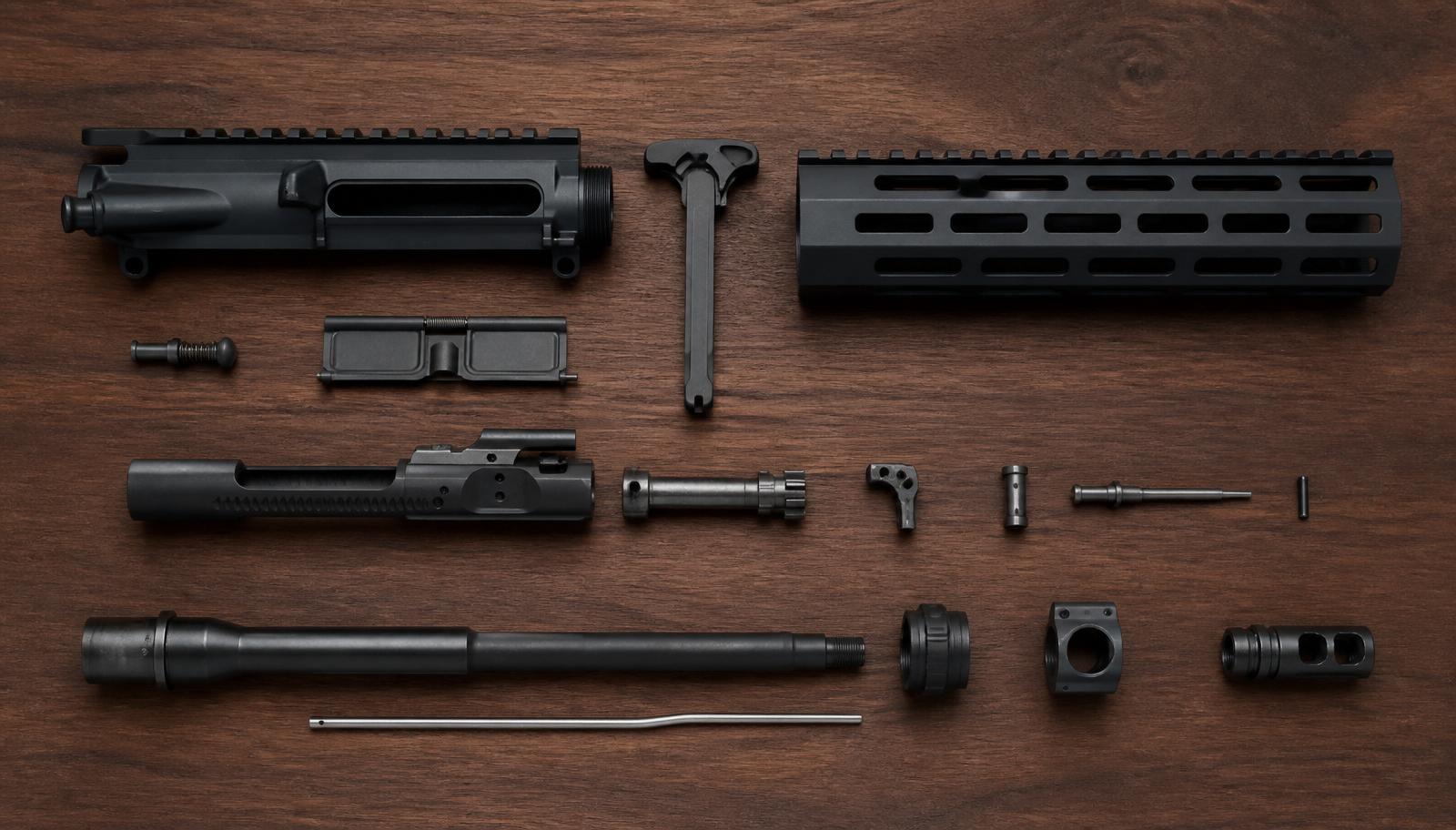
The AR-15 upper receiver group is where the mechanical work of firing actually happens: the bolt locks, the round fires, gas cycles the action, and the empty case ejects, all inside or attached to the upper. Understanding what each part does turns a lot of AR-15 conversations from confusing to obvious. This is a full parts-by-part walkthrough of a complete upper, roughly in the order you'd encounter each piece if you took one apart. As always, verify your federal, state, and local laws before buying, building, or modifying any firearm part.
The Upper Receiver (Housing)
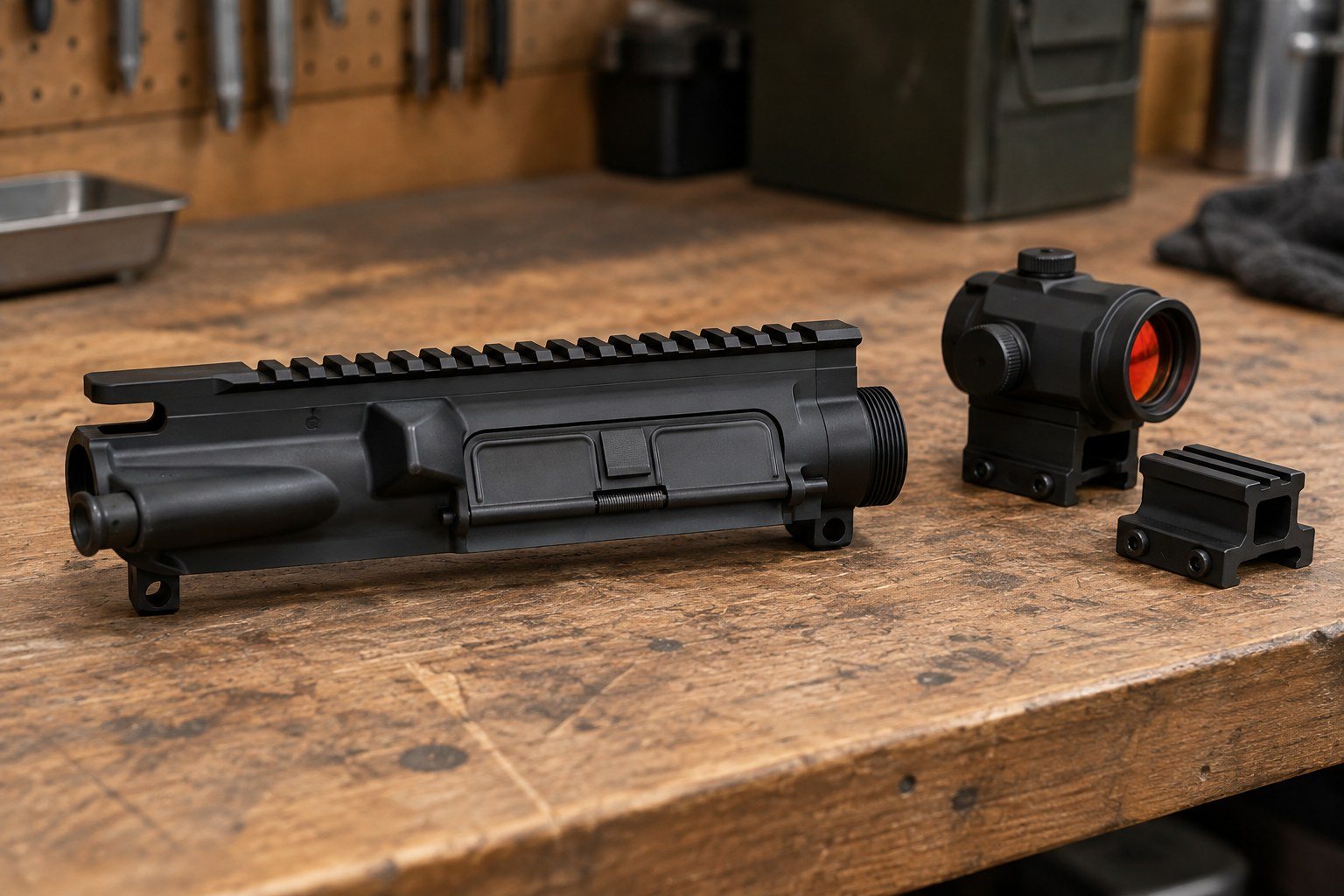
The upper receiver itself is the machined 7075-T6 aluminum housing everything else attaches to. It has a threaded barrel socket at the front, a Picatinny rail on top for optics, and channels on the sides that let the charging handle and bolt carrier group slide back and forth. It also carries the ejection port on the right side and, on most mil-spec designs, a forward assist bump just behind it.
The receiver doesn't contain chamber pressure when the rifle fires; that job belongs to the steel barrel extension and bolt, covered below. That's exactly why the AR-15's aluminum receiver can be so light without failing: it's a housing and alignment fixture, not a pressure vessel.
Receivers are made two ways: forged (hammered into shape under pressure, then machined) or billet (CNC-machined from a solid block). Both are strong enough for any normal use; the differences are mostly cosmetic and dimensional. See our billet vs. forged uppers guide for the manufacturing tradeoffs.
Two details on the receiver matter more than the forged-or-billet label. First, the front and rear takedown lugs on the bottom have to fit your lower; a mil-spec upper will mate with any mil-spec lower, but tolerances vary, so a little wobble between the two halves is normal and does not affect accuracy. Second, check whether the receiver has M4 feed ramps cut into its front face. They should line up with matching ramps on the barrel extension; a mismatched pair can cause rounds to nose-dive into the extension and fail to feed.
Ejection Port, Dust Cover, and Brass Deflector
The ejection port is the rectangular opening on the right side of the receiver that spent cases fly out of. It's sized to clear a case even if the bolt cycles hard, and it's the same opening you look through to check the chamber during a safety check.
A hinged dust cover closes over that opening when the rifle is at rest, keeping rain, sand, and debris out of the action. It's held shut by spring tension and pops open automatically the first time the bolt carrier group cycles, whether from firing or from manually racking the charging handle. It has no effect on function beyond keeping the action clean, but it's standard on essentially every mil-spec and commercial upper.
Just above and behind the ejection port is the brass deflector, a small raised fin cast into the aluminum. It doesn't do much for a right-handed shooter, but it deflects ejecting brass down and away from a left-handed shooter's face instead of across it.
The ejection port also doubles as a free diagnostic tool. On a right-handed rifle, spent cases from a healthy, properly gassed gun usually land somewhere between the 2 and 4 o'clock positions relative to the muzzle. Brass consistently thrown forward toward 1 o'clock often points to an under-gassed or dirty action, while cases flying back toward 5 o'clock suggest the rifle is over-gassed, a common symptom when a suppressor is added.
Forward Assist
The forward assist is a spring-loaded, serrated plunger mounted on the right rear of the receiver, just ahead of the charging handle. Pressing it in pushes a pawl against the bolt carrier's serrations, nudging the bolt fully into battery if it hangs up short of locking.
It's a holdover from the rifle's military origins: early M16s sometimes needed a manual push to seat a round when the action was dirty or under-lubricated, giving soldiers a quiet way to do that without racking the handle and ejecting a good round. Civilian shooters running clean, well-maintained rifles rarely if ever need it, and some upper receivers, called "slick-side" uppers, omit the feature to save weight and cost. Neither configuration is more or less reliable; it's a preference decision, not a functional one.
Bolt Carrier Group (BCG)
The bolt carrier group is the moving assembly that cycles inside the upper receiver every time you fire, and it's the most complex subassembly in the rifle. It's built from several parts:
- Bolt carrier. The tube-shaped piece that houses everything else and rides in the receiver's internal channels; its weight and geometry set the timing of the action.
- Bolt. The rotating locking piece with seven lugs that engage the barrel extension, sealing the chamber during firing.
- Extractor. A spring-loaded hook on the bolt face that grips the case rim and pulls the empty case from the chamber as the bolt moves rearward.
- Ejector. A spring-loaded plunger set into the bolt face that flicks the extracted case out through the ejection port.
- Gas rings. Three thin rings on the bolt tail that seal against the carrier so gas pressure pushes the carrier rearward instead of leaking past the bolt.
- Cam pin. A hardened pin through the bolt and carrier; as the carrier moves, it forces the bolt to rotate and unlock from the barrel extension.
- Firing pin and retaining pin. The firing pin strikes the primer when driven forward by the hammer; a small cotter-style retaining pin keeps it captured in the carrier.
Nearly every upper-related malfunction traces back to one of three parts in the BCG: the extractor, the gas rings, or the gas tube it works against.
BCGs are sold in several coatings, phosphate (mil-spec parkerizing), nitride (black nitride or QPQ), nickel boron, and DLC. All are strong enough for normal use; the real differences are cleaning ease and fouling resistance, not reliability. Two quick checks tell you a lot about any BCG. The gas key on top of the carrier should be secured by two screws that are staked, meaning metal from the carrier has been punched into the screw heads so they cannot back out; a loose gas key leaks gas and causes short-stroking. And a simple gas ring test works on the bench: collapse the bolt into the carrier, stand the assembly on the bolt face, and if the carrier slides down under its own weight, the rings are worn and due for replacement. For a full breakdown of coatings and how to pick a BCG, see our BCG buying guide.
Charging Handle
The charging handle is the T-shaped lever at the rear of the upper receiver that you pull to manually cycle the bolt carrier group: to chamber the first round, clear a malfunction, lock the bolt to the rear, or verify the chamber is empty. It rides in a dedicated channel above the BCG and does not move during firing.
Standard charging handles have a single small latch on the left side. Extended and ambidextrous versions add a larger latch, or a latch on both sides, so the handle can be worked without breaking a cheek weld, which matters more as more optics and accessories get mounted forward on the rifle. If you run a suppressor, look at gas-busting charging handles too. A can raises back pressure, and some of that gas vents out around the handle and into the shooter's face; handles with internal seals or deflectors reduce that noticeably. See the charging handle guide for a deeper breakdown of the options.
Barrel and Barrel Extension
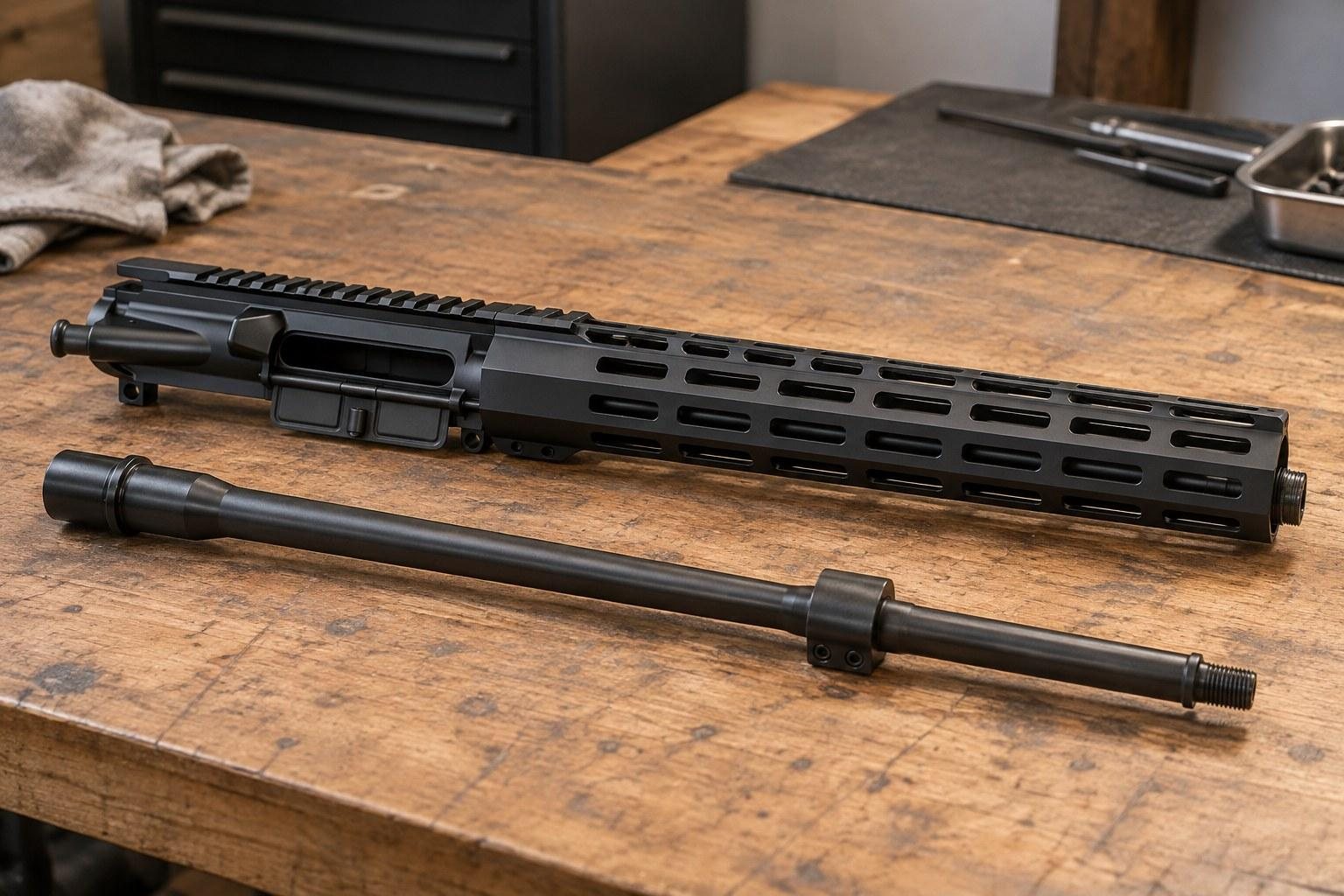
The barrel is a steel tube with a rifled bore and a chambered rear end. Its length, twist rate, and profile define most of what the rifle is capable of downrange: velocity, effective range, and how well it stabilizes a given bullet weight.
On a typical 5.56 upper you will see twist rates of 1:7, 1:8, or 1:9 inches. Faster twists (1:7, 1:8) stabilize heavier bullets in the 62 to 77 grain range, while 1:9 handles standard 55 grain loads well but can struggle with the heaviest projectiles. Profile matters too: a lightweight or pencil profile saves weight for carry rifles, while government and heavy profiles hold accuracy longer during strings of rapid fire because they heat up more slowly. Length is also a legal question. Under federal law, a rifle with a barrel shorter than 16 inches is a short-barreled rifle regulated under the NFA, and pistol-configuration builds bring their own rules. The 2023 ATF pistol brace rule has since been vacated by the courts, but federal guidance and state laws continue to change, so check current federal and state law before building anything short.
The chamber end of the barrel carries the barrel extension, a separate steel piece with locking lugs matching the bolt's lugs. When the bolt rotates and locks, it locks into this extension, not into the aluminum receiver. The extension and bolt together contain the pressure generated when a round fires; the receiver only holds the two in alignment. The barrel extension is also where headspace is set: the distance between the bolt face and a reference point in the chamber. Pairing a new bolt with a barrel should always be verified with go and no-go gauges. That's the mechanical reason an AR-15 upper can use a comparatively light aluminum housing without any loss of strength where it counts.
Gas Block and Gas Tube
The gas block clamps or pins onto the barrel over a small hole called the gas port. When the rifle fires, expanding propellant gas bleeds off through that port before the bullet leaves the muzzle, and the gas block redirects it rearward.
From the gas block, that gas travels through the gas tube, a thin stainless steel tube running back into the upper receiver and into the BCG's gas key. Pressure entering the key pushes the carrier rearward relative to the still-locked bolt, which rotates the bolt free and drives the whole cycle of unlocking, extraction, ejection, and reloading. It's a small, cheap, unglamorous part that the entire action depends on.
Most gas blocks are sized for a 0.750 inch barrel journal, though some heavy and bull barrels use 0.875 inch or 0.936 inch, so measure before you order. Low-profile blocks sit under a free-float handguard, while traditional front sight base blocks double as a front sight. If the block is set screw mounted, it must sit squarely over the gas port; a block that has shifted even slightly will starve the action of gas.
Gas systems come in four standard lengths, pistol, carbine, mid-length, and rifle, each paired to a range of barrel lengths to keep the action's timing correct. Running the wrong length for a given barrel is a common cause of unreliable cycling. See our gas system length guide for the pairing chart.
Handguard
The handguard is the tube, or two-piece clamshell on older designs, that surrounds the barrel and gas system. It protects your support hand from a barrel that gets genuinely hot after sustained firing, and it provides mounting surfaces, M-LOK, KeyMod, or Picatinny depending on the model, for lights, foregrips, slings, and other accessories.
Modern handguards are almost always free-floating, attaching only to the receiver's barrel nut rather than the barrel itself. That keeps grip pressure, a bag rest, or a mounted bipod from touching the barrel, which keeps harmonics consistent and generally improves practical accuracy over older drop-in handguards that contacted the barrel directly. Because a free-float handguard clamps to the barrel nut, that nut is a key part in its own right: it is threaded onto the receiver and torqued, typically within a 30 to 80 ft-lb range on mil-spec designs, to hold the barrel extension tight against the receiver face. Handguard length is usually matched to the gas system, so the gas block ends up just past the end of the rail or tucked under it: roughly 7 inches for carbine gas, 9 to 10 inches for mid-length, and 12 inches or more for rifle length. Many shooters also pick a length that leaves room for their support hand and mounted light without crowding the muzzle device. The handguard buying guide covers length selection, mounting standards, and gas system clearance.
Muzzle Device
The muzzle device threads onto the barrel's crown at the front of the upper. It's the last part the bullet passes before leaving the rifle, and it's also removable and swappable without any gunsmithing, just the correct thread pitch and a wrench.
Common types include flash hiders (reduce visible muzzle flash), muzzle brakes (vent gas sideways and rearward to cut felt recoil, at the cost of more side blast), compensators (vent gas upward to fight muzzle rise), and thread protectors (a plain cap with no ballistic function). Choosing between them trades off recoil control, flash signature, and blast for shooters next to you. Thread pitch has to match the barrel: 1/2x28 is the standard for 5.56 and .223, while .30 caliber barrels such as .300 Blackout typically use 5/8x24. Most devices are timed with a crush washer or shims so their ports face the right direction, and brakes in particular should be timed correctly so the gas vents evenly. Our muzzle devices guide compares the categories side by side.