The 338 ARC is one of the most capable long-range cartridges you can run on a standard AR-15 platform, and if you shoot in North Texas, where crosswinds off the Red River Valley can wreck a lighter bullet at distance, it deserves a serious look. We build 338 ARC uppers to order at our shop in Sherman, TX, serving the Denison area, each one assembled, headspaced, and function-checked before anything ships to your door.
Here you'll find exactly what you need for a 338 ARC build set up for long-range shooting, from barrel selection to bolt carrier group to magazines, so you can stop guessing and start building. Ready to build your 338 ARC upper? We can put together exactly what you need.
Does the 338 ARC Actually Perform at Distance?
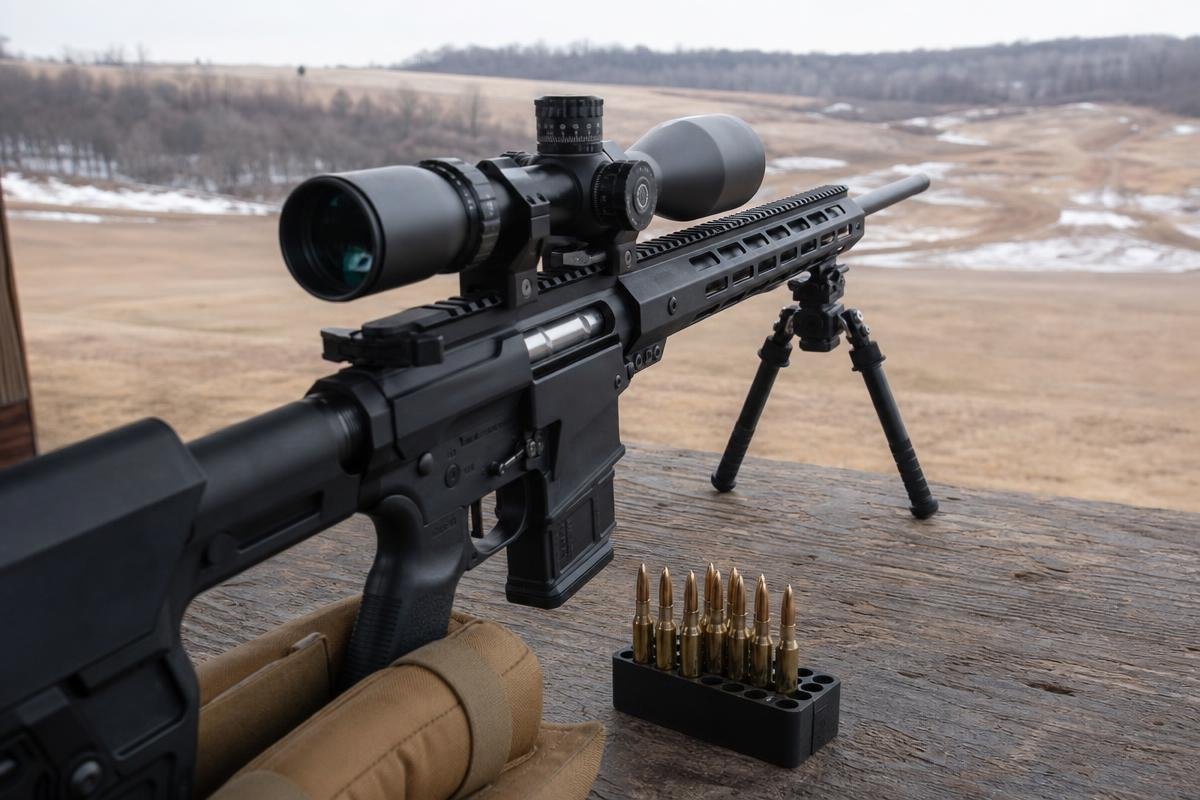
Shooters across the Red River Valley know the crosswinds don't forgive light bullets at distance. That raises a fair question: does a .338-caliber round in an AR-15-pattern rifle actually earn its keep past 500 yards, or is it a marketing story dressed up in ballistic data?
This article answers that with real numbers, not spec-sheet claims. We cover the 338 ARC's ballistic profile, barrel and twist rate requirements, how it stacks up against competing long-range AR calibers, and a practical build path for North Texas shooters. AR15Parts.com carries 338 ARC uppers built to order, built and verified in-house before they ship to your door.
What Is the 338 ARC and Why Does It Matter for Long-Range Work?
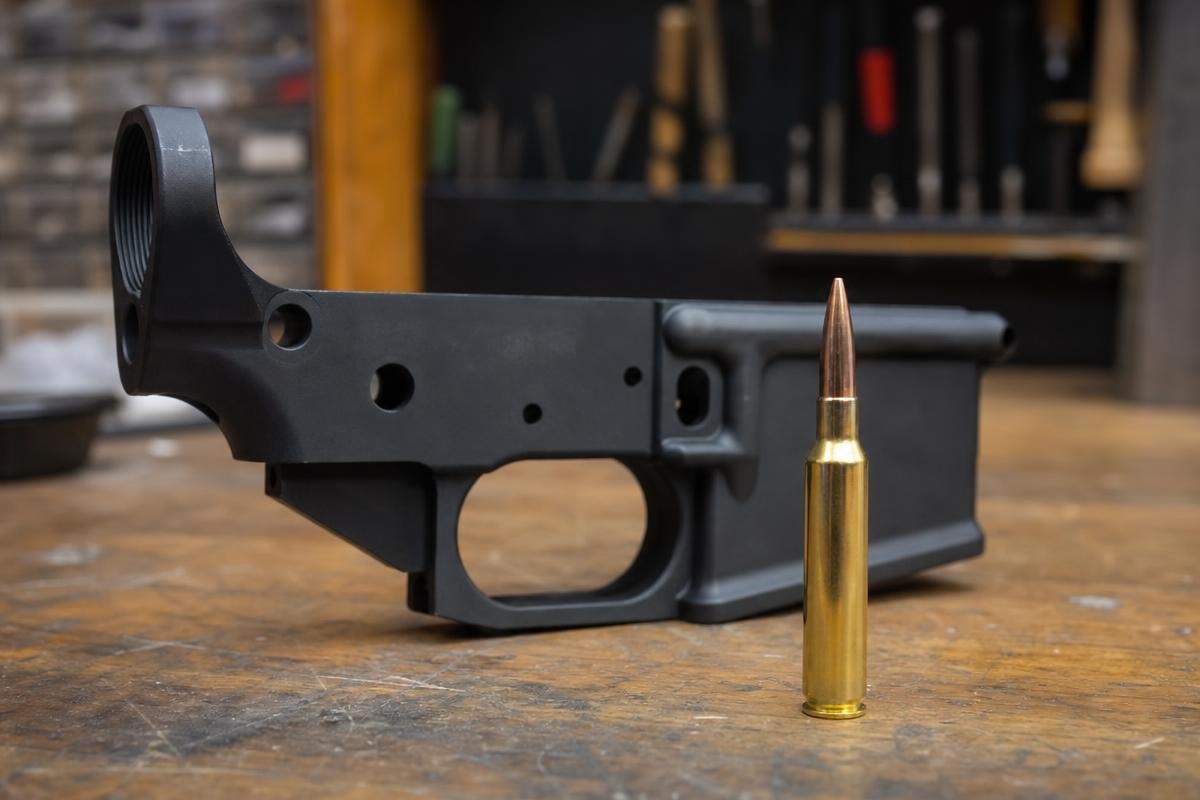
The 338 ARC is a purpose-built long-range cartridge designed to run in an AR-15 platform without requiring a larger action. It fills a real gap. The 6mm ARC handles target work out to 1,000 yards with lighter bullets, but once you push past that distance or move into large-game hunting territory, you need more bullet weight and more retained energy. The 338 ARC delivers both without forcing you into a bolt gun or an AR-10 chassis.
Cartridge Origins and Design Intent
The 338 ARC was developed to bring genuine .338-caliber performance to the AR-15 format. Where the 338 Lapua Magnum requires a full-length magnum action and a rifle that weighs north of 15 pounds, the 338 ARC runs in a standard lower. The case uses a rebated-rim design, which allows it to headspace correctly on a modified bolt face without changing the lower receiver, trigger group, or stock. That is a meaningful engineering distinction.
Typical bullet weights run from 185 to 300 grain. For long-range performance at distance, the 185 to 215 grain range is the practical sweet spot. Quality match bullets in that window carry ballistic coefficients above 0.500, which is what you need when persistent valley crosswinds are pushing hard across a 500 to 800 yard range.
How the 338 ARC Fits Into the AR-15 Platform
A dedicated upper is required. That means a new barrel, bolt carrier group, and chamber cut for the 338 ARC. The lower receiver, trigger, buffer, and stock you already own carry over directly. The lower stays. The upper does the work.
If you already run an AR-15 in 5.56 or 6mm ARC, stepping up to the 338 ARC does not mean buying a complete rifle. You buy a 338 ARC complete upper built to order and drop it onto your existing lower. For Grayson County shooters evaluating whether to step up their long-range setup, that is a straightforward cost argument in favor of making the move.
Ballistic Performance: What the 338 ARC Delivers at Distance
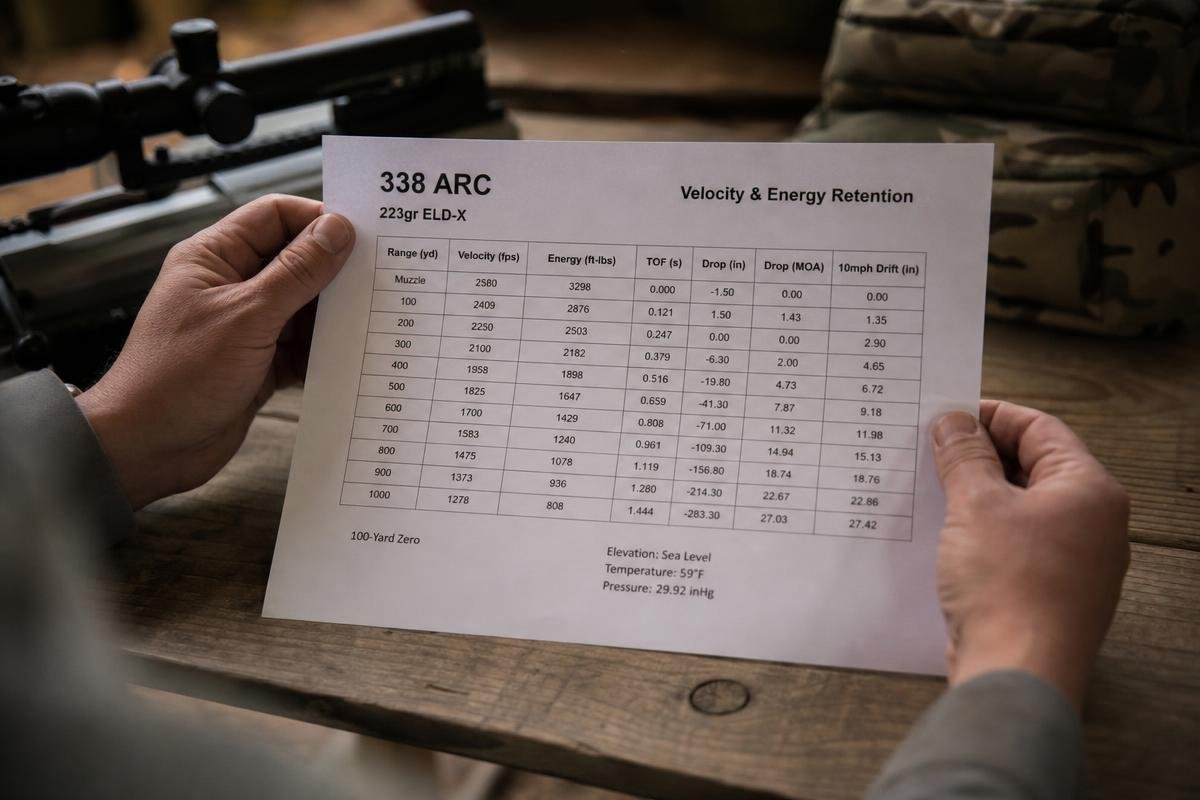
The 338 ARC launches a 200-grain match bullet at roughly 2,500 to 2,600 fps from a 20-inch barrel. That combination of bullet weight and velocity produces a flight path that holds together at distances where most AR calibers start falling apart.
Velocity, Energy, and Drop at 500, 800, and 1,000 Yards
At 500 yards, expect roughly 1,800 to 1,900 fps with over 1,400 ft-lbs of energy still on target. At 800 yards, the bullet is still moving near 1,500 fps, solidly supersonic. At 1,000 yards, it stays supersonic where lighter, lower-BC AR rounds have already gone transonic or dropped below Mach 1.
That last point matters. Transonic instability is the primary accuracy killer at distance. As a bullet decelerates through roughly Mach 1.2 to Mach 1.0, aerodynamic turbulence destabilizes its flight. The 338 ARC clears that danger zone cleanly at 1,000 yards. Most 5.56 loads do not.
Wind Drift and BC Advantage Over Lighter AR Calibers
A 77-grain 5.56 bullet drifts roughly 40 to 50 inches at 800 yards in a 10 mph crosswind. A 200-grain .338 bullet with a G7 BC of 0.280 to 0.310 drifts approximately 20 to 25 inches under the same conditions. That is a real-world difference of nearly two feet on target.
If you shoot outdoors in this part of North Texas, that gap is not abstract. Spring crosswinds here are persistent and gusty. Cutting your wind drift in half at 800 yards changes what a correction looks like and how often you need one. The 338 ARC earns its heavier bullet weight and reduced magazine capacity back in exactly these conditions. If you are ready to build around this performance, our 338 ARC complete uppers are shop-assembled and headspaced before they ship.
Hardware Requirements: Barrel, Twist Rate, and Upper Configuration
Optimal Barrel Length for Long-Range Accuracy
The 338 ARC barrel length for accuracy is not a preference call at 1,000 yards. It is a physics problem. A 20-inch barrel is the minimum for serious long-range work. A 22 or 24-inch barrel extracts the most velocity from the cartridge and keeps the bullet supersonic further downrange.
A 16-inch barrel costs you roughly 100 to 150 fps at the muzzle. That loss compounds into earlier transonic transition and measurably more drop past 800 yards. If your goal is consistent hits at distance, run 20 inches or longer. That is the answer.
Shooters running outdoor ranges with 500 to 1,000-yard capability will feel the difference. Texas summers also push barrel temperatures up fast. After 30 to 40 rounds in July heat, a stainless steel barrel handles those heat cycles better than chrome-moly. That is a practical local reason to spec stainless, not just a data sheet preference.
Twist Rate and Bullet Stabilization
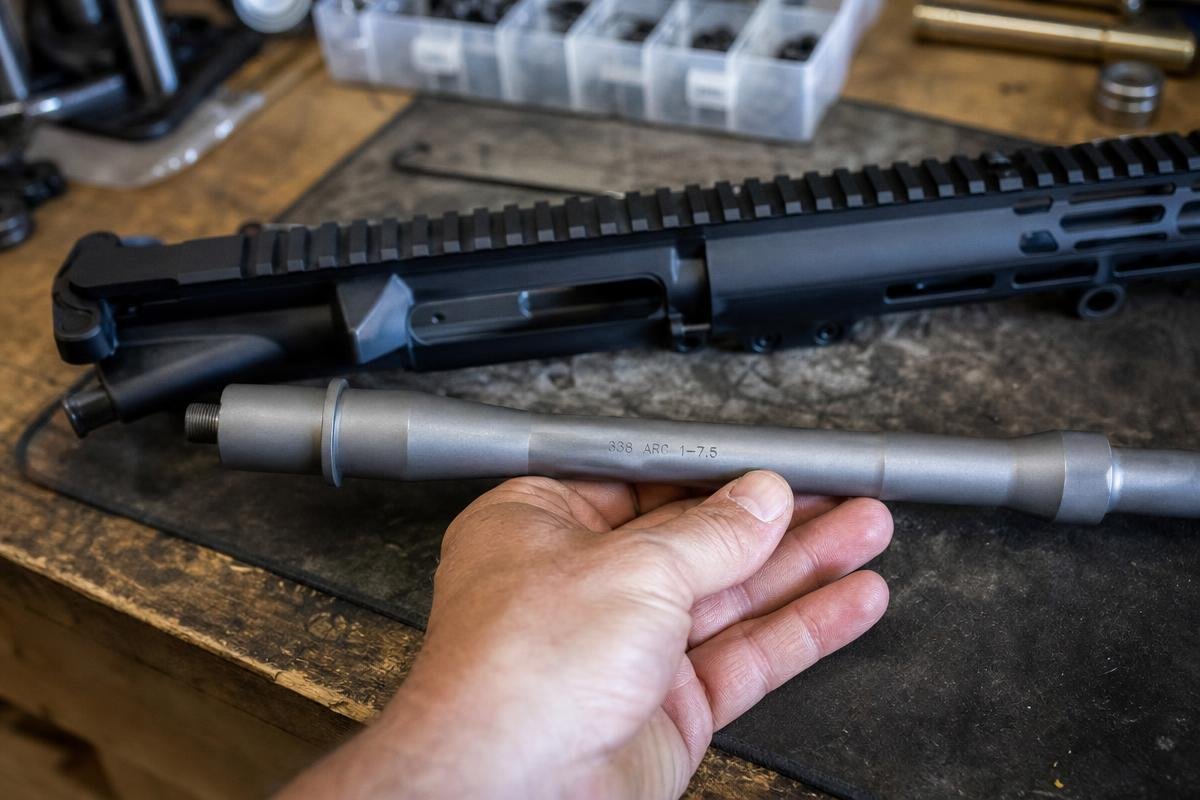
The 338 ARC is built around heavy, high-BC projectiles. A 1:10 twist rate handles 185 to 215 grain match bullets well. If you are running heavier 250 to 300 grain projectiles, a 1:9 twist gives you better stabilization. Under-stabilized bullets yaw in flight, and yaw destroys your ballistic coefficient and your groups. Do not guess on twist rate when you are speccing a 338 ARC AR-15 build for distance work.
Upper Receiver and BCG Considerations
The 338 ARC requires a dedicated bolt face. You cannot run a standard 5.56 bolt or swap in a 6.5 Grendel bolt and call it close enough.
A wrong bolt face is not a minor error. It is a safety issue. We build and verify every upper before it ships to your door. Our 338 ARC uppers are built with the correct bolt face, matched barrel, and confirmed headspace. You are not piecing together a parts kit and hoping for the best. You are getting a confirmed, ready-to-run upper.
Browse our full lineup of AR-15 complete uppers in 19+ calibers if you want to compare configurations before you commit to a build. Tell us your barrel length preference and we'll spec the build around it.
How Does the 338 ARC Compare to Other Long-Range AR Calibers?
The 338 ARC does not exist in a vacuum. Several capable long-range AR calibers compete for the same role, and each one makes real tradeoffs. The ballistic profile is covered in the previous section. Here we focus on how the 338 ARC stacks up head-to-head against the alternatives, so you can pick the right tool for your range sessions or your next North Texas deer season.
338 ARC vs 6mm ARC: Different Tools for Different Ranges
For competitive target shooting in a gas-gun format like PRS, the 6mm ARC complete upper is the stronger choice. It launches a 103-108 grain bullet with a BC above 0.500, produces significantly less recoil, and lets you stay on target for faster follow-up shots. Magazine capacity is better too.
Where the 6mm ARC wins on speed and shootability from 600 to 1,000 yards, the 338 ARC wins on raw retained energy and bullet diameter past 800 yards. For shooters who also hunt large game, that energy advantage matters in the field. A 6mm ARC cannot make the same dual-use argument.
338 ARC vs 6.5 Grendel and 224 Valkyrie
The 6.5 Grendel is a proven 800-yard AR-15 round with years of match ammunition development behind it. Recoil is lower than the 338 ARC, and factory ammo options are wide. Where the Grendel is well-established and comfortable to shoot, the 338 ARC hits harder at distance and carries more energy into the target past 800 yards.
The 224 Valkyrie was designed to stay supersonic past 1,300 yards with a 90-grain bullet. It is a legitimate 1,000-yard option and recoil is light. Where the Valkyrie offers flat trajectory and low recoil, the 338 ARC answers with greater bullet diameter and terminal energy.
For a Grayson County shooter who splits time between long-range target work and hunting, the 338 ARC is the best ARC caliber for that dual purpose. The Valkyrie and Grendel do not cross over into large-game hunting with the same authority. Not sure which caliber fits your build? Call us at (888) 706-0633 and we will walk you through the options.
Building a Capable 338 ARC Long-Range Rifle on an AR-15 Lower
The good news on a 338 ARC AR-15 build: your existing lower, trigger, and stock carry over. You are buying an upper, not a whole rifle. That keeps the cost manageable and the build straightforward.
Upper Selection: What to Look for in a 338 ARC Upper
For serious distance work, you want a 20-inch or longer stainless steel barrel. Stainless handles heat cycles better during extended range sessions, and the extra length squeezes every foot-per-second out of the 338 ARC's case capacity. Twist rate should be 1:10. That stabilizes the heavy, high-BC projectiles this cartridge is designed around.
The bolt must be headspaced specifically to 338 ARC. A free-float handguard is not optional at this range. It needs to be long enough to position a bipod well forward without any contact with the barrel. Barrel pressure kills accuracy at 800 yards fast. Our uppers are built and verified in-house before they ship to your door. No FFL required.
Barrel length for 338 ARC accuracy starts at 20 inches for long-range intent. Shorter barrels give up velocity you cannot get back downrange.
Optics, Mounts, and Accessories for Distance Work
At 800 to 1,000 yards, a first focal plane scope with at least 20x magnification is the practical floor. You also need 60 or more MOA of total elevation adjustment. The 338 ARC drops significantly past 600 yards, and a scope without enough travel runs out of adjustment before you run out of target.
A quality bipod and rear bag are standard for prone work. If you are shooting at an outdoor range on uneven ground, a bipod that adjusts for cant saves you real frustration. A muzzle brake is worth serious consideration here. The 338 ARC generates meaningful recoil. A brake cuts felt recoil enough to improve follow-up shot speed and help you spot your own impacts without losing the target.
Long-Range Shooting in Grayson County: Range Conditions and Practical Considerations
If you shoot anywhere near the Denison and Sherman area, you already know the wind. Spring and fall bring persistent crosswinds off the river valley that will expose every weakness in a light, low-BC load. That is exactly where the 338 ARC separates itself from smaller AR calibers. The heavier bullet carries its velocity and resists lateral drift in a way that a 77-grain 5.56 simply cannot match past 400 yards.
Outdoor ranges in this part of Texas give you real distance, with several facilities offering 500 to 1,000 yard capability. That is the range where the 338 ARC's design intent becomes obvious. Running this round at 100 yards tells you almost nothing. Get it to 600 and you start to understand what a 338 ARC for long range shooting really means in practice.
Texas summers are hard on barrels. Extended range sessions in July and August push barrel temperatures up fast, and that is a direct argument for stainless steel over chrome-moly. We covered barrel material in the hardware section, and the local climate reinforces that recommendation. Stainless handles heat cycles better and holds its throat geometry longer under repeated fire.
There is also a dual-use angle worth mentioning. A lot of shooters in this part of the state are deer hunters first and target shooters second. The 338 ARC carries enough energy at distance to make it a serious hunting round, not just a paper-puncher. If you want more detail on that side of the equation, our breakdown of whether the 338 ARC is a capable hunting cartridge covers it directly. We build and ship 338 ARC uppers from our shop at 2022 S Crockett St in Sherman, about 10 miles from Denison, so local shooters do not have to look far.